L a - b e a u t é - s a u v e r a - l e - m o n d e ~ D o s t o ï e v s k i

L a - b e a u t é - s a u v e r a - l e - m o n d e  ~  D o s t o ï e v s k i


Friday, July 21, 2023

A Vestal Virgin, at any rate - presumed portrait of mlle Bourgevin de Linas, by Alexandre Roslin, 1756


This portrait of a lady as a Vestal Virgin, signed and dated Roslin le suedois/1756, is said to portray a certain mademoiselle Bourgevin de Linas. Whether or not it does will have to remain a mystery it seems. And as I've been unable to discover any pertinent genealogical records related to that name, any actual young lady of the Bourgevin de Linas family will also continue to elude us. Alors tant pis ! 


In Roslin's work, the details are always vividly described and the handling of textures precise... and exquisite. In this painting, for me, the "star of the show", even more than the perfectly executed white satin, is the beautiful, shimmering scarf.


*


This portrait has been featured once before on this blog, included in a large group of Roslin's portraits.


Sunday, July 16, 2023

Quiet rooms and yellow upholstery - selected paintings by René-François-Xavier Prinet

 
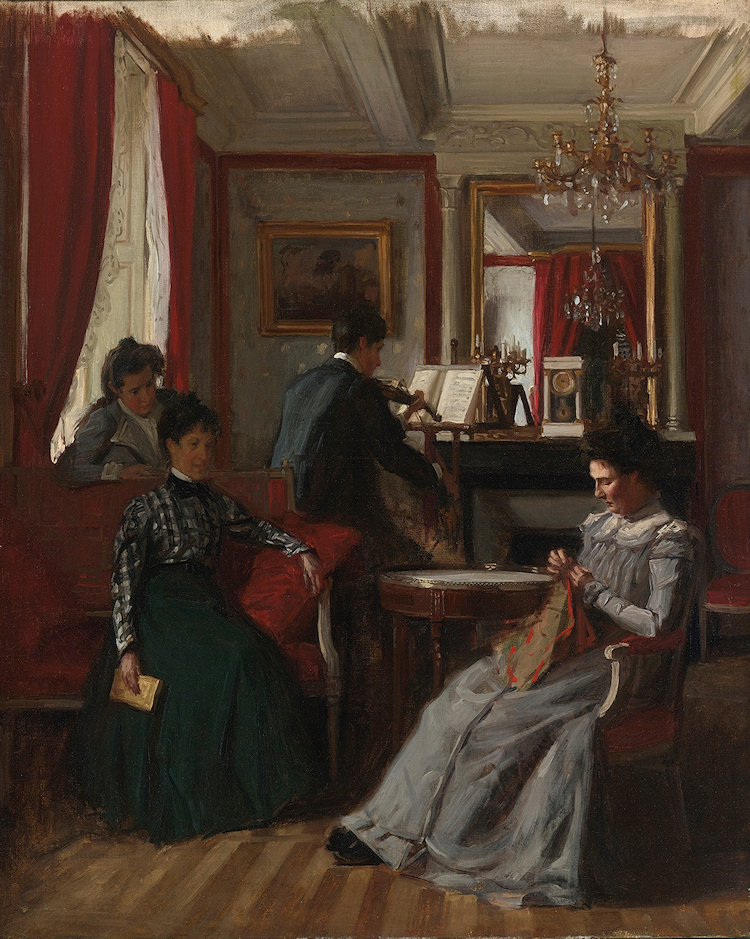
Salon de famille, circa 1905.
Jeune femme à la lecture.
La Tricoteuse.
Elégante sur un canapé, 1886 (?).
Nu allongé.
Le Canapé jaune, 1904.
Au salon à Luxeuil, réunion chez les Desgranges.
Circa 1920.
Les Deux amies, before 1922.
Femme à son secrétaire, 1928.
La lecture, before 1914.
Les Deux soeurs (Edith and Helene Taillefer de Laportalière), 1929-32.
Portrait de la famille Saglio, before 1908.

I apologize for the spotty inclusion of titles and dates; I did try!

*

René-François-Xavier Prinet (31 December 1861, Vitry-le-François - 26 January 1946, Bourbonne-les-Bains), French painter and illustrator. He was the son of an Imperial Prosecutor, whose promotion brought about the family's move to Paris, where they lived in a home not far from the École Nationale Supérieure des Beaux-Arts. He was supported in his desire to study art and, around 1880, he began his studies in earnest, first in the studios of Jean-Léon Gérôme, where he remained for five years. In 1885, his painting "The Infant Jesus" was accepted for display at the Salon. This was followed by studies at the Académie Julian. Later, he was named a professor at the École Nationale, where he created and directed their first workshop for female artists. In 1891, he received a commission from the government to create decorations in the Palais de la Légion d'honneur; he was made a chevalier of the Légion d'honneur in 1900. His best known work, "The Kreutzer Sonata", first exhibited at the Salon of 1901, was purchased by Luitpold, Prince Regent of Bavaria. He produced his first illustrations in 1909 and, over the course of his career, he would illustrate works by Balzac, Pierre Loti, Anatole France, and Henri Bataille, among many others. In 1913, he was appointed Secretary for the Société Nationale des Beaux-Arts and travelled to the United States, serving on the jury for an exhibition at Carnegie Mellon University; he also presented several works then, and again in 1920. In 1943, he was elected to the Académie des Beaux-Arts. In addition to painting, he wrote two texts, Initiation à la peinture, in 1935, and Initiation au dessin.


Friday, July 14, 2023

Mythological clay - Hercules, terracotta, by John Michael Rysbrack, 1745


*

John Michael Rysbrack (né Jan Michiel Rijsbrack; 24 June 1694, Antwerp - 8 January 1770, London), Flemish sculptor, who spent most of his career in England, where he was one of the foremost sculptors of monuments, architectural decorations, and portraits in the first half of the eighteenth century. The son of the landscape painter Pieter Rijsbraeck, both of his brothers were painters, as well. He was apprenticed to the Antwerp sculpture master Michiel van der Voort the Elder from 1706 to 1712, and became a member of the Guild of St. Luke in Antwerp in 1714-15; none of his works from this period have been preserved. Along with his older brother, he moved to England about 1720 where they subsequently built successful careers; their younger brother later joined them. In London, the sculptor quickly established himself as the leading figure in his field, a position he was to retain until the mid-1740s, remaining one of the top three sculptors in Britain until shortly before his death. He also operated an important workshop with many assistants, including other Flemish sculptors such as Gaspar van der Hagen and James Francis Verskovis; the workshop's output left an important imprint on the practice of sculpture in England. Rysbrack produced portraits and monuments of lively baroque composition, executing busts and funerary monuments of many of the most prominent men of his day, including the monument to Isaac Newton in Westminster Abbey - he created upwards of sixteen monuments for the Abbey - as well as a statue of Marlborough, and busts of Walpole, Bolingbroke, and Pope. He was responsible for the bronze equestrian statue of William III in Queen Square, Bristol, erected in 1733. He died in Vere Street, Westminster, at the age of seventy-five and is buried in St Marylebone Parish Church.


Sunday, July 9, 2023

Portraits des dames - a selection of females, painted

 
Emilie Henriette Massmann, the fiancée of Frederik Wilhelm Caspar von Benzon, by Christoffer Wilhelm Eckersberg, 1820.
Susanna van Meckema, Dutch School, circa 1600-25.
The Kavos sisters, by Alexander Mikhailovich Lyubimov, 1906.
Joséphine Baker, by Jean-Gabriel Domergue, circa 1936.
Unknown sitter, Cuzco School, circa 1780s-90s.
Kopfstudie, by Franz Wiegele, 1919.
Dame einen Papagei fütternd, by Anna Rosina de Gasc, née Lisiewska, 1747.
Unknown sitter, Circle of Jacques-Henri Sablet, circa 1800.
Princess Louisa Maria Stuart, by François de Troy, 1705.
Elizabeth Jane Gardner, by William-Adolphe Bouguereau (her husband), 1879.
Unknown sitter, by Thomas Desangle, 1785.
 Ludwika Karolina Radziwiłł, Margravine of Brandenburg and Electress Countess Palatine of Neuberg, Polish School, 1681.
Miss Jane Woode, British School, circa 1750.
Le Turban Vert, by Tamara de Lempicka, 1929.
Isabelle Depestre, comtesse de Seneffe, by Antoine Vestier, circa 1785.
Hermine Gallia, by Gustav Klimt, 1903-04.