L a - b e a u t é - s a u v e r a - l e - m o n d e ~ D o s t o ï e v s k i

L a - b e a u t é - s a u v e r a - l e - m o n d e  ~  D o s t o ï e v s k i


Showing posts with label Autochrome. Show all posts

Friday, September 9, 2022

Pierrot et Pierrette amoureux - two Autochromes by Alphonse Van Besten, circa 1912

 
"Pierrot in Love #1."
"Pierrot in Love #2."

*

Sébastien Alphonse Van Besten ( 17 November 1865, Brussels - 4 February 1926, Borgerhout), Belgian photographer and painter, best known for his work with the Autochrome process of early color photography. As a Belgian representative for the French photographic supply company Lumière & Jougla, he traveled the country visiting and doing presentations for photo clubs. During the First World War, he fled to the Netherlands, where he continued to make photographs and give presentations.


Sunday, November 28, 2021

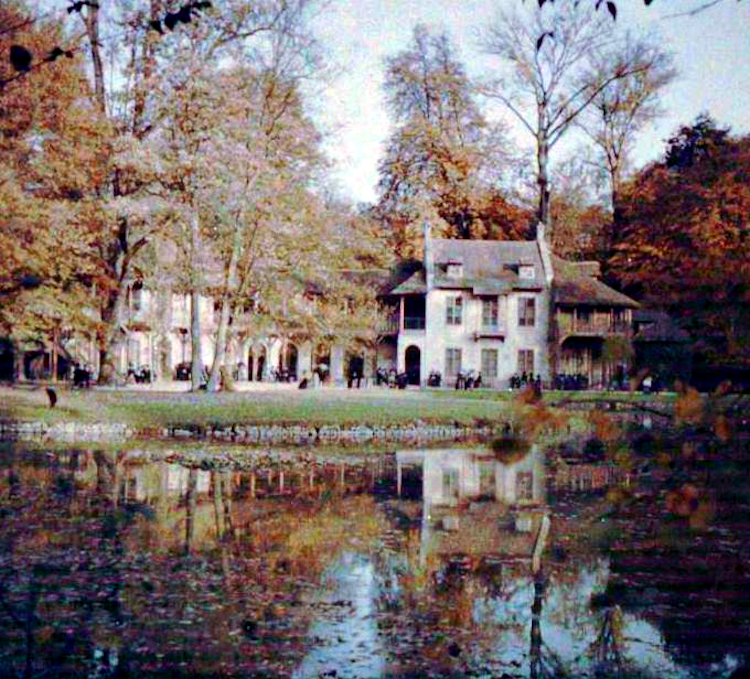
Le parfum pâlissant des temps passés - Versailles and Trianon in Autochromes, circa 1910s-1920s

 
The Belvédère pavilion in the Jardin anglais of the Petit Trianon. (Two images.)

The modern brain seems unable to endure black and white photography. Apparently, historical images really need to be "colorized" to make the people and situations comprehensible, relatable: "Well, you know, that color just brings history to life!"  (Don't get me started... again.) But we do have the Autochrome - a color photographic process in use from the first decade of the twentieth century until the early Thirties - to help these folks along, to possibly divert them away from their fiendish colorizing impulses. I should think that images produced by this method would be something fairly calming to those feverish little color-mad brains, while yet not being an insult to the sensibilities of those of us who have more respect for historical truth and for the rights of the images' original creators, whose aesthetics are perhaps slightly more refined, and who have...what?...an imagination...?

The buildings of the Hameau de la reine. (Eight images.) Here, the maison de la reine. (Four images.)
The moulin.
The colombier and maison du garde.
The colombier.
The boudoir.


Friday, September 3, 2021

Tatiana sur une plage d'Oléron (titre factice) ("fictitious title") - autochromes by Ernest-Louis Lessieux, after 1907


Sadly, I have no information on the model, the circumstances of the creation of the series, or an explanation of the mystifying title.

*

Ernest-Louis Lessieux (3 August 1848, La Rochelle - 4 January 1925, Menton), French artist.

Biography courtesy of Chris Beetles Gallery, London:

A confident watercolourist and draughtsman, Ernest Lessieux developed a career as both a teacher and an exhibiting artist. Moving from La Rochelle to Menton, on the Riviera, he became popular with English visitors, in particular, who took lessons from him and bought his work. This success enabled him to make a number of sketching tours around the Mediterranean and so broaden his range, often in the company of his son, the artist Louis Lessieux.

Ernest Lessieux was born on 3 August 1848, at 2 Rue du Brave Rondeau, La Rochelle, the capital of the department of Charente-Maritime, on the west coast of France. he was the second of four children of the stained glass painter, Louis Jean Lessieux, and his wife, Marie Catherine (née Guillon). Until 1862, he attended the Ecole Municipale, in Nantes, some 85 miles north of La Rochelle.
he then remained in the town to work in the studio of a painter and decorator.

In 1865, Lessieux moved to Paris to study at the Ecole Nationale Supérieure des Beaux-Arts under the draughtsman and printmaker, Maxime Lalanne, and the painter and illustrator, Luc-Olivier Merson. Five years later, in 1870, he volunteered to serve in the army in the war against Prussia. When it ended, in 1871, he returned to his native department, and settled in Rue des Fonderies, Rochefort. (The street has since been divided and renamed as rue de la République and rue Pujos.) There he became both curator of the museum and a teacher of drawing at the Lycée. In the same year, he married Victorine Virginie Boisramé in La Rochelle. Their only child, Louis Ernest, would be born in 1874. Once established, in 1878, he began to exhibit annually at the Salon des Artistes Françaises.

Between 1884 and 1886, Lessieux stayed with his family in Menton, on the Riviera, for the sake of his health. Just over a decade later, in 1897, they settled in the town, in Maison Cerutti, Rue de la Marne, a house decorated with murals by the local artist, Guillaume Cerutti-Maori. Lessieux soon became successful and wealthy by giving lessons in art, mainly to the many English visitors. He also exhibited work regularly at the Salle Grenier with the Société des Amis des Arts de Menton, of which he was a promoter, then the Vice-President and the Dean.

Lessieux spent time at La Cotinière, a newly-acquired house on the Ile D’oléron, close to Rochefort, and also began to undertake extensive sketching tours to Italy, Spain and Morocco, often in the company of his son, Louis, who had become his pupil. Louis is known to have helped his father produce the images of cruise ships that were commissioned by the Compagnie Générale des Transatlantiques for publication as postcards and posters. Lessieux’s other illustrative projects included further postcard designs and two books: Jules Bourelly’s Les Perles de la Côte d’Azur (1900), and Les Alpes Françaises (circa 1910). In 1909, he was made a member of the Salon while, in 1923, he was awarded the title officier de l’Instruction Publique.

Lessieux died at home, at the Maison Cerrutti, Menton, on 4 January 1925. A month later, a memorial exhibition was mounted at the Salle Grenier, by his son, Louis, who had also become a professional artist. In February 1926, a marble bust of Lessieux by his friend, the Russian sculptor, Léopold Bernstamm, was placed in a square between the museum and his former home.

His work is represented in numerous French public collections.


Sunday, November 29, 2020

Randomly XIX


ND.
Autochrome, circa 1914.
ND. Courtesy Stephen Rutledge.
Décoration de la salle à manger dans la maison de la citoyenne Dervieux, rue Chantereine à Paris, by Jean-Louis Prieur, before 1795.
François-Guillaume Ménageot, by Marie-Victoire Lemoine, circa 1785.
Il Tuffatore (The Diver), by Nino Migliori, 1951.
Photograph by Mike Heydon, New Zealand, 2016.
 Annunciation, by John Shelley, 1968.
Circa 1860s.
Hernando Carlos María Teresa Fitz- James Stuart y Falcó, duque de Peñaranda, conde de Montijo, silver medalist in polo at the Olympic games in Antwerp, 1920.
 Fred Astaire dancing for American GIs, garden front Château de Versailles, 18 September 1944.
Friedrich Wilhelm III of Prussia and his family, by Heinrich Anton Dähling, 1806.
ND.
Lady Cowdray, by Adam de Colone, 1621.
Les Frères, by Robert Doisneau, 1934.
Lisboa, by Gérard Castello-Lopes, 1957.
 Elegant Ladies in a Townhouse Interior, English School, circa 1830s.
Male nude, by Demetrio Cosola, 1875.
Photograph by J. Van der Heyden, Antwerp, circa 1915-20. Courtesy Ralf De Jonge.
Jilted, by Briton Riviere, 1887.
Lupo, by Giuseppe Baldrighi, circa second half of the eighteenth century.
 Madame Helga von Bluhm, circa 1867-69.
Gown by Dior, photograph by Clifford Coffin, 1948. Photographed in the peristyle of the Grand Trianon, Versailles.
 Promotional art work for the SS Normandie, circa 1935.
ND. Courtesy Stephen Rutledge.
ND.
Portrait of a Buttero, by Edoardo Gelli, circa late nineteenth-early twentieth century.
ND.
Mexico, circa 1870s.
Portrait of a Lady, by Raimundo de Madrazo y Garretta, 1881.
Circa 1860s.
William West, 1st Baron De La Warr (second creation), British School, circa 1550.
 Victoria, Duchess of Kent and her daughter, the future Queen Victoria, by Sir William Beechey, 1821.
Miniature copy of the above, by Henry Bone, circa 1824.
Woman With Birdcage, Afghanistan, by Thomas Abercrombie, 1968.
ND.
ND. Courtesy Stephen Rutledge.
Sermon on the Mount, by Robin Guthrie, 1922.
 Mrs. Mary Livius, née Foster-Barham, by Mather Brown, circa 1785.
Sketch for the above.
ND.
The Ukraine, 1949.
Meleager and Atalanta, by Jacob Jordaens, 1620-23.
 Unknown man, Sweden, 1949.
Circa 1913.
Hog farm employees, Tule Lake Relocation Center, Newell, California, by John Cook, circa 1942-45.
Anna Maria Charlotte Wyndham Quinn, née Dunraven, attributed to Richard Rothwell, circa 1836.
Iris Beerbohm Tree, by Augustus John, circa 1920.
ND.
 Miniature self-portrait, by Louis-Marie Autissier, 1817.
 Des Moines, Iowa USA, photograph by Nina Leen for Life Magazine, 1945.
Femina magazine cover, May 1914. Courtesy Andre Duveen.
Märchenball, Szene um den "Gestiefelten Kater", with Eduard Lang, Clara Lang, Adolf Seder, and Heinrich Lang, photograph by Josef Albert, Munich, 1862.
ND.