L a - b e a u t é - s a u v e r a - l e - m o n d e ~ D o s t o ï e v s k i

L a - b e a u t é - s a u v e r a - l e - m o n d e  ~  D o s t o ï e v s k i


Showing posts with label Marie Antoinette. Show all posts

Sunday, November 2, 2025

Favourites - best friends of the queen, dressed "en gaulle," portraits by Vigée Le Brun, 1782


Until just weeks ago, even with an obsession begun in childhood with all things Marie Antoinette and the last days of the ancien régime, it had never registered with me that the queen's two closest friends - the famous "favourites" - had been born on the very same day: 8 September 1749. 

Marie-Thérèse Louise, princesse de Lamballe.

Marie-Thérèse Louise, princesse de Lamballe (8 September 1749 - 3 September 1792) had already been widowed at the age of nineteen when, two years later, she met the fourteen year-old dauphine upon the latter's arrival in France in 1770. The two became immediate and very close friends. 

Yolande Martine Gabrielle de Polastron, duchesse de Polignac.

Yolande Martine Gabrielle de Polastron, duchesse de Polignac (8 September 1749 - 9 December 1793) was formally presented to Marie Antoinette five years later. The new queen was said to be "dazzled" by Gabrielle and agreed to pay the Polignac family's debts so that the new "favourite" could afford to reside at Versailles. Beautiful and charming, she quickly became the undisputed leader of the queen's intimate circle. 


Marie-Thérèse was very wealthy in her own right. But she was more reserved than the queen's new friend, kind but not at all brilliant. And her own ill-health and that of her father-in-law often kept her away from Versailles, leaving the way for the more vivacious Gabrielle to dominate the queen's affections. The two women never really got along, though both would suffer in the ever increasing scurrilous assaults on the queen's character; among other slanders, both were falsely accused in the libels of being her lesbian lover. 


Over time, the entire Polignac family benefited enormously from the queen's considerable generosity, causing much resentment at court. Marie Antoinette, herself, eventually tired of their constant demands for money and privileges, their frequent attempts to influence political matters and, after the queen's second son was born in 1785, her relationship with Gabrielle distinctly cooled. Not long after, she and Marie-Thérèse began to grow closer again.


At the fall of the Bastille, well aware of the public's hatred, Gabrielle and all the members of the Polignac family went into exile, first to Switzerland, then Turin, Rome, Venice and, finally, Vienna. After the king and queen were removed to Paris in October 1789, Marie-Thérèse immediately joined the royal family in the Tuileries Palace, reassuming her court duties; she was constantly at their sides during the next two years. Following the disastrous Flight to Varennes of the royal family in June 1791, she travelled to Brussels, then England. Though the queen repeatedly asked her not to return to France, she rejoined the royal family some four months later. 


After the attack on the Tuileries the following August, and after the royal family was moved to the Temple, she was separated from them and transferred to the La Force prison. A month later, during what became known as the September Massacres, the prisons were seized by mobs, and the prisoners were placed before hastily assembled people's tribunals, which judged and executed them summarily. Brought before the tribunal, she agreed to take the oath to liberty but refused to denounce the king and queen, and she was handed over to the mob. 


There are many horrific and varying stories about the exact manner of her murder, most of which are certainly apocryphal. What is known for certain is that her head was placed on a pike, paraded through the streets of Paris to the windows of the Temple, where the mob unsuccessfully tried to force the queen to look at the mutilated remains of her friend. The princesse de Lamballe was five days away from her forty-third birthday.


Since her flight from Paris, Gabrielle had kept in contact with the queen through their correspondence. She had been in poor health for several years, but had become increasingly ill while living in Switzerland. The duchesse de Polignac died in Vienna, probably of cancer, at the age of forty-four, shortly after learning of Marie Antoinette's execution, two months before.

*

A self-portrait of the artist, circa 1781-82.

By the early 1780's the star portraitist of the day, Vigée-Le Brun, had developed a new and very particular pictorial formula that she employed several times in the portrayal of the young, royal and aristocratic ladies who were her most important clients; this eventually even included the queen. 

A second portrait of the duchesse de Polignac, 1783.

Rather than posing them in sumptuous gowns and lavish jewels, she portrayed them very simply dressed, often wearing a straw hat, with wild flowers in their hands or in their hair; they appeared as one might see them walking in the summery gardens of the queen's own Petit Trianon.

Marie Antoinette's early nemesis, Jeanne Bécu, comtesse du Barry, 1781.

Of particular note was the style of gown they wore, dubbed variously as à la Creoleen chemise or, most frequently and lastingly, en gaulle. Consisting of multiple layers of very fine muslin, with softly gathered, puffed sleeves, a ruffled neckline, and an unfitted bodice, it featured a simple satin sash at the waist. It became a very popular style, a fashion that spread well beyond France and the artist's lofty clientele. 

The queen's sister-in-law, the comtesse de Provence, 1782-83. Like the portrait of Marie Antoinette en gaulle, this was also met with disapproval at the 1783 Salon.

But when Vigée-Le Brun's portrait of the queen dressed en gaulle was displayed at the Paris Salon in 1783, the public was outraged. The inspiration behind the alternate moniker, en chemise - a term denoting a lady's shift; in other words, her underwear - was definitely taken to heart. 

Marie Antoinette en gaulle, 1783.

The alarm was so great, the cry being that the queen was being shown in her underthings, that the portrait was removed from the wall and the artist hastily painted another to be exhibited before the close of the Salon. In the second, the queen assumes the same pose, tenderly holding a pink rose, but now less offensively - in other words, more regally - dressed in gray silk and lace.

The queen as the public demanded she be seen, 1783.


Sunday, August 24, 2025

Just wood and a little bit of metal - two mechanical tables for Marie Antoinette by Jean-Henri Riesener


Marie-Antoinette’s table à écrire.

Described in an inventory of 1789 simply as a writing table, this piece offered Marie-Antoinette several more options beyond that. Made by Jean-Henri Riesener in 1781 for the queen’s Grand Cabinet Intérieur at Versailles, the table is fitted with a mechanism that allows the top to slide back while, at the same time, the main drawer moves forward. The central velvet-lined compartment of the drawer is topped by a writing surface that can be ratcheted up to form a lectern or reversed to show a mirror. The marquetry surface of the table's top is richly embellished with a pattern of trelliswork enclosing rosettes, a design feature frequently used by Riesener on his furniture meant for the queen. The central medallion encloses a trophy with the attributes of poetry and literature and the Latin motto Numine afflatur - “inspired by divinity”. The marquetry decoration is now faded, but judging from the better-preserved marquetry on the lids of the inner compartments - which can be released by pressing a small button on the drawer front - and on the outer sides of the drawers, visible when the table is open, the table's surface must have been very colorful. The cabinetmaker achieved this through a clever selection of contrasting woods and the use of organic - and, therefore, not very permanent - dyes to expand the natural palette of the wood. The table is mounted with gilt-bronze moldings around the top, along the lower edge of the frieze, and running down the tapering legs. Gilt-bronze plaques in relief adorn the drawer front and the sides. Four years after it was delivered, this multifunctional table mécanique was sent to the Château de Saint-Cloud, where it was placed in the queen’s dressing-room.

The design of the gilt-bronze plaques at the sides of the table gracefully combines the two outermost figural elements of the drawer front plaque.

*


Table mécanique of Marie-Antoinette.

The number 2964 painted underneath the top of this table corresponds to an entry in the Journal du Garde-Meuble de la Couronne and identifies this multipurpose table as one of the first pieces ordered by Marie-Antoinette from her favorite cabinetmaker, Jean-Henri Riesener. The table was delivered to Versailles on December 12, 1778, exactly a week before the long-awaited birth of her first child, Marie-Thérèse-Charlotte. To alleviate Marie-Antoinette’s discomfort during the advanced state of her pregnancy, this table was fitted by Jean-Gotfritt Mercklein, a mécanicien in her service, with a special mechanism. Hidden behind a finely decorated gilt-bronze plaque at either end, this mechanism allowed the queen to use the table in either a seated or a standing position. By means of a detachable crank at one side, the top can be raised or lowered on ratcheted metal shafts that move up or down within the hollow legs. The table could therefore be used for various activities such as eating and writing, but also for reading and dressing, since the central panel of the top can be lifted to form a lectern and reversed to reveal a mirror. Pressing buttons along the front edge of the table releases the hinged lids to six compartments for the storage of small items, perhaps cosmetics and/or writing implements. Over time, the intricate marquetry decoration has lost some of its original coloring. Framed alternately with natural - originally white - holly and black-stained holly, the bois satiné trelliswork encloses rosettes cut of an originally bright yellow barberry wood against a stained, soft yellow sycamore ground.

The inner surface of a lid of one of the table's six compartments.

*

Text - much - adapted from that on the website of the Metropolitan Museum of Art; both tables are in their collection.


Sunday, April 17, 2022

Females of the species - miscellaneous portraits of women and girls, circa 1750-1960


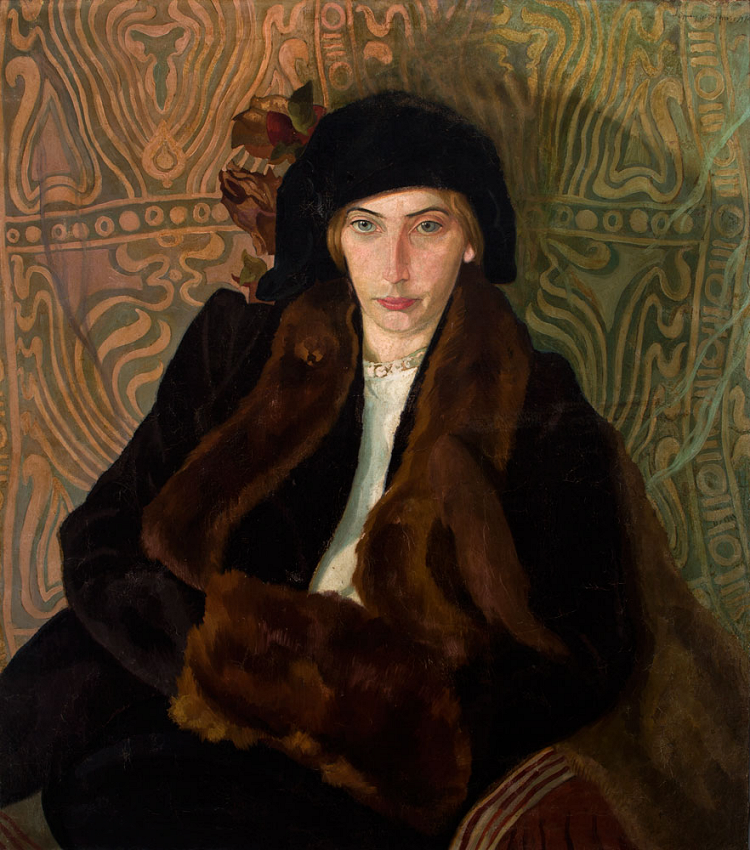
Portrait of a lady, by Józef Męcina-Krzesz, 1920.
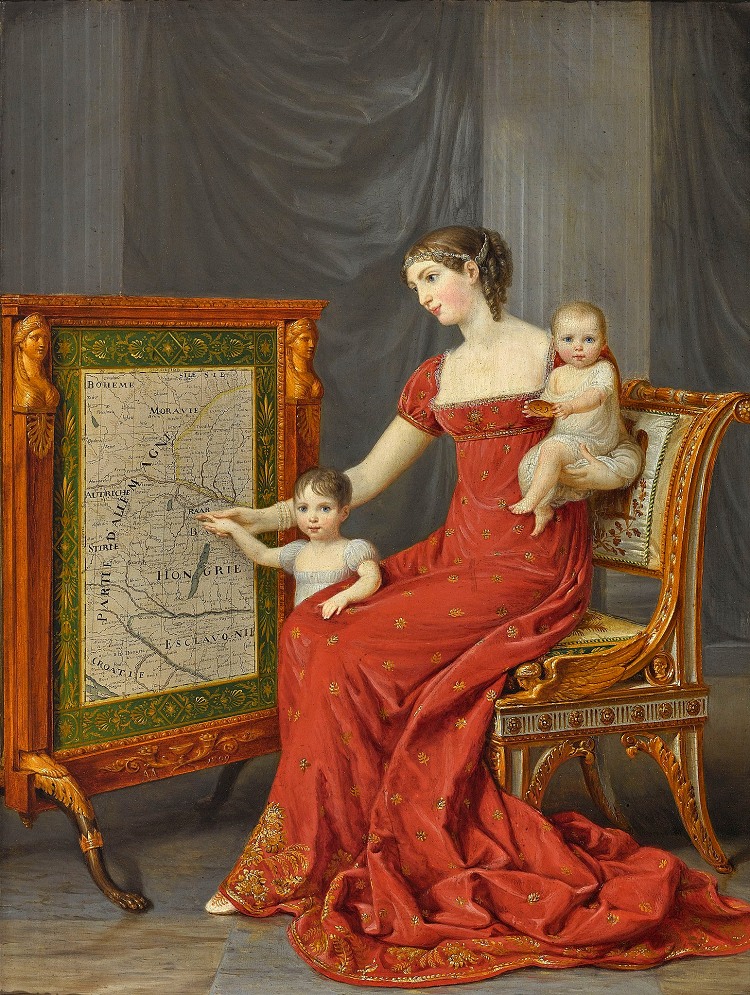
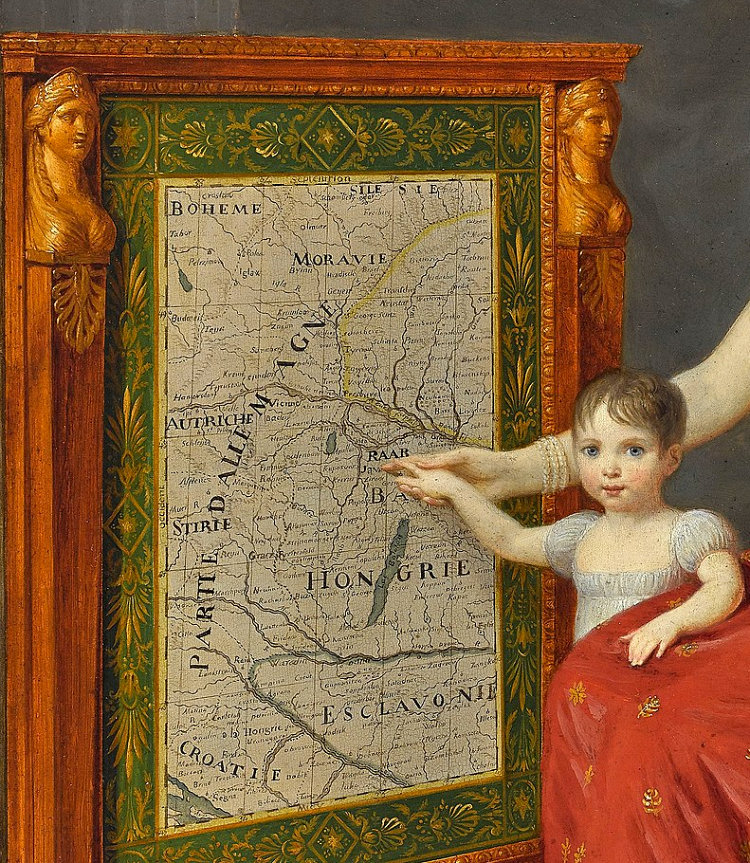
Princess Augusta of Bavaria with her daughters Joséphine and Eugénie, by Andrea Appiani, 1809.
Princess Joséphine, the future queen of Sweden and Norway, points to the location in Hungary where her father, Prince Eugène de Beauharnais,
Viceroy of Italy and stepson of Napoléon, led a military victory against the Austrian army at the Battle of Raab, 14 June 1809. 
Alda Weston, Lady Hoare, in a Green Cloak, by St. George Hare, 1909-10.
Karoline von Schlotheim, by Wilhelm Böttner, 1788.
The sisters Karolina and Anna Strauss, ballet dancers from the Teatr Wielki, Warsaw, by Jan Ksawery Kaniewskicirca, 1853.
Queen María Cristina of Spain, by José Moreno Carbonero, 1906.
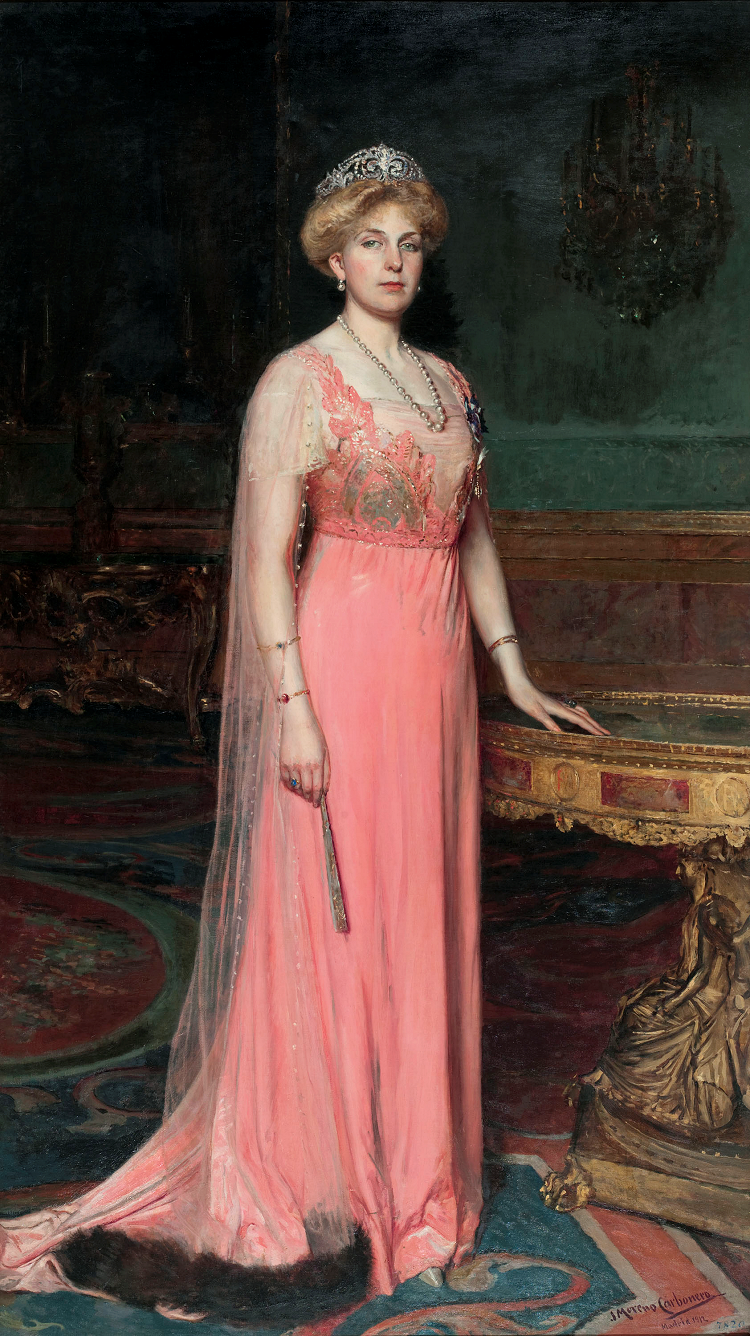
^ Her daughter-in-law, Queen Victoria Eugénie of Spain, by José Moreno Carbonero, 1912.
The painter and the portrait.
The daughters of Puerto Rican governor Ramón de Castro, by José Campeche y Jordán,1797.
Marie Antoinette as a Vestal Virgin, by François Dumont, circa 1791 or later. There are several versions of this, some if not most created after her death.
Zinaida Ivanova, comtesse de Chauveau, formerly Princess Yussupova (née Narishkina), by Gerasim Ignatievich Kadunov, 1858.
Marina, Duchess of Kent, by Simon Elwes, circa 1955-60.
In 1945, at the height of his career, Elwes suffered a near-fatal stroke which paralyzed his right side, including
his painting hand. He re-taught himself to paint with his left and went on to even greater success.
The Chinese Girl, also known as The Green Lady, Monika Pon-su-san, by Vladimir Tretchikoff, 1952.
Portrait of Zofia with cacti, by Tadeusz Pruszkowski, 1920.
Possibly Claire Josèphe Hippolyte Léris de Latude, a French actress known professionally as mademoiselle Clairon, by Maurice Quentin de La Tour, circa 1750.
 Octavie Wylezynska, baronne de Löwenthal, by Franz Xaver Winterhalter, 1859.
Eugenii Dunin-Borkowskiej, by Stanisław Ignacy Witkiewicz, also known as "Witkacy", 1912.
Marie-Thérése Charlotte of France, dauphine and duchesse d'Angoulême, by Antoine-Jean Gros, 1816.
Grand Duchess Sergei, Elisaveta Feodorovna, by Friedrich August von Kaulbach, circa 1892.
^ Her niece and ward, Grand Duchess Maria Pavlovna, Princess Wilhelm, Duchess of Södermanland, by Bernhard Österman, 1913.
Young Woman with a Fan, by Simon Maris, circa 1906. The model appears to be wearing an early 19th-century costume.
 Mrs. Frederick L. Pratt, neé Jeannie Williams, by Philip de László, 1928.
^ Her sister-in-law, Mrs. Robert Livingston Fryer, neé Melissa Dodge Pratt, by Philip de László, 1923.
Portrait de l'impératrice Eugénie en costume de dogaresse, the Empress Eugénie in a Venetian-style costume she wore to a ball on 9 February 1863.
The genre photographer "Marck" added - in oil paint - color and an imaginary Venetian background to the original photograph.
Circa 1850s.