L a - b e a u t é - s a u v e r a - l e - m o n d e ~ D o s t o ï e v s k i

L a - b e a u t é - s a u v e r a - l e - m o n d e  ~  D o s t o ï e v s k i


Showing posts with label Chanel. Show all posts

Sunday, July 30, 2023

Two portraits of Grand Duchess Maria Pavlovna (or three - no, four... five?) by Bernhard Österman, circa 1913

 
These portraits were all taken during her marriage to Prince Wilhelm of Sweden, Duke of Södermanland, 1908-1914.
I have no idea why, in this one portrait, her eye color is mismatched; I've never come across any mention of heterochromia related to Maria Pavlovna.

This third painting, of which I've - frustratingly - never found a better, larger, uncropped version, is certainly a portrait of Maria Pavlovna, and almost certainly the work of Österman, but I've been unable to discover any documentation for it. (I apologize for the poor quality of the image.)


This next charming portrait by Österman is "presumed" to be a portrayal of the same subject, and I believe it is. The lighting is the same as in the first three examples; all of Österman's portraits of her were posed with basically the same lighting. The hair style and color - a wig or dressed and powdered - and the gown, reminiscent of eighteenth century styles, would signify fancy dress.


*

Speaking of gowns, the Grand Duchess was always very interested in clothes. In exile in Paris during the twenties, she would even start her own embroidery business, Kitmir, successful for a time, during which she worked closely with Chanel, among others designers. Some of her personal wardrobe remains in the collection of the Sörmlands museum, including the gown featured below. She can be seen here wearing the same gown as she posed once again for Österman - a fifth portrait, seen unfinished, its whereabouts are unknown - and the top of its bodice can be seen in the second portrait featured in this post.


Another digression: In the first portrait, seen in the Grand Duchess' hair is a diamond link necklace worn as a bandeau. The necklace was given to her by her aunt, the Grand Duchess Elisaveta Feodorovna. Both women were frequently photographed wearing the piece in its two configurations.


And because I can't seem able to stop my digressions, here are two post-Revolution portraits of Maria Pavlovna by artists I've never heard of. 

Pencil sketch by Nicolas Paganiotti Zarokilli, 1919.
Drypoint by Alex-Ceslas Rzewuski, 1925.


Friday, June 16, 2023

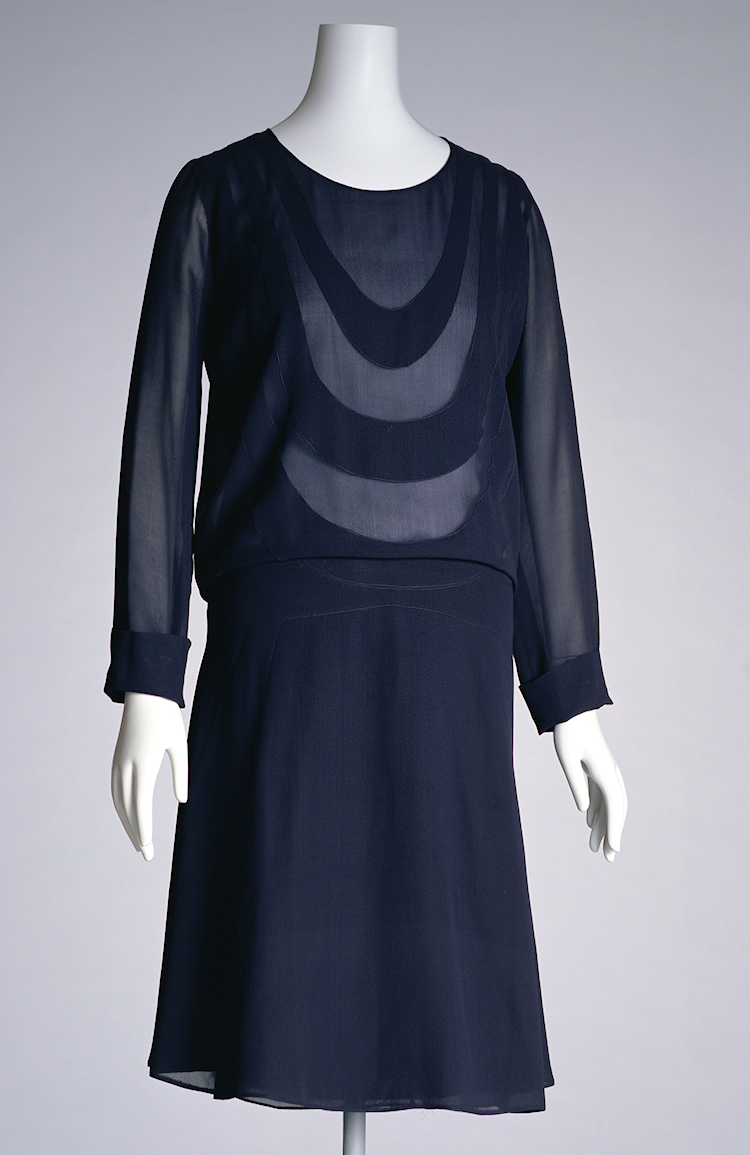
Les Années folles - French fashion of the 1920's from the collection of the Kyoto Costume Institute

 
Boué Sœurs, circa 1923.
Sonia Delaunay, circa 1925.
Vionnet, 1929.
Lelong, circa mid-1920s.
Chanel, circa 1927.
Vionnet, 1927.
Zimmermann - textile design by Raul Dufy, circa 1922.
Poiret, circa 1923.
Vionnet, 1924.
Chanel, circa 1926.
Callot Sœurs, 1922.
Lanvin, circa first half of the 1920s.
Vionnet, 1922.


Sunday, September 11, 2016

The bewildered bridegroom - Grand Duke Dmitri Pavlovich and Audrey Emery, Biarritz, 21 November 1926


Conspirator in the murder of Rasputin, lover of Coco Chanel, Grand Duke Dmitri Pavlovich was fairly the archetype of the polished and penniless aristocratic Russian emigré. Born and raised in the bosom of Romanov luxury, accustomed to fast society in pre-war St. Petersburg, by the time he'd made his way - post-war, post-revolution - to Paris, he was almost thirty and had little going for him beyond impeccable tailoring and a flawless pedigree. He found work as a champagne salesman, but devoted more enthusiasm to a string of relationships with many of the most fascinating women of his day. Eventually, rather than continuing in the champagne business or, worse, ending up a "professional guest", he did what other attractive and charming ci-devants of the male persuasion sometimes did: he married a rich American. He made a morganatic union with Audrey Emery, the Cincinnati-born daughter of a real-estate millionaire; the bride was given the courtesy title Princess Romanovskaya-Ilyinskaya. (They had one child together, Paul - named after his father - and divorced in 1937.) There's no reason to assume the Grand Duke married more out of expediency than for love, but in these photographs posed for the press on their wedding day, it may be too tempting to ponder the stunned expression on the groom's face.


Saturday, November 15, 2014

Gowns by Vionnet, 1937, 1938, 1939


Madeleine Vionnet (22 June 1876, Chilleurs-aux-Bois – 2 March 1975, Paris), one of the greatest, most innovative, most influential fashion designers of all time. Referred to as the "queen of the bias cut" and the "architect among dressmakers", she is best known for the simple elegance of her classically-inspired designs and for popularizing the bias cut; aided by the enthusiastic embrace of Hollywood, the bias cut became the look of the Thirties.


Born into a poor family, and with hardly any education, she began her apprenticeship as a seamstress at the age of twelve. After a brief marriage at eighteen and the loss of a child, she left her husband and went to London to work as a seamstress in a hospital. There, she began working as a fitter for the dressmaker Kate Reily, but eventually returned to Paris where she worked for six years at the fashion house of Callot Sœurs as a toile maker. (A toile is a designer's test garment; in the United States it is usually referred to as a "muslin".) Her own tastes were at odds with the often elaborately decorated Callot house style, but Vionnet always noted the importance of her years there, saying, "without the example of the Callot Sœurs, I would have continued to make Fords. It is because of them that I have been able to make Rolls Royces."


She went on to design for Jacques Doucet between 1907 and 1911, and in 1912 she opened her own house, only to close it two years later at the advent of World War I. But she re-established the house in 1923, opening new premises on the Avenue Montaigne. Only a few years after that she opened premises in New York. Her work was hugely influential, especially during the early Thirties. She was highly regarded by her fellow couturiers, and she led the fight for copyright laws in fashion. She also employed what were considered revolutionary labor practices at the time: paid holidays, maternity leave, day-care, a dining hall, and a resident doctor and dentist. She was forced to close her house once more, at the coming of World War II in 1939, and retired the next year. She lived for thirty-five more years, passing away at the age of ninety-eight.


Unlike her great contemporary Chanel, Vionnet had no taste for self-promotion, and that, combined with her early retirement, has had the result that her name is not as generally well known as it should be. But like Chanel, her designs have a timelessness that ensures that the particulars of line and drape and ornamentation that she created continue to reappear - again and again, year after year - in the work of her design successors; which of the gowns shown here would be wrong today, on any lovely, celebrated woman on any red carpet?


These designs are from some of her last collections. I love the subtle variations in the garments pictured - a particular skirt will have two different bodices - and the changing but consistently imagined ornamentation; there is sort of mutation in some of the patterning from dress to dress. (And I'm so glad we have access to some of the original photographic documentation, as the ugly mannequins and the flattened, wrinkled state of the surviving garments, in the more recent images here, most definitely do not show the dresses at they ought to be seen.)

The same dress as above, but looking quite a bit less fresh....