L a - b e a u t é - s a u v e r a - l e - m o n d e ~ D o s t o ï e v s k i

L a - b e a u t é - s a u v e r a - l e - m o n d e  ~  D o s t o ï e v s k i


Showing posts with label Antoine-Jean Gros. Show all posts

Friday, July 9, 2021

Fournier x 3 - portraits of three unrelated-as-far-as-I-know gentlemen bearing the same surname


Edmond Fournier (1832 - 8 September 1855, Sebastopol), lieutenant in the 96th infantry killed - beaten to death in a trench - at the capture of Sebastopol during the Crimean War. He was a maternal first cousin of the painter Édouard Manet; they were born the same year. Fournier shared the same name as his father, Edmond Fournier, a former artillery officer and aide-de-camp to the duc de Montpensier. The elder Fournier was instrumental in steering his young nephew Manet toward an art career. The twenty-three year old artist was deeply affected by the death of his cousin and visited his uncle a few weeks later. The following day his uncle expressed his thanks: "Pontcelles, 1 October 1855, I am so unhappy and so sad, my dear Édouard, that I am afraid I have not expressed to you strongly enough how grateful I am for the visit you made us yesterday. In almost all of his letters, my poor Edmond told us about you and asked us about your work and your successes. [...]"

Edmond Fournier, by Charles Gleyre, 1856.

Intended as an oval format, the portrait was made posthumously - painted the year after Fournier's death - with the likeness almost certainly taken from a photograph.

*


And then there's this fellow, this particular Fournier; other than his name, I have no idea who he is. I searched and searched online and... nothing. In the upper right corner Ingres wrote, "Rome, 1815." And at the top, at center, is inscribed calligraphically in pen and ink, "À L'amitié." To friendship. The latter, at least, leads me to the radical hypothesis that the handsome fellow portrayed here may very well have been a good friend of the artist. Beyond that...?

 Jean-Joseph Fournier, by Jean-Auguste-Dominique Ingres, 1815.

*


François Louis Fournier-Sarlovèze (6 September 1773 Sarlat, France - 8 January 1827), French general of the Napoleonic Wars. A brilliant soldier, he was as well known for his erratic and often violent behavior off the battlefield. He is primarily remembered as the aggressor in a famous series of duels with Pierre-Antoine, comte Dupont de l'Étang. Begun in 1794, they continued for nineteenth years, eventually numbering at least thirty engagements; the contest was only finally resolved when Dupont overcame Fournier in a pistol duel and forced a promise to desist. (The story of the duels was fictionalized by Joseph Conrad in his short story of 1908, The Duel, later adapted for the 1977 Ridley Scott film The Duellists.) After the Restoration Louis XVIII allowed him to add Sarlovèze to his family name and promoted him as inspector-general of the cavalry.

General François Louis Fournier, later Fournier-Sarlovèze, by Antoine-Jean Gros, before 1812.
As is obvious from the pentimento of the figure's left leg, the general was first posed in a different stance.


Sunday, January 28, 2018

Random females - a selection of portraits


Portrait of a Young Lady in a Blue Dress, by Franz Schrotzberg, circa 1830s.
Anonymous Daguerreotype, circa 1840s-50s.
Mrs. Francine Clore, née Halphen, by Sir James Gunn, circa 1940.
Geertruida the Dubbelde, wife of Aert van Nes, by Bartholomeus van der Helst (background by Ludolf Bakhuysen), 1668.
Marie Caroline, duchesse de Berry, in the gardens of the Château de Bagatelle in the Bois de Boulogne, by Baron Gérard, 1820.
"The Blue Veil", by Glauco Cambon, 1907.
Joséphine Baker, by Baron George Hoyningen-Huene, 1929.
Celeste Coltellini, Madame Meuricoffre, by Antoine-Jean Gros, 1790s.
Doña María Antonia Gonzaga de Caracciolo, marquesa viuda de Villafranca, by Francisco Goya y Lucientes, circa 1795.
Irene von Meyendorff, circa 1941-44.
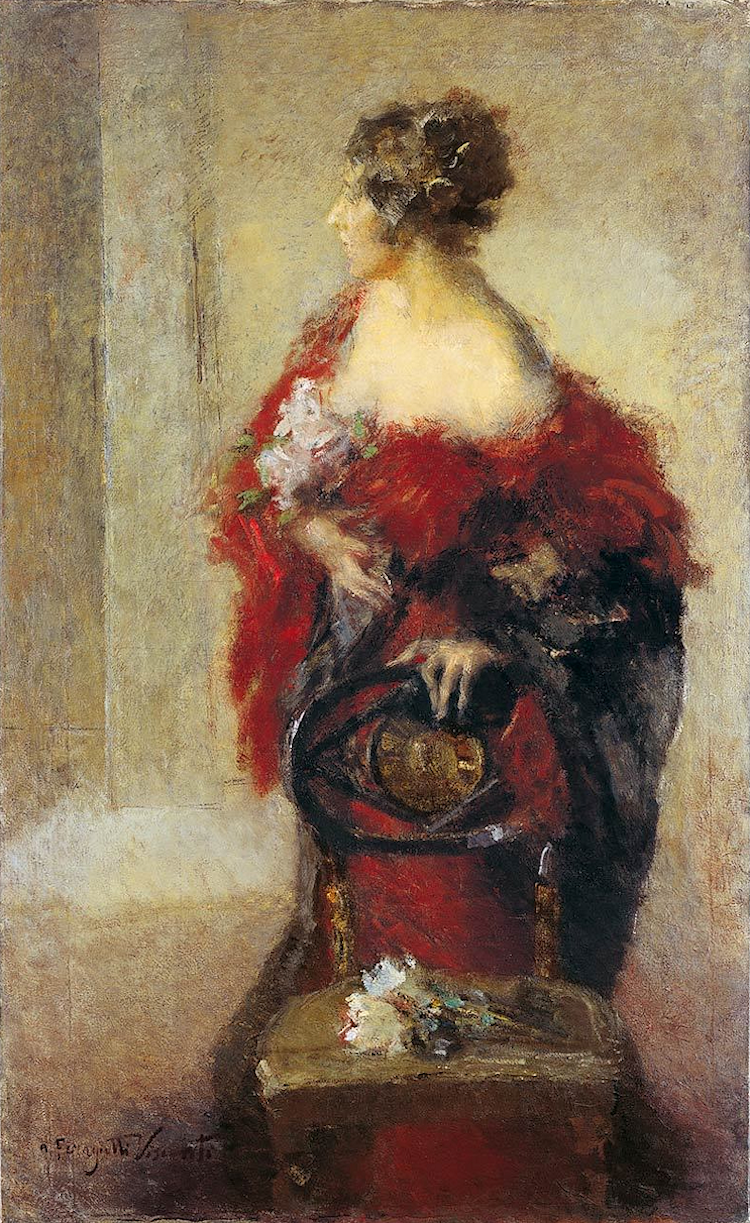
"Portrait in Red", by Adolfo Feragutti Visconti, 1915.
Duchess Charlotte Frederica of Mecklenburg-Schwerin as a child, by Christoph Friedrich Reinhold Lisiewski, 1791.
"Portrait d'une princesse de Bragance", Gillot Saint-Èvre, 1832.
Princess Egon von Ratibor, née Princess Leopoldine Lobkowicz, by Philip de László, 1899.
Minnie, the wife of Harold Alzana (seated behind), in costume for the "Gold Rush" tableau, 1949.
Mrs. Daniel DeSaussure Bacot, by Samuel F. B. Morse, 1820.
Anna Pavlovna of Russia, Queen of the Netherlands, by François Joseph Kinson, 1824.
 Marie Madeleine Maret, née Léjéas, duchesse de Bassano, by Baron Gérard, circa 1805-10.
Court Lady, by Diego Velázquez, circa 1635.
Marie Henriette, duchesse de Brabant, later Queen of the Belgians, Sir William Ross, 1853.
Rachel, Countess of Dudley, née Gurney, wife of the 2nd Earl, circa 1911. (The photograph is dated "1911", but may have been taken earlier.)
"Madame P.", by Eugène Fichel, 1857.
Madame de Serres, by Joseph Boze, 1787.
Portrait of an Unknown Lady, circa 1830s.
Unknown Woman, by Carl Timoleon von Neff, 1845.
Princess Maria Cristina Amelia Teresa of Naples and Sicily, later Queen of Sardinia, by Élisabeth Louise Vigée Le Brun, 1790.
Unknown subject and artist, circa 1690-1700.
The Reventlow Sisters, Malvina and Hilda, by Heinrich August Georg Schiøtt, circa 1850.
Adriana Jacobusdr Hinlopen, wife of Johannes Wijbrants, by Lodewijk van der Helst, 1667.
"A Portrait of a Beauty", Qing Dynasty, Nineteenth Century.
Portrait of a Lady In a Blue Dress, by Anton Ebert, 1893.
Unknown, circa 1860. Courtesy Ralf de Jonge.
Portrait of an Unknown Woman, by Alexander Grigoryevich Varnek, circa 1810s-20s.
Self-portrait by Therese Concordia Mengs Maron, sister of Anton Raphael Mengs, and wife to another painter, Anton von Maron, circa 1744-45.