L a - b e a u t é - s a u v e r a - l e - m o n d e ~ D o s t o ï e v s k i

L a - b e a u t é - s a u v e r a - l e - m o n d e  ~  D o s t o ï e v s k i


Showing posts with label Cartier. Show all posts

Sunday, December 28, 2025

Merely the very best "accessories" - Alice, Viscountess Wimborne and her jewelry at auction, Christie’s, 2025


The Wimborne family owned a truly impressive collection of jewels, many of which remained in the family's collection into the current century. A number of them, though, - those pictured here, along with a few other pieces - were auctioned by Christie’s, London in November of this year.

Pendant, with carved and calibré set emeralds, diamonds, and pearls, circa 1925.
Lady Wimborne posed in the ballroom of Wimborne House, a Cecil Beaton portrait from the 1930s.
In addition to other jewels, Lady Wimborne is wearing the original, longer version of the diamond sautoir and the emerald and diamond pendant.
Paired here as originally worn, the pendant and the sautoir were auctioned separately.
*
Pendant with ruby and calibré set rubies, purple/pink sapphire, and diamonds, circa 1925.
This 1928 portrait of Lady Wimborne by Beaton was published in the Tatler and dubbed "The Shingled Vicereine" because of the her stylish "shingled" hairstyle.
Dressed in a gown by Poiret, she wears the ruby/sapphire and diamond pendant suspended from the diamond sautoir, seen again in its original, longer form.
Her ruby and diamond bandeau-style tiara by Chaumet, seen here, was sold at Christie's in 1971.
*
Cartier emerald and diamond bracelet, circa 1925.
Another Beaton portrait of Lady Wimborne from the 1930s.
In addition to the Chaumet tiara and sautoir and emerald pendant, her Cartier emerald and diamond bracelet can clearly be seen, among others, on her left wrist.
*
Diamond sautoir - originally longer - circa 1925.
*
Emerald and diamond earrings, circa 1920.
*
Composite diamond and emerald tiara - some elements possibly created earlier - the three flowerhead elements mounted en tremblant, circa 1915.
The back of the central flowerhead element, showing how it is set en tremblant.

*

Viscountess Wimborne, by Sir John Lavery, 1939. Inscribed on the reverse by the artist, "THE LADY IN WHITE/VISCOUNTESS/WIMBORNE."
The gown, by Vionnet, appears to be the same one worn by the sitter in the first and third Beaton portraits shared above.

Alice Katherine Sibell, Viscountess Wimborne (née Grosvenor, 26 September 1880, Watford, England - 17 April 1948, London), English aristocrat and prominent society hostess. She married Ivor Churchill Guest - later Baron Ashby St Ledgers, then 1st Viscount Wimborne - in 1902. They had one son, Ivor Guest, later 2nd Viscount Wimborne, and two daughters, Rosemary and Cynthia. She and her husband were amicably separated by the 1930s, and from 1934 to her death she was in a relationship with the composer William Walton; she is credited as the inspiration for his Violin Concerto. Photographed by Beaton, her portrait painted by Lavery, she was known for her vivacity, individual style, and personal independence. She was also an astute political spouse and great supporter of the arts. She died of lung cancer at the Ritz at the age of sixty-seven.

In his Laughter in the Next Room, published in 1948 - the year of her death - her friend, the writer and poet, Sir Osbert Sitwell, wrote of her:

Her great beauty, subtle and full of glamour though it was, and the fact that she was the wife of one of the richest men in England, were apt to blind people equally to her political intelligence, interest, and experience. The attitude she presented to the world of a fashionable beauty who dressed with daring and loved admiration, the guise of an accomplished woman of the world, which was hers naturally, by birth, tradition and upbringing, hid from the crowd the clever woman who inhabited this exquisite shell.


Friday, March 24, 2017

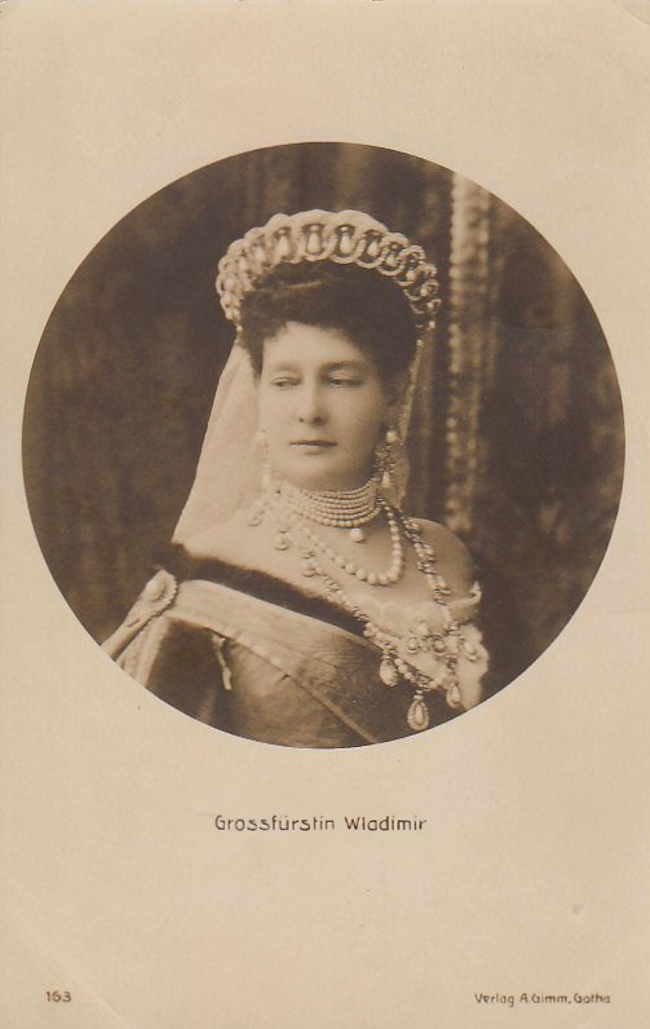
Changing your gown but not your pose (or artist) - two portraits of the Grand Duchess Vladimir by Boris Kustodiev


1911. This appears to be a preparatory sketch for the finished painting which was only completed two years later.
1913. In the final version, the Grand Duchess is portrayed wearing an entirely different court gown and jewels.

***

The Grand Duchess wearing exactly the same court gown and jewels as in the first painting; considering that the pose is also exactly the
same in this photograph and in both paintings, it may be possible that the artist worked from photographs rather than from life.
The famous "Vladimir tiara", now in the collection of the British royal family, worn in the two images above and in the first painting.
An earlier image of the Grand Duchess wearing the sapphire and diamond necklace worn in
the second painting and showing the original setting of her sapphire and diamond tiara.
The new version of the sapphire and diamond tiara (1909) and the devant de corsage (1910) worn in the second portrait; both by Cartier.

***

Edited - heavily - and adapted - a lot - from the Sotheby's website:

This second portrait of the Grand Duchess Vladimir (1854-1920, sometimes referred to as "Grand Duchess Maria Pavlovna the Elder"), is dated 1913. Kustodiev completed the painting almost two years after making his initial study. The subject was the daughter of the Grand Duke of Mecklenburg-Schwerin Friederich Franz II and Augusta of Reuss Kostritz. Princess Marie of Mecklenburg-Schwerin would become a key figure in the life of the Russian capital after her union with Grand Duke Vladimir Alexandrovich of Russia (1847-1909), son of Emperor Alexander II. Among other things, Grand Duke Vladimir was President of the Imperial Academy of Arts in St. Petersburg and the Grand Duke’s financial support - from his private funds - allowed many artists to flourish beyond the conservative boundaries and culture of the Imperial court. The Grand Duchess Vladimir took over the Presidency of the institution after the death of her husband in 1909; in Kustodiev's portrait she stands before a bust of her husband, and the Imperial Academy of Arts can be seen in the background, its presence symbolic of their lifelong involvement with the arts.

Kustodiev painted the dominating figure of Grand Duchess Vladimir, proud and dignified and covered in spectacular jewels – she was famous for her jewelry. In fact, it is said that she spent much of the annual pension of 1 million gold francs she received after the death of her husband on her jewelry. In Kustodiev’s portrait, she wears her famous sapphire and diamond diadem commissioned from Cartier 1909; the firm re-used stones belonging to the client, the central sapphire weighing 137.20 carats The tiara later belonged to her niece, Queen Marie of Roumania, whose daughter, Princess Ileana, sold it back to Cartier in the Fifties. The stomacher (devant de corsage) worn by the Grand Duchess was also made by Cartier, again using the client's stones, in 1910. The necklace and earrings appear to be Russian and of an earlier date.

The Grand Duchess fled St. Petersburg in February 1917. She settled in Kislovodsk in the Caucasus until February 1920, when she finally left Russia. Remarkably, her jewels which she placed in a secret safe in the Vladimir Palace, had remained undiscovered by the Bolsheviks despite repeated searches. Albert Stopford, a British secret agent and family friend, recovered the jewels and the Grand Duchess’ jewelry eventually found its way to Cartier, Paris in a diplomatic pouch; Cartier has archival photographs of all of the Grand Duchess Vladimir’s jewels taken around 1920. After the Grand Duchess’ death on September 6, 1920, the jewels were divided among her children: Grand Duke Kyrill received the pearls, Grand Duke Boris the emeralds, Grand Duke Andrei the rubies, and Grand Duchess Elena the diamonds.


Friday, September 30, 2016

Maharaja Yadavindra Singh, Mahendra Bahadur, Maharaja of Patiala, circa 1938


Maharaja Sir Yadavindra Singh, Mahendra Bahadur, Yadu Vansha Vatans Bhatti Kul Bushan, Maharaja of Patiala, GCIE, GBE (17 January 1913, Patiala – 17 June 1974, The Hague), Maharaja of Patiala from 1938 to 1974. He was the son and heir of Maharaja Bhupinder Singh, who he succeeded when he was only twenty-five. He had two wives, two children, was a noted horticulturist - later serving as chairman of the Indian Horticulture Development Council - and was a first-class cricketer who played in a Test match in 1934. He was also a much respected figure among his princely contemporaries - and a physically impressive one; he stood about six feet five inches tall. He served in Malaya, Italy, and Burma during World War II and, at Independence, he was influential in persuading other princely rulers to join the Indian Union. He served as president of the Indian Olympic Committee from 1938 to 1960, as Indian delegate to the United Nations General Assembly from 1956 to 1957, and to UNESCO in 1958. He later served as Indian Ambassador to Italy from 1965 to 1966 and as Indian Ambassador to the Netherlands from 1971 until his sudden death of heart failure at the age of sixty-one. On the orders of Prime Minister Indira Gandhi, the Maharaja of Patiala was cremated with full state honors.

(I haven't been able to definitely identify exactly when these images of the Maharaja were taken. But they seem likely to be from the time of his accession in 1938.)


***

One of the many jewels worn by the Maharaja in these images is the famous Patiala necklace created by the house of Cartier. Between 1925 and 1928, on the orders of his father, Maharaja Bhupinder Singh, most of the crown jewels of Patiala were redesigned by the firm; it was their single largest commission by any client. The finished necklace incorporated some 2,930 diamonds, including the world's seventh largest diamond, the 234.69 carat "De Beers", along with seven other diamonds which ranged from 18 to 73 carats, and a few Burmese rubies. Twenty years after its completion, this amazing item seems to have disappeared. The likely story is that, over time, the more important stones were removed and sold. Eventually, the "De Beers" reappeared and was sold in 1982 for over three million dollars. The remains of the original setting were found in London in 1998, and Cartier purchased the very incomplete necklace and spent four years restoring it. The missing stones have been replaced with carefully chosen copies.


Thursday, November 14, 2013

The strange beauty of Merle Oberon


Photograph by George Hurrell, circa 1936.

Merle Oberon (February 19, 1911, Bombay - November 23, 1979, Malibu) , born Estelle Merle O'Brien Thompson - nicknamed "Queenie" - was an actress of mixed Anglo-Indian parentage, a fact she worked hard to conceal because of the prejudices of the time. The circumstances of her birth are still very murky; she herself claimed to have been born and raised in Tasmania. She was married four times, acquired a most impressive collection of jewelry, and had a film career that lasted forty-five years, from 1928 to 1973.

Publicity for Folies Bergère de Paris, photograph by George Hurrell, 1935.
The Private Life of Don Juan, 1934.
Folies Bergère de Paris, 1935.
Photograph by George Hurrell, 1935.

***

Probably the most important piece in her collection, a necklace of diamonds and 29 baroque emerald beads, Cartier, 1938.