L a - b e a u t é - s a u v e r a - l e - m o n d e ~ D o s t o ï e v s k i

L a - b e a u t é - s a u v e r a - l e - m o n d e  ~  D o s t o ï e v s k i


Showing posts with label Queen Victoria. Show all posts

Friday, October 4, 2024

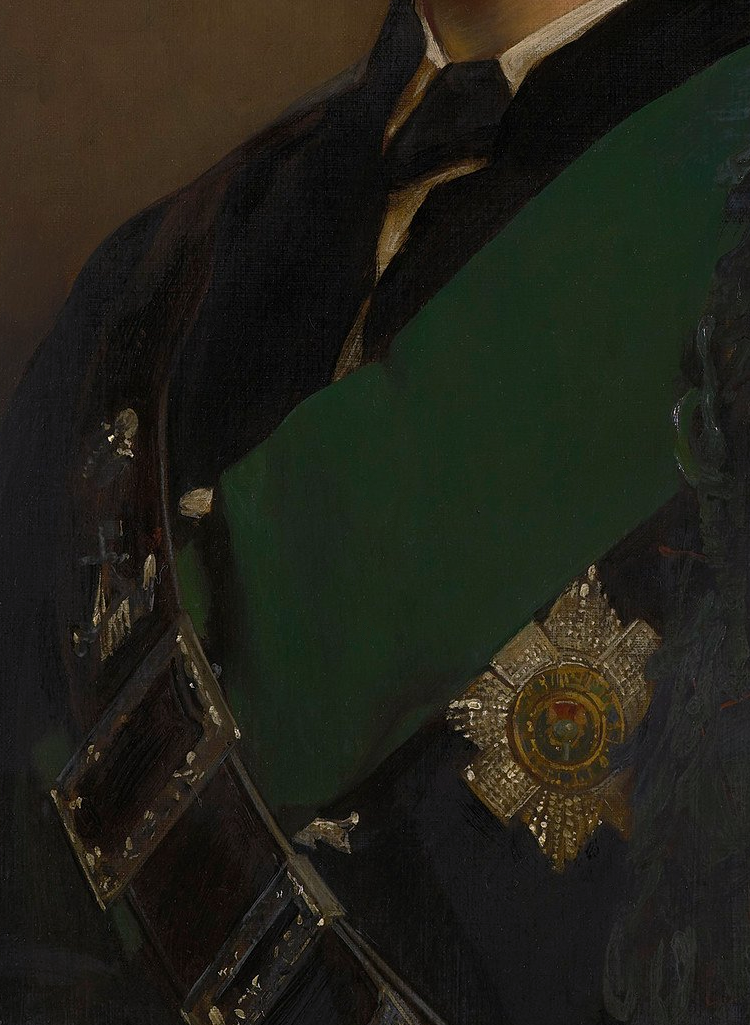
The Marquess and Marchioness of Lorne, by Heinrich von Angeli, 1875


In 1871, Princess Louise (Louisa Caroline Alberta; 18 March 1848, London - 3 December 1939. London), the sixth child and fourth daughter of Queen Victoria and Prince Albert, married John Campbell (John George Edward Henry Douglas Sutherland Campbell; 6 August 1845, London - 2 May 1914, Cowes), the Marquess of Lorne and, later, the 9th Duke of Argyll.


This was the first time since 1515 that a legitimate daughter of the sovereign had married a subject of the Crown. The pair shared a common love of the arts - Louise was a talented sculptor - but the marriage was childless and unhappy, and they spent much time apart. Lorne formed close friendships with men who were known to be homosexual or bisexual, and there has been conjecture that he may have been as well. Louise was an energetic supporter of the arts, higher education, and of the feminist cause.


*


Lorne was Governor General of Canada from 1878 to 1883, and the couple's tenure there was a success. On their return to England, Queen Victoria allocated them apartments in Kensington Palace where they would live for the remainder of their lives. Lorne succeeded to the title of Duke of Argyll in 1900. He suffered from dementia in his last years and Louise nursed him devotedly, the couple becoming closer than they had been before. Following his death in 1914 at the age of sixty-eight, Louise had a nervous breakdown, writing to a friend shortly afterwards: "My loneliness without the Duke is quite terrible. I wonder what he does now!" The Princess lived on for another twenty-five years, passing away at the age of ninety-one.

Lorne wears Highland dress in his portrait, along with the riband and star of the Order of the Thistle.

The portraits were commissioned by Queen Victoria who, on their delivery, was delighted with the results. She wrote to her eldest daughter, Victoria, Crown Princess of Prussia: "I have now got Louise's here and I own it is most exquisite. It is wonderfully, marvelously like, and there is a depth of feeling in the eye and mouth which are Louise herself and (as with all Angeli's pictures) you can look at it quite close by as though it were enamel - which is really what the surface is like…Lorne's is very good too and equally characteristic." 


*

Von Angeli was paid £150 for each of the portraits, the pair of which were placed in the Queen's drawing-room at Osborne House.


Sunday, September 29, 2024

A small memento - sapphire ring, Queen Victoria's coronation gift to one of her train bearers


This sapphire and diamond ring is engraved inside the band with Queen Victoria's cypher and the date of the Coronation in 1838, and was given to one of her eight train bearers who assisted her on that momentous occasion. It no longer seems to be recorded to whom the particular ring was originally given, but it was added to the royal collection by Queen Mary in 1925. And while I haven't found any mention of this on the Royal Collection's website, on the inside of the ring, behind the central sapphire, there appears to be something of a translucent "window"... and would that be, to make the gift that much more personal, a tiny bit of the queen's hair behind?

Queen Victoria Receiving the Sacrament at her Coronation, 28 June 1838, by Charles Robert Leslie, 1838-39.

Charles Robert Leslie's painting shows the Queen receiving the Sacrament towards the latter part of her Coronation. Queen Victoria's half-sister Feodora, Princess of Leiningen, wrote to the Queen later that year that the moment depicted in the painting "was the most touching of the whole ceremony, and one that is always before me; human greatness bowing before greatness above, I saw many eyes that were filled with tears; and I shall never forget that picture."


Queen Victoria was delighted with the painting too. She thought "the group of my youthful trainbearers is excessively pretty.". She wrote to Princess Feodora that it was "the loveliest picture of the coronation you can imagine; it is to be for me, and is a great deal smaller than Hayter's picture [see below] …. He has got me so like … and all the others, he has got so like, I am charmed with it'. It was praised by contemporaries and exhibited at the Royal Academy in 1843.

Queen Victoria described her train bearers in her Journal, as "all dressed alike and beautifully" in white satin and silver tissue, with pink roses in their hair.

*

Coronation of Queen Victoria in Westminster, Abbey 28 June 1838’, by Sir George Hayter, 1839-40.

Sir George Hayter's painting captures the moment in the coronation when, after the crowning, "the people with loud and repeated shouts, will cry 'GOD SAVE THE QUEEN': and immediately the Peers and Peeresses present will put on their Coronets" - in the queen's words, "a most beautiful and impressive moment." The queen is portrayed seated on the Coronation Chair, wearing the Imperial State Crown and holding in her right hand the Sceptre with the Cross and in her left the Sceptre with the Dove. 


Hayter was commissioned to record the scene less than a week before the coronation itself. The finished work depicts sixty-four of those participating or merely present during the ceremony, based on private sittings with the individuals in the two years following the event. The artist's family modelled the gowns and robes for him; his daughter Louisa modeled for the queen's hands.


*

The eight train bearers - who all seemed to find highly decorative - are nonetheless not terribly well represented in either of these coronation paintings. In Leslie's, only six appear - one almost entirely obscured - while in Hayter's a mere three make the cut.


*

The coronation day, from Queen Victoria's diary:

"I was awoke at four o'clock by the guns in the Park, and could not get much sleep afterwards on account of the noise of the people, bands, etc., etc. Got up at seven, feeling strong and well; the Park presented a curious spectacle, crowds of people up Constitution Hill, soldiers, Bands, etc.


"At ten I got into the State Coach with the Duchess of Sutherland and Lord Albemarle and we began our Progress. It was a fine day, and the crowds of people exceeded what I have ever seen; many as there were the day I went to the City, it was nothing, nothing to the multitudes, the millions of my loyal subjects, who were assembled in every spot to witness the Procession. Their good humour and excessive loyalty was beyond everything, and I really cannot say how proud I feel to be the Queen of such a Nation. I was alarmed at times for fear that the people would be crushed and squeezed on account of the tremendous rush and pressure.

Detail from a commemorative panorama - over 3 metres (almost ten feet) long - showing the procession within Westminster Abbey and identifying the key figures.

"I reached the Abbey amid deafening cheers at a little after half-past eleven; I first went into a robing-room quite close to the entrance where I found my eight train-bearers: Lady Caroline Lennox, Lady Adelaide Paget, Lady Mary Talbot, Lady Fanny Cowper, Lady Wilhelmina Stanhope, Lady Anne Fitzwilliam, Lady Mary Grimston and Lady Louisa Jenkinson – all dressed alike and beautifully in white satin and silver tissue with wreaths of silver corn-ears in front, and a small one of pink roses around the plait behind, and pink roses in the trimmings of the dresses.


"Then followed all the various things; and last (of those things) the Crown being placed on my head – which was, I must own, a most beautiful impressive moment; all the Peers and Peeresses put on their coronets at the same instant. My excellent Lord Melbourne, who stood very close to me throughout the whole ceremony, was completely overcome at this moment, and very much affected; he gave me such a kind, and I may say fatherly look. The shouts, which were very great, the drums, the trumpets, the firing of the guns, all at the same instant, rendered the spectacle most imposing. The Archbishop had (most awkwardly) put the ring on the wrong finger, and the consequence was that I had the greatest difficulty to take it off again, which I at last did with great pain. At about half-past four I re-entered my carriage, the Crown on my head, and the Sceptre and Orb in my hands, and we proceeded the same way as we came – the crowds if possible having increased. The enthusiasm, affection, and loyalty were really touching, and I shall remember this day as the Proudest of my life! I came home at a little after six, really not feeling tired. At eight we dined."


Friday, August 9, 2024

Awakening to the news - Queen Victoria being told she is now queen, Kensington Palace, Tuesday, 20 June 1837

 
Queen Victoria Receiving the News of her Accession, by Henry Tanworth Wells, 1887. In the Royal Collection.

Upon the death of her uncle, King William IV, Princess Alexandrina Victoria of Kent, aged eighteen years and three weeks, ascended the throne of the United Kingdom as Queen Victoria. This is an extract from her diary on that momentous day :

I was awoke at 6 o'clock by Mamma, who told me that the Archbishop of Canterbury and Lord Conyngham were here, and wished to see me. I got out of bed and went into my sitting-room (only in my dressing-gown), and alone, and saw them. Lord Conyngham (the Lord Chamberlain) then acquainted me that my poor Uncle, the King, was no more, and had expired at 12 minutes past 2 this morning, and consequently that I am Queen. Lord Conyngham knelt down and kissed my hand, at the same time delivering to me the official announcement of the poor King's demise. The Archbishop then told me that the Queen was desirous that he should come and tell me the details of the last moments of my poor, good Uncle; he said that he had directed his mind to religion, and had died in a perfectly happy, quiet state of mind, and was quite prepared for his death. He added that the King's sufferings at the last were not very great but that there was a good deal of uneasiness. Lord Conyngham, whom I charged to express my feelings of condolence and sorrow to the poor Queen, returned directly to Windsor. I then went to my room and dressed.

Since it has pleased Providence to place me in this station, I shall do my utmost to fulfil my duty towards my country; I am very young and perhaps in many, though not in all things, inexperienced, but I am sure, that very few have more real good will and more real desire to do what is fit and right than I have ...


*

Victoria Regina, by Henry Tanworth Wells, 1880. A second - earlier - version by the same artist. Given to the Tate by the artist's daughter on his death in 1903.
Your Majesty, color photogravure after Mary Louisa Gow, published by The Graphic, 1895.
Illustration published in The Graphic, 1 June 1897, during Queen Victoria's Diamond Jubilee.
Queen Victoria Awakened to Hear the News of her Accession, published in the Illustrated London News, 14 May 1911.
A color version of the same.


Friday, March 4, 2022

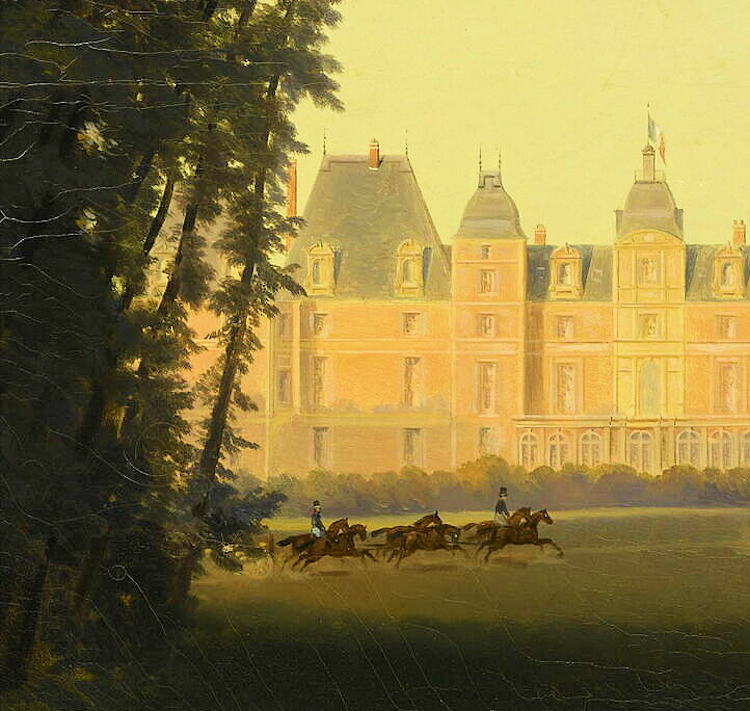
Retour de la promenade en char à bancs de la reine Victoria, l'arrivée au château d'Eu, 4 septembre 1843

 
Retour de la promenade en char à bancs de la reine Victoria, l'arrivée au château d'Eu, 4 septembre 1843, by Jean-Antoine-Siméon Fort, 1844.

The Château d'Eu is a former royal residence in the commune of Eu in Normandy. Built in the sixteenth century to replace an earlier château which had been purposely demolished in 1475 to prevent its capture by the English, it had been the property of the Orléans family since its acquisition in 1657. Between 1830 and 1848 it served as the summer residence of Louis-Philippe. In 1964, the town of Eu acquired the château, in which, in 1973, it installed its City Hall and created the Musée Louis-Philippe.


Louis-Philippe and the royal family twice entertained Queen Victoria and Prince Albert at the château, from 3 to 7 September 1843 and from 8 to 10 September 1845. The first visit was to cement an early form of the Entente Cordiale between Britain and France, and was the first time monarchs of the two countries had met since the famous summit meeting of Henry VIII of England and François I of France on the Field of the Cloth of Gold/Camp du Drap d'Or in June of 1520. 


The British royal couple and large family of the "Citizen King" and Queen Marie-Amélie subsequently became close. There was also a family connection; one of the king's daughters-in-law, the duchesse de Nemours, was a first cousin of both Victoria and Albert. With the Revolution of 1848 and his abdication, Louis-Philippe and the Orléans family fled to exile in England where the former king died two years later.


char à bancs (literally a "carriage with wooden benches") was a large, open-sided carriage - or later a motor coach - with benched seats arranged in rows, facing forward, designed for short-distance, fair-weather travel and sightseeing. A char à bancs presented to Queen Victoria by Louis-Philippe has been preserved in the Royal Mews.

Queen Victoria driving out with Louis-Philippe from the Quadrangle, Windsor Castle, by Joseph Nash, 1844.
Louis-Philippe made the queen a gift of a char à bancs - seen here on the king's reciprocal visit to England - after she had admired the carriages the year before.

*

Jean-Antoine-Siméon Fort (28 August 1793 – 24 December 1861), French artist who painted in both oil and watercolor. Louis-Philippe commissioned several of his works, including four large battle scenes intended for the king's musée historique de Versailles.


Friday, April 2, 2021

A prince of Portugal at fourteen - studio of Anthonis Mor, circa 1552


Dom João Manuel, Prince of Portugal (3 June 1537 – 2 January 1554), Portuguese infante, the eighth child of King João III of Portugal by his wife Catarina of Austria, herself the daughter of Philip I of Castile. João Manuel was born in the Royal Palace of Évora and became the heir to the throne of Portugal at the age of two. He had survived his four older brothers who died in early childhood, though he was a sickly child as well. Of his parents' nine children he and his elder sister Maria Manuela were the only ones to survive past the age of six years old, and all of his siblings predeceased him. It is believed that the successive inter-marriages between the houses of Spain and Portugal were probably responsible for the ill health and early deaths of the children. In January of 1552, at the age of fourteen, he married Princess Joanna of Spain, his first cousin - twice over, through both the paternal and maternal lines. João Manuel died almost exactly two years later at the age of sixteen, probably of tuberculosis, although it's possible the cause was diabetes, a disease that had afflicted his maternal grandfather. Eighteen days later his only child, a son, was born; the child would survive and go on to reign as King Sebastião I of Portugal.


This portrait is part of the Royal Collection and is a contemporary replica of the lost original, destroyed by fire at the palace of El Pardo in 1604. This is one of two known replicas, both of which would have been executed under the artist’s direct supervision in Portugal. Thought to be created in order to be used as part of the prince's marriage negotiations, the painting moved between various royal collections in Portugal and Spain until, in the 1830s, it entered that of Louis-Philippe, King of the French, who had it displayed in his "Galerie Espagnole" in the Louvre. Queen Victoria purchased it from the deposed monarch's estate in 1853.


Sunday, November 29, 2020

Randomly XIX


ND.
Autochrome, circa 1914.
ND. Courtesy Stephen Rutledge.
Décoration de la salle à manger dans la maison de la citoyenne Dervieux, rue Chantereine à Paris, by Jean-Louis Prieur, before 1795.
François-Guillaume Ménageot, by Marie-Victoire Lemoine, circa 1785.
Il Tuffatore (The Diver), by Nino Migliori, 1951.
Photograph by Mike Heydon, New Zealand, 2016.
 Annunciation, by John Shelley, 1968.
Circa 1860s.
Hernando Carlos María Teresa Fitz- James Stuart y Falcó, duque de Peñaranda, conde de Montijo, silver medalist in polo at the Olympic games in Antwerp, 1920.
 Fred Astaire dancing for American GIs, garden front Château de Versailles, 18 September 1944.
Friedrich Wilhelm III of Prussia and his family, by Heinrich Anton Dähling, 1806.
ND.
Lady Cowdray, by Adam de Colone, 1621.
Les Frères, by Robert Doisneau, 1934.
Lisboa, by Gérard Castello-Lopes, 1957.
 Elegant Ladies in a Townhouse Interior, English School, circa 1830s.
Male nude, by Demetrio Cosola, 1875.
Photograph by J. Van der Heyden, Antwerp, circa 1915-20. Courtesy Ralf De Jonge.
Jilted, by Briton Riviere, 1887.
Lupo, by Giuseppe Baldrighi, circa second half of the eighteenth century.
 Madame Helga von Bluhm, circa 1867-69.
Gown by Dior, photograph by Clifford Coffin, 1948. Photographed in the peristyle of the Grand Trianon, Versailles.
 Promotional art work for the SS Normandie, circa 1935.
ND. Courtesy Stephen Rutledge.
ND.
Portrait of a Buttero, by Edoardo Gelli, circa late nineteenth-early twentieth century.
ND.
Mexico, circa 1870s.
Portrait of a Lady, by Raimundo de Madrazo y Garretta, 1881.
Circa 1860s.
William West, 1st Baron De La Warr (second creation), British School, circa 1550.
 Victoria, Duchess of Kent and her daughter, the future Queen Victoria, by Sir William Beechey, 1821.
Miniature copy of the above, by Henry Bone, circa 1824.
Woman With Birdcage, Afghanistan, by Thomas Abercrombie, 1968.
ND.
ND. Courtesy Stephen Rutledge.
Sermon on the Mount, by Robin Guthrie, 1922.
 Mrs. Mary Livius, née Foster-Barham, by Mather Brown, circa 1785.
Sketch for the above.
ND.
The Ukraine, 1949.
Meleager and Atalanta, by Jacob Jordaens, 1620-23.
 Unknown man, Sweden, 1949.
Circa 1913.
Hog farm employees, Tule Lake Relocation Center, Newell, California, by John Cook, circa 1942-45.
Anna Maria Charlotte Wyndham Quinn, née Dunraven, attributed to Richard Rothwell, circa 1836.
Iris Beerbohm Tree, by Augustus John, circa 1920.
ND.
 Miniature self-portrait, by Louis-Marie Autissier, 1817.
 Des Moines, Iowa USA, photograph by Nina Leen for Life Magazine, 1945.
Femina magazine cover, May 1914. Courtesy Andre Duveen.
Märchenball, Szene um den "Gestiefelten Kater", with Eduard Lang, Clara Lang, Adolf Seder, and Heinrich Lang, photograph by Josef Albert, Munich, 1862.
ND.