L a - b e a u t é - s a u v e r a - l e - m o n d e ~ D o s t o ï e v s k i

L a - b e a u t é - s a u v e r a - l e - m o n d e  ~  D o s t o ï e v s k i


Showing posts with label Lotte Laserstein. Show all posts

Sunday, October 5, 2025

Struggle and release - two etchings by Erich Wolfsfeld


The Bound Man, circa 1907-1909.

*

Three Archers, circa 1911.
(This detail is from a different "pull" of the etching.)
Study for or variation on "Three Archers," circa 1909-10.

*

Self-portrait, 1908.

Erich Wolfsfeld (27 April 1884, Krojanke/Krajenka, Prussia/Poland - 29 March 1956, London), German etcher, painter, and teacher. After spending his childhood in Berlin, from 1902 to 1913, he studied at the Berlin Academy of Fine Arts where he focused, particularly, on printmaking. He also studied in Rome and London, as well as in Paris at the Académie Julien under Jules Lefebvre. In 1911 he won the Kaiser Wilhelm Gold Medal. By 1914 he had exhibited in Berlin, Leipzig, and Vienna to good notices, but his early success was interrupted by the First World War. Serving in the German army as an officer and a trainer of military police dogs, he was still able to work during his service, and produced a number of drawings of military subjects. After the war, in 1920, he was appointed professor of painting and etching at Berlin Academy, where his pupils included the painter Lotte Laserstein. He also travelled widely in North Africa and the Middle East, frequently depicting Arab subjects. He held his professorship at the Academy until 1936, when he was forced out due to his Jewish origins. Three years later, he fled to Britain, joining his wife who had preceded him there. In August of that year Graves Art Gallery in Sheffield opened a solo exhibition of his work, only to cancel it two days later owing to Britain's entry into the Second World War. The following June he was among a large number of German-born artists interned on the Isle of Man. After his release, he initially resettled in Sheffield, then moved to London. He went on to hold various exhibitions in England, and was an associate member of the Royal Society of Painter-Printmakers, exhibiting frequently in its shows, as well as with the Royal Academy of Arts. Several exhibitions of his work have been held since his death in London at the age of seventy-one.


Sunday, August 11, 2019

Painting your life - selected work of Lotte Laserstein


 Selbstporträt mit einer Katze, 1928.
 Der Motorradfahrer/Am Motorrad, 1929.
In meinem Atelier, 1928.
Mongole, circa 1927.
Russisches Mädchen, circa 1928.
Polly Tieck, 1929.
Mackie Messer, circa 1932. (With self-portrait.)
Gutsbesitzersohn, 1934.
Sitzende Frau mit roter Baskenmütze, 1931.
Im Gasthaus, 1927.
Im Gasthaus, circa 1927.
ND.
Liegendes Mädchen, circa 1931.
Rauchender Mann - Wilhelm Thiermann, circa 1930.
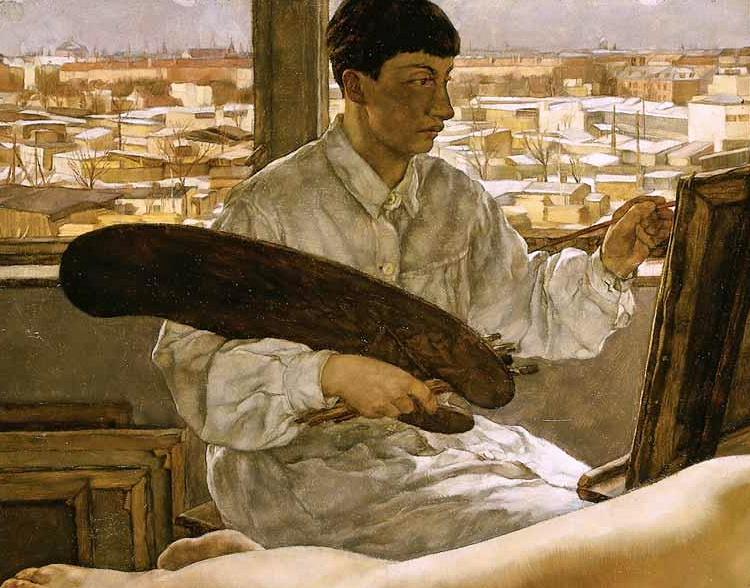
Ich und mein Modell, circa 1929-30.
Vor dem Spiegel, 1930-31.
Tennisspielerin, 1929.
 Frau Im Cafe - Lotte Fischler, 1939.
 Freifrau Alice Lagerbielke, 1938.
Traute Rose mit weißen Handschuhen, circa 1931.
 Weiblicher Rückenakt, circa 1931.
Anna Karger, circa 1933.
Anna Karger, circa early 1930s.
Junge mit Kasperpuppe - Wolfgang Karger, 1933.
Mädchen mit Katze, circa 1932-33.
Abend über Potsdam, 1930.
Morgentoilette, 1930.
Der spanische Kellner, 1958.
Dame in blau mit Schleierhut, circa 1939.
Russisches Mädchen mit Puderdose, 1928.
Selbstporträt im Atelier, circa 1927.
Kopf eines jungen Mannes, circa 1926.
Madeleine, circa early 1940s.
 Selbstporträt, circa late 1920s.

*

Posing with her painting Abend über Potsdam, circa 1930.

Lotte Laserstein (28 November 1898, Preussisch Holland, East Prussia – 21 January 1993, Kalmar, Sweden), German figurative painter and portrait artist. She is said to have declared at the age of eleven that she would never marry, but devote her life to painting. In 1921 she was one of the first female students admitted to the Berlin Academy, where she would study with the painter Erich Wolfsfeld; in her last two years at the academy she was his Atelier Meisterschal (star pupil.) She would be greatly influenced by the nineteenth century realists Adolph Menzel and Wilhelm Leibl, as well as the portraiture of Hans Holbein.

She won the Academy’s Gold Medal in 1925 and after leaving the school set up her own studio in Berlin. She exhibited during the late 1920s, and in 1931 she held her first solo exhibition in Berlin. In 1934, however, labelled under new Nazi racial laws as "three-quarters Jewish", she was barred from exhibiting in public, and in 1935 was forced to abandon her studio. Finally, in 1937, just as her work began to receive critical acclaim, with two paintings hung in that year's Paris Salon, she traveled to an exhibition of her work at the Galleri Modern in Stockholm... and never returned to Germany. She arranged to gain Swedish citizenship the following year through a marriage to a Swedish friend. After great effort, she was able to get her sister out of Germany, but her mother would die at Ravensbruck in 1943. Laserstein spent the rest of her long life in Sweden teaching and working as a portrait painter. Overshadowed for decades by new artistic trends, her early work was "rediscovered" to great acclaim during her last decade of her life. She died at the age of ninety-four.

Selbstporträt, 1950. (Her best known work, Abend über Potsdam, is in the background - reversed, as the artist would be working from a mirror.)