|
| Alfonso XIII - Alfonso León Fernando María Jaime Isidro Pascual Antonio de Borbón y Habsburgo-Lorena - King of Spain, 1927. |
 |
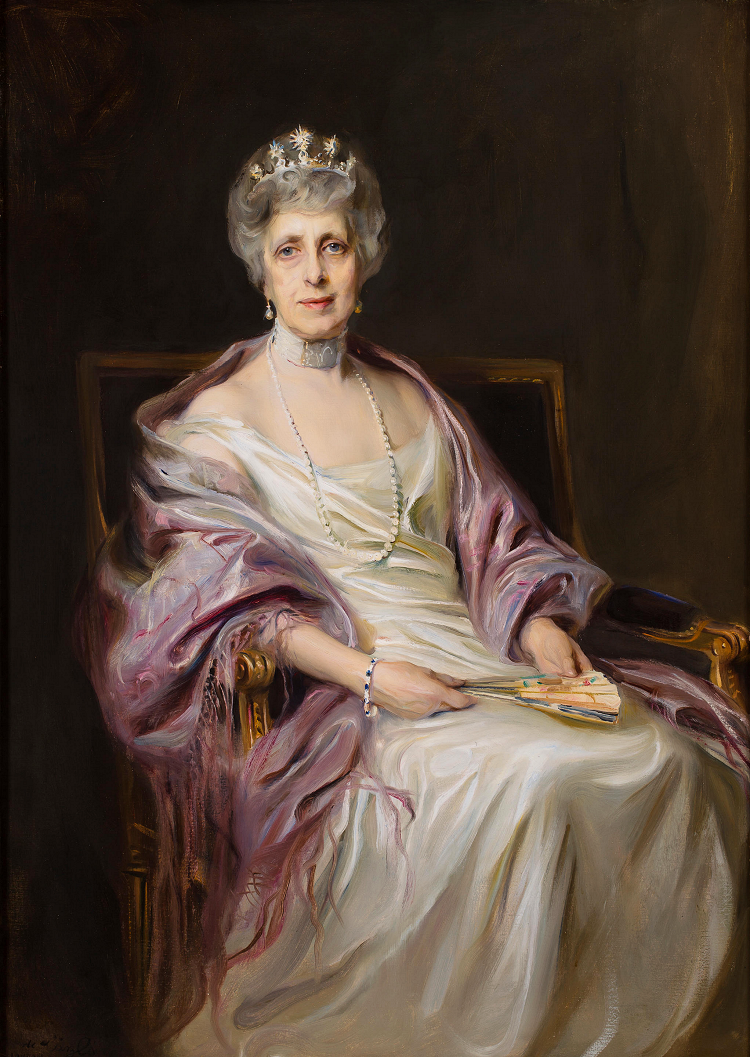
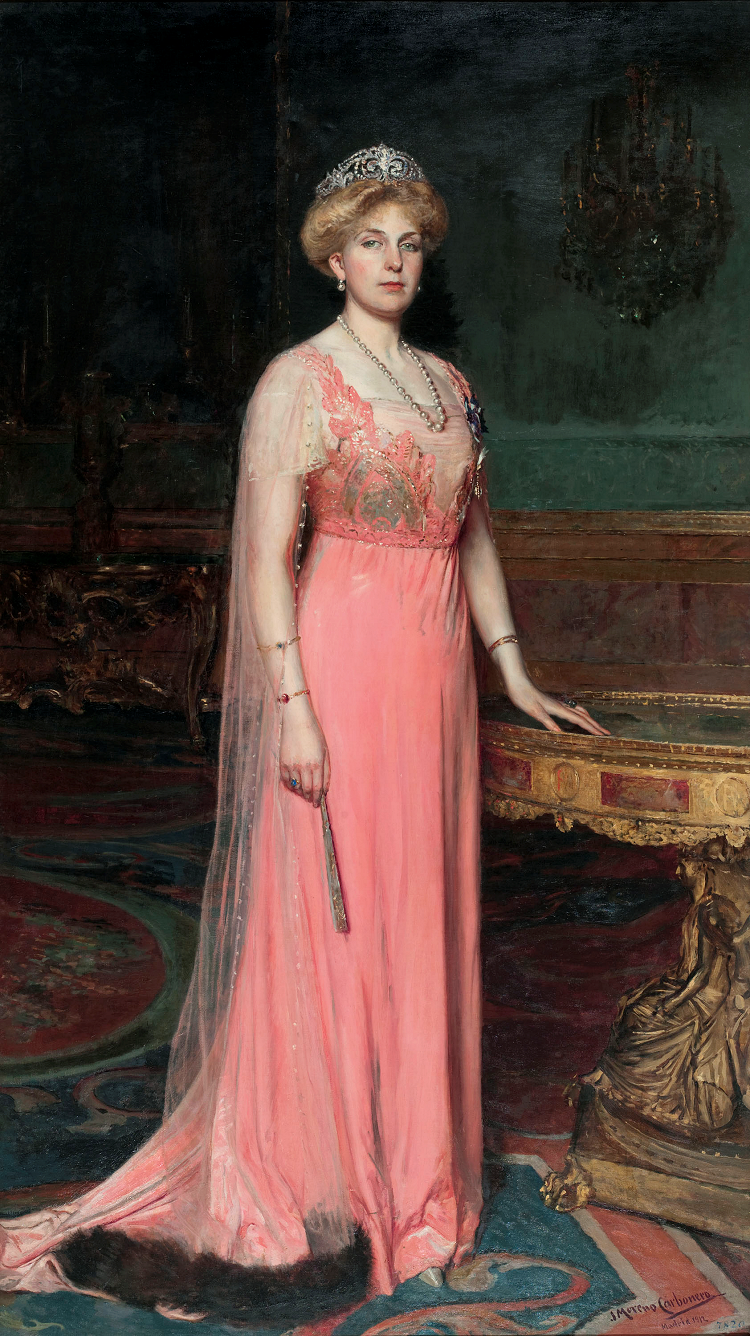
| Queen Victoria Eugenie, née Victoria Eugenie Julia Ena of Battenburg, 1926. |
De László, that incredibly prolific Hugarian, painted nearly all the crowned heads of Europe in his day. And the Spanish Royal Family certainly got more "coverage" than most. He painted King Alfonso XIII and Queen Victoria Eugenie on several occasions, as well as the King's mother and the couple's six children. Though this royal "family unit" was often an unhappy and even tragic one - read much of
their story here, in a previous post about the Queen - they are all glamorous and self-assured in these portraits, their troubles varnished over, invisible beneath de László's glorious brushwork.
 |
| Queen Victoria Eugenie, 1910. |
 |
| Alfonso XIII, 1910. |
 |
| Queen Victoria Eugenie, 1912. |
 |
| Dowager Queen María Cristina, née Maria Christina Henriette Desideria Felicitas Raineria of Austria, mother of the King, 1910. |
 |
| Queen Victoria Eugenie, 1920. |
 |
| Alfonso XIII, 1927. |
 |
| Queen Victoria Eugenie, 1927. |
 |
| Queen Victoria Eugenie, 1927. (Sketch for the above portrait.) |
 |
Alfonso, Príncipe de Asturias - Don Alfonso Pío Cristino Eduardo Francisco Guillermo Carlos Enrique Eugenio Fernando Antonio
Venancio de Borbón y Battenberg - at twenty, 1927. |
 |
| Alfonso, Príncipe de Asturias, 1927. |
 |
Infante Jaime, Duque de Segovia, later duc d'Anjou - Don Jaime Leopoldo Isabelino Enrique Alejandro Alberto Alfonso Víctor Acacio
Pedro Pablo María de Borbón y Battenberg - at nineteen, 1927. |
 |
Infanta Beatriz - Doña Beatriz Isabel Federica Alfonsa Eugénie Cristina Maria Teresia Bienvenida Ladislàa de Borbón y
Battenberg - later Principessa di Civitella-Cesi, at eighteen, 1927. |
 |
| Another portrait of Infanta Beatriz, 1927. |
 |
Infanta María Cristina - Doña María Cristina Teresa Alejandra María de Guadalupe María de la Concepción Ildefonsa Victoria
Eugenia de Borbón y Battenberg - later Contessa Marone, at sixteen, 1927. |
 |
| Infante Juan, Conde de Barcelona - Don Juan Carlos Teresa Silverio Alfonso de Borbón y Battenberg - at fourteen, 1927. |
 |
| Infante Gonzalo - Don Gonzalo Manuel María Bernardo Narciso Alfonso Mauricio de Borbón y Battenberg - at thirteen, 1927. |
***
I spend a ridiculous amount of time gathering and prepping images for this blog. Early on, I wasn't quite so fastidious. But I quickly became more and more obsessive about the size and quality of the images; I am a visual artist after all. So I hunt and hunt, comparing the different versions of the same painting or photograph that are to be found - uncovered; it's often real detective work! - to try and get the fullest image - so many one finds are cropped - in the largest size and the best quality. And then I spend a lot of time with any necessary Photoshopping, sizing the images and cleaning them up, adjusting the color and sharpness, trying to get the very best version I can; I know how often my own paintings have been badly reproduced so, honestly, I feel a lot of responsibility to the artists whose work I'm presenting.
I see a lot of odd things out there on the internet; the various and varied filters of reproduction often do crazy things to a work of art. I thought the portrait of Infante Jaime was a particularly perverse example of this. I was lucky to find the two following images - fairly large, clear, and detailed - and then realized that they were actually the same portrait. I've examined them very, very closely, and they
are the same painting; there's no way that anyone could have copied every brushstroke so exactly. And it's also clear to me that the first one
is a color reproduction, not a black and white photograph of the painting tinted with color. So how is it even possible that these two are so different - and where did the red go? If I hadn't seen the second image, I'd have thought the uniform jacket was grey. The obvious defect in the second image was that the background had been so darkened that all the detail there was lost; the cast shadow behind the figure is indiscernible and the signature almost so. Neither version was really acceptable, so I melded the two images together. I hope this is something much more like what the great de László produced; for accuracy's sake, and because it's a wonderful painting.
THIS
PLUS THIS
EQUALS THIS







%20Monika%20Pon-su-san%20by%20Vladimir%20Tretchikoff,%201952.png)