L a - b e a u t é - s a u v e r a - l e - m o n d e ~ D o s t o ï e v s k i

L a - b e a u t é - s a u v e r a - l e - m o n d e  ~  D o s t o ï e v s k i


Showing posts with label Grand Duchess Maria Pavlovna. Show all posts

Sunday, July 30, 2023

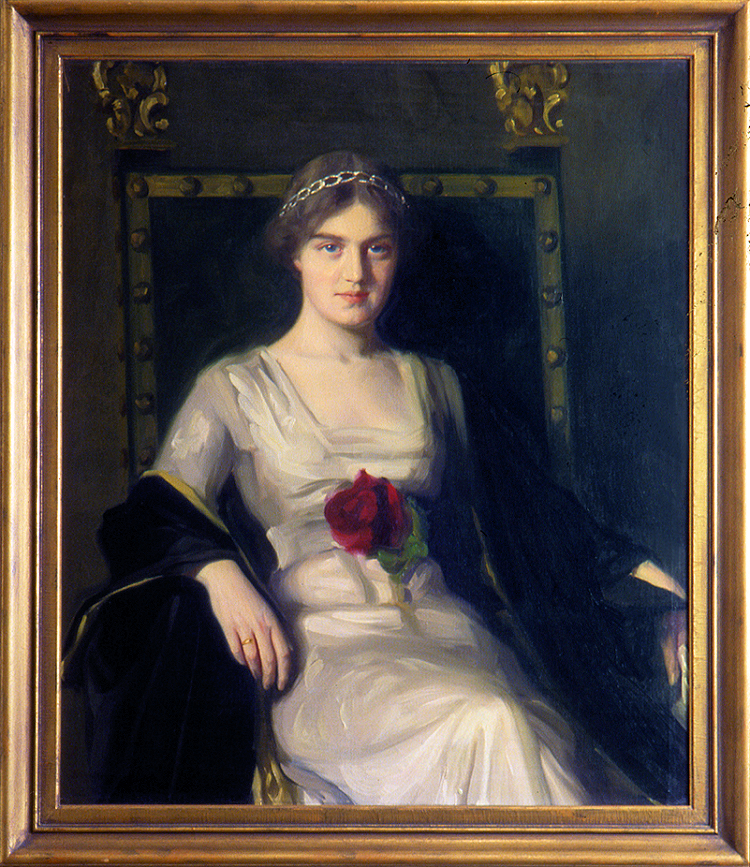
Two portraits of Grand Duchess Maria Pavlovna (or three - no, four... five?) by Bernhard Österman, circa 1913

 
These portraits were all taken during her marriage to Prince Wilhelm of Sweden, Duke of Södermanland, 1908-1914.
I have no idea why, in this one portrait, her eye color is mismatched; I've never come across any mention of heterochromia related to Maria Pavlovna.

This third painting, of which I've - frustratingly - never found a better, larger, uncropped version, is certainly a portrait of Maria Pavlovna, and almost certainly the work of Österman, but I've been unable to discover any documentation for it. (I apologize for the poor quality of the image.)


This next charming portrait by Österman is "presumed" to be a portrayal of the same subject, and I believe it is. The lighting is the same as in the first three examples; all of Österman's portraits of her were posed with basically the same lighting. The hair style and color - a wig or dressed and powdered - and the gown, reminiscent of eighteenth century styles, would signify fancy dress.


*

Speaking of gowns, the Grand Duchess was always very interested in clothes. In exile in Paris during the twenties, she would even start her own embroidery business, Kitmir, successful for a time, during which she worked closely with Chanel, among others designers. Some of her personal wardrobe remains in the collection of the Sörmlands museum, including the gown featured below. She can be seen here wearing the same gown as she posed once again for Österman - a fifth portrait, seen unfinished, its whereabouts are unknown - and the top of its bodice can be seen in the second portrait featured in this post.


Another digression: In the first portrait, seen in the Grand Duchess' hair is a diamond link necklace worn as a bandeau. The necklace was given to her by her aunt, the Grand Duchess Elisaveta Feodorovna. Both women were frequently photographed wearing the piece in its two configurations.


And because I can't seem able to stop my digressions, here are two post-Revolution portraits of Maria Pavlovna by artists I've never heard of. 

Pencil sketch by Nicolas Paganiotti Zarokilli, 1919.
Drypoint by Alex-Ceslas Rzewuski, 1925.


Sunday, April 17, 2022

Females of the species - miscellaneous portraits of women and girls, circa 1750-1960


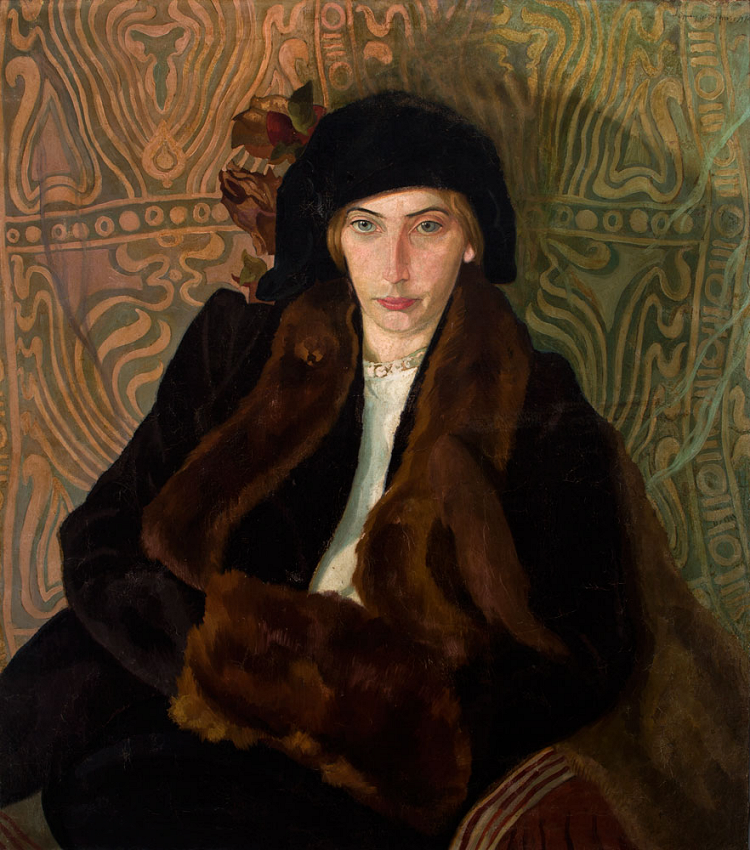
Portrait of a lady, by Józef Męcina-Krzesz, 1920.
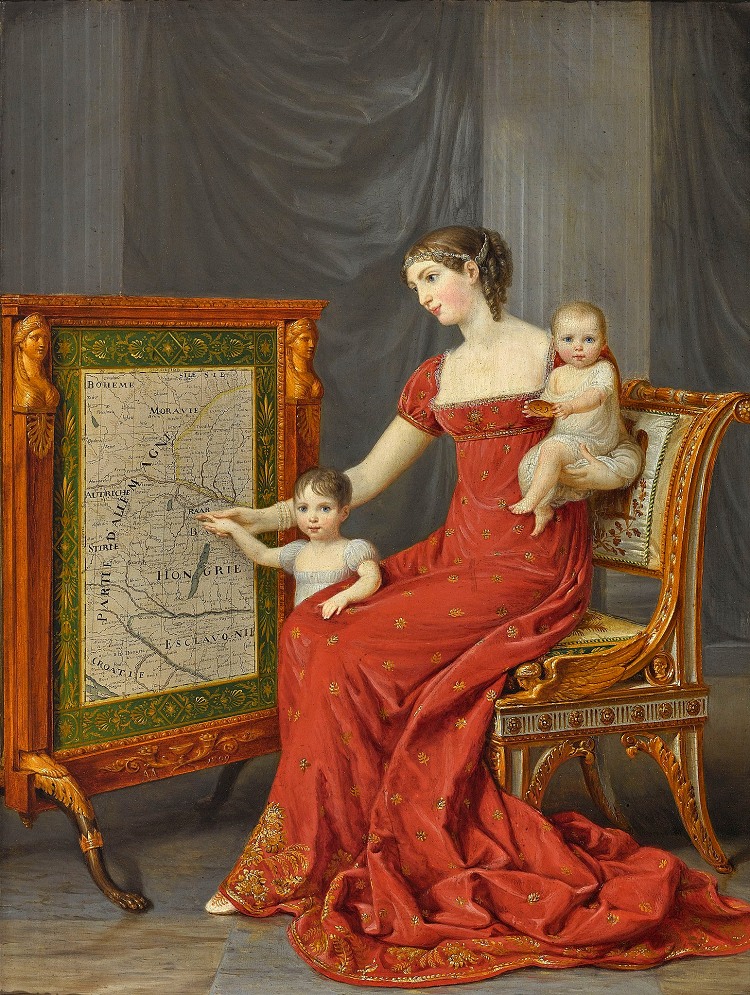
Princess Augusta of Bavaria with her daughters Joséphine and Eugénie, by Andrea Appiani, 1809.
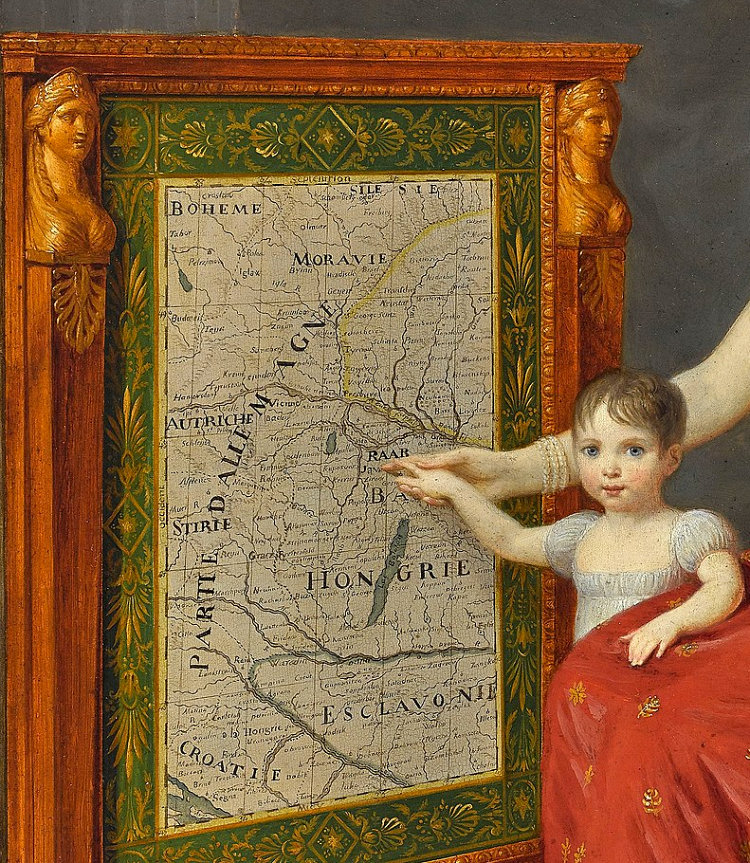
Princess Joséphine, the future queen of Sweden and Norway, points to the location in Hungary where her father, Prince Eugène de Beauharnais,
Viceroy of Italy and stepson of Napoléon, led a military victory against the Austrian army at the Battle of Raab, 14 June 1809. 
Alda Weston, Lady Hoare, in a Green Cloak, by St. George Hare, 1909-10.
Karoline von Schlotheim, by Wilhelm Böttner, 1788.
The sisters Karolina and Anna Strauss, ballet dancers from the Teatr Wielki, Warsaw, by Jan Ksawery Kaniewskicirca, 1853.
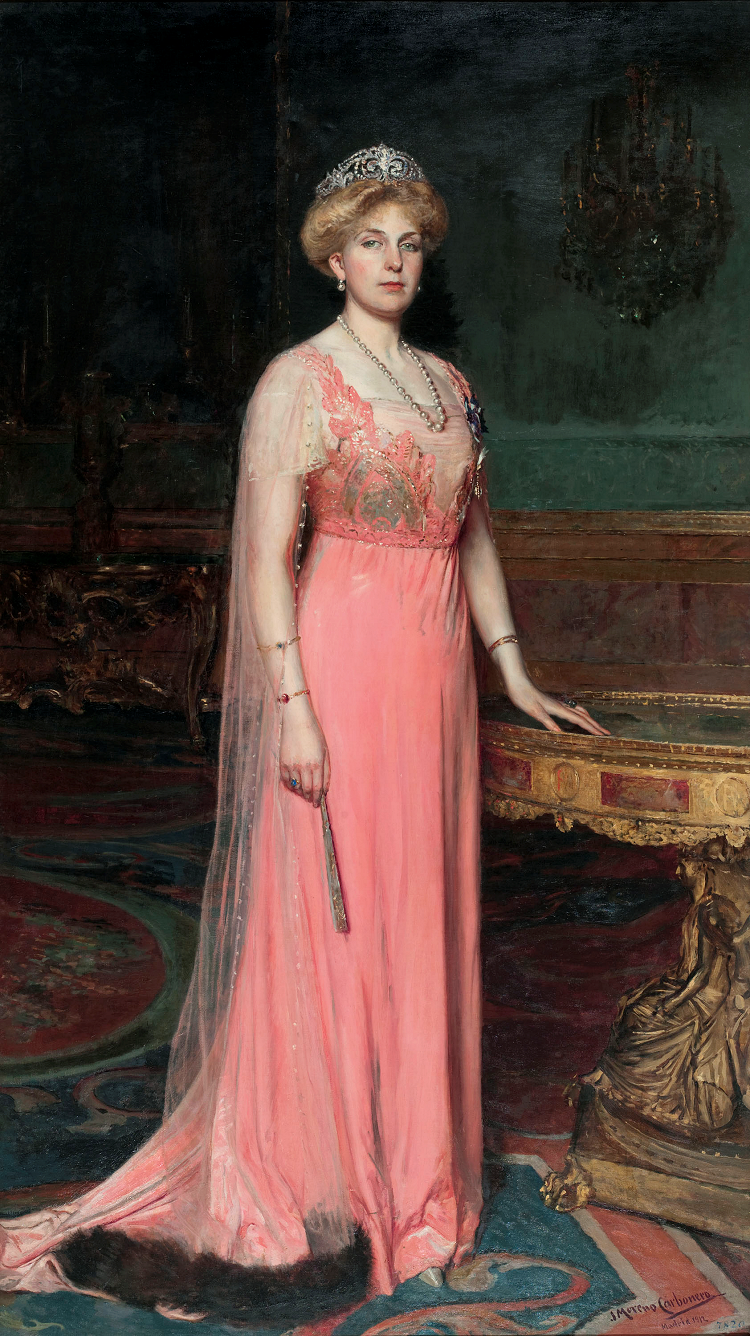
Queen María Cristina of Spain, by José Moreno Carbonero, 1906.
^ Her daughter-in-law, Queen Victoria Eugénie of Spain, by José Moreno Carbonero, 1912.
The painter and the portrait.
The daughters of Puerto Rican governor Ramón de Castro, by José Campeche y Jordán,1797.
Marie Antoinette as a Vestal Virgin, by François Dumont, circa 1791 or later. There are several versions of this, some if not most created after her death.
Zinaida Ivanova, comtesse de Chauveau, formerly Princess Yussupova (née Narishkina), by Gerasim Ignatievich Kadunov, 1858.
Marina, Duchess of Kent, by Simon Elwes, circa 1955-60.
In 1945, at the height of his career, Elwes suffered a near-fatal stroke which paralyzed his right side, including
his painting hand. He re-taught himself to paint with his left and went on to even greater success.
The Chinese Girl, also known as The Green Lady, Monika Pon-su-san, by Vladimir Tretchikoff, 1952.
Portrait of Zofia with cacti, by Tadeusz Pruszkowski, 1920.
Possibly Claire Josèphe Hippolyte Léris de Latude, a French actress known professionally as mademoiselle Clairon, by Maurice Quentin de La Tour, circa 1750.
 Octavie Wylezynska, baronne de Löwenthal, by Franz Xaver Winterhalter, 1859.
Eugenii Dunin-Borkowskiej, by Stanisław Ignacy Witkiewicz, also known as "Witkacy", 1912.
Marie-Thérése Charlotte of France, dauphine and duchesse d'Angoulême, by Antoine-Jean Gros, 1816.
Grand Duchess Sergei, Elisaveta Feodorovna, by Friedrich August von Kaulbach, circa 1892.
^ Her niece and ward, Grand Duchess Maria Pavlovna, Princess Wilhelm, Duchess of Södermanland, by Bernhard Österman, 1913.
Young Woman with a Fan, by Simon Maris, circa 1906. The model appears to be wearing an early 19th-century costume.
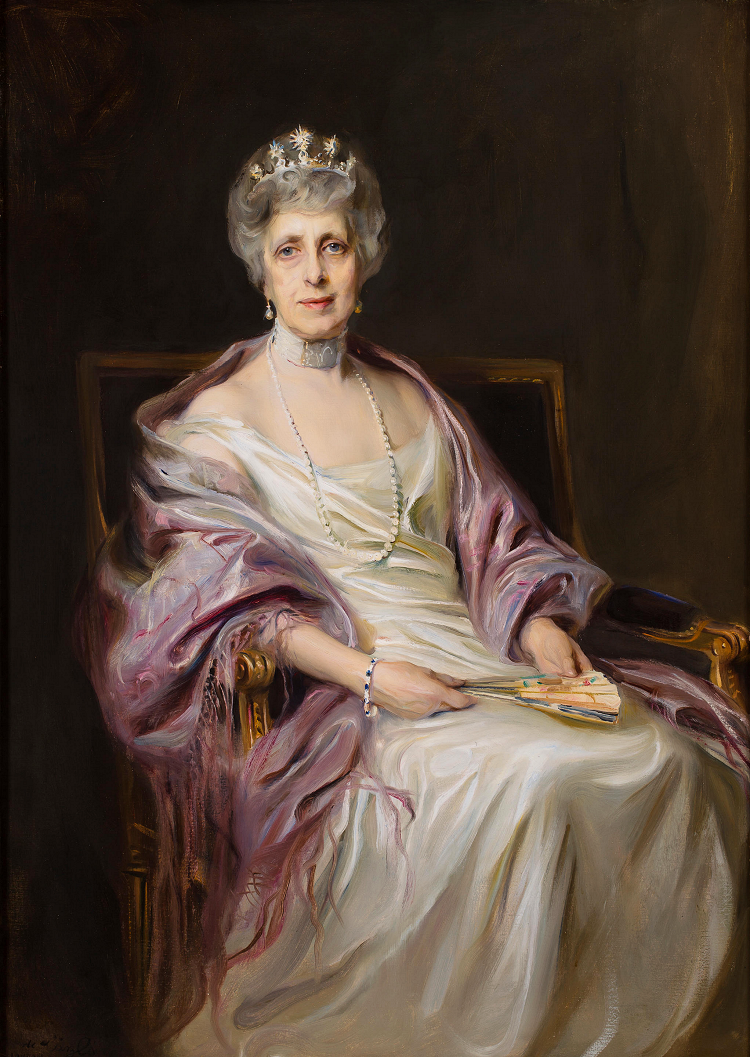
 Mrs. Frederick L. Pratt, neé Jeannie Williams, by Philip de László, 1928.
^ Her sister-in-law, Mrs. Robert Livingston Fryer, neé Melissa Dodge Pratt, by Philip de László, 1923.
Portrait de l'impératrice Eugénie en costume de dogaresse, the Empress Eugénie in a Venetian-style costume she wore to a ball on 9 February 1863.
The genre photographer "Marck" added - in oil paint - color and an imaginary Venetian background to the original photograph.
Circa 1850s.