L a - b e a u t é - s a u v e r a - l e - m o n d e ~ D o s t o ï e v s k i

L a - b e a u t é - s a u v e r a - l e - m o n d e  ~  D o s t o ï e v s k i


Showing posts with label Boris Kustodiev. Show all posts

Sunday, September 21, 2025

Twenty-eight gentlemen - a selection of portraits and self-portraits

 
Self-portrait, by Joseph Highmore, 1747.
Self-portrait at the age of twenty, by Sir David Wilkie, between 1804 and 1805.
Self-portrait, by George Hendrik Breitner, 1882.
French School, circa 1780s.
Ignazio Degotti, scenographer of the Paris Opéra, miniature by Ferdinando Quaglia, 1812.
Jules Richemont, by Gustave Caillebotte, 1879.
Count Sergei Platonovich Zubov, by Giovanni Boldini, 1913.
"Black Hunter" - portrait of David Lawrence, by Andrew Wyeth, 1938.
The poet Janko Lavrin, by Boris Kustodiev, 1909.
The sculptor Alessandro Vittoria, by Giovanni Battista Moroni, 1552.
Raymond de Verninac, by Henri-François Riesener, circa 1822-25.
Count Wenzel Anton Kaunitz, by Jean-Étienne Liotard, 1762.
Self-portrait, by Eliseu Visconti, circa 1900.
Portrait of a man with glasses, attributed to Rembrandt Peale or French School, circa 1820s.   
Alfonso XIII, by Ramón Casas y Carbó, 1904.
Lord Berners (Gerald Hugh Tyrwhitt-Wilson, 14th Baron Berners), by Rex Whistler, 1924.
The sculptor Tommaso Bandini, cousin of the artist, by Enrico Bandini, circa 1835.
Portrait of a man, called "Il Condottiere", possibly Sforza Maria Sforza, by Antonello da Messina,  circa 1475.
Selbstbildnis im Gruenen (self-portrait in the green), by Siegfried von Leth, 1906.
 Portrait of a gentleman, Anthonis Mor, circa 1570.
Matreier Bub (boy from Matrei), by Franz Eichhorst, circa 1920s.
Leo Ornstein at the Piano, by Leon Kroll, 1918.
 John, Lord Mountstuart, later 4th Earl and 1st Marquess of Bute, by Jean-Étienne Liotard, 1763.
Camillo Borghese (Don Camillo Filippo Ludovico Borghese, Prince of Sulmona and of Rossano, Duke and Prince of Guastalla), by François Gérard, circa 1810.
Richard Meade, 3rd Earl of Clanwilliam, by Sir Thomas Lawrence, 1819.
Presumed Portrait of Jean André Soubry, by Nicolas de Largillière, circa 1729.
The painter Eduard Bendemann, by Friedrich von Amerling, 1837.
Francis Owen in van Dyck costume, by Jean-Étienne Liotard, 1773.


Friday, March 24, 2017

Changing your gown but not your pose (or artist) - two portraits of the Grand Duchess Vladimir by Boris Kustodiev


1911. This appears to be a preparatory sketch for the finished painting which was only completed two years later.
1913. In the final version, the Grand Duchess is portrayed wearing an entirely different court gown and jewels.

***

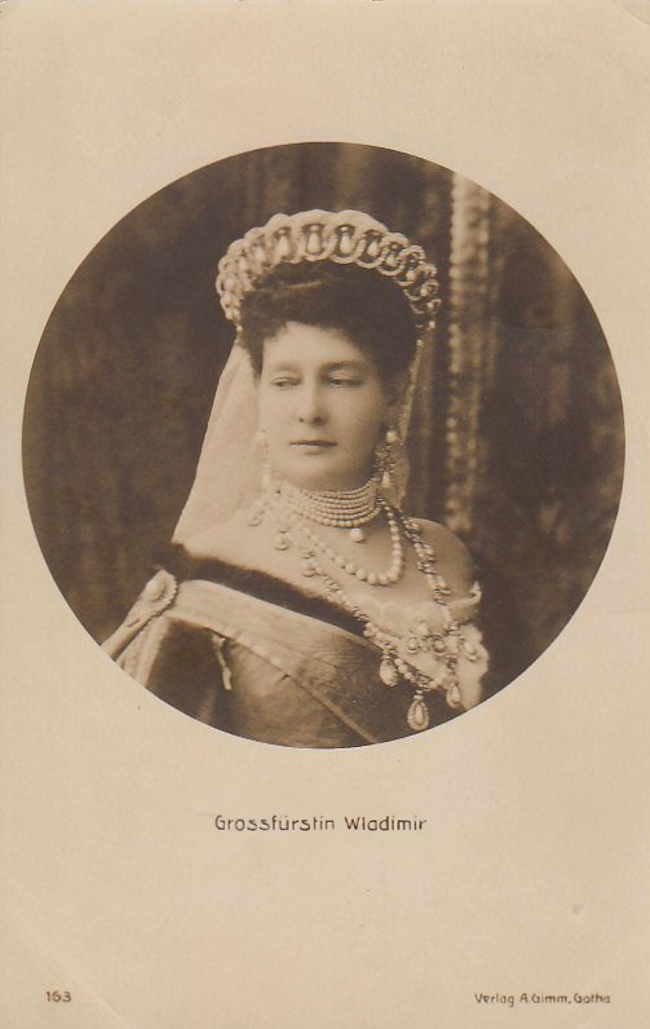
The Grand Duchess wearing exactly the same court gown and jewels as in the first painting; considering that the pose is also exactly the
same in this photograph and in both paintings, it may be possible that the artist worked from photographs rather than from life.
The famous "Vladimir tiara", now in the collection of the British royal family, worn in the two images above and in the first painting.
An earlier image of the Grand Duchess wearing the sapphire and diamond necklace worn in
the second painting and showing the original setting of her sapphire and diamond tiara.
The new version of the sapphire and diamond tiara (1909) and the devant de corsage (1910) worn in the second portrait; both by Cartier.

***

Edited - heavily - and adapted - a lot - from the Sotheby's website:

This second portrait of the Grand Duchess Vladimir (1854-1920, sometimes referred to as "Grand Duchess Maria Pavlovna the Elder"), is dated 1913. Kustodiev completed the painting almost two years after making his initial study. The subject was the daughter of the Grand Duke of Mecklenburg-Schwerin Friederich Franz II and Augusta of Reuss Kostritz. Princess Marie of Mecklenburg-Schwerin would become a key figure in the life of the Russian capital after her union with Grand Duke Vladimir Alexandrovich of Russia (1847-1909), son of Emperor Alexander II. Among other things, Grand Duke Vladimir was President of the Imperial Academy of Arts in St. Petersburg and the Grand Duke’s financial support - from his private funds - allowed many artists to flourish beyond the conservative boundaries and culture of the Imperial court. The Grand Duchess Vladimir took over the Presidency of the institution after the death of her husband in 1909; in Kustodiev's portrait she stands before a bust of her husband, and the Imperial Academy of Arts can be seen in the background, its presence symbolic of their lifelong involvement with the arts.

Kustodiev painted the dominating figure of Grand Duchess Vladimir, proud and dignified and covered in spectacular jewels – she was famous for her jewelry. In fact, it is said that she spent much of the annual pension of 1 million gold francs she received after the death of her husband on her jewelry. In Kustodiev’s portrait, she wears her famous sapphire and diamond diadem commissioned from Cartier 1909; the firm re-used stones belonging to the client, the central sapphire weighing 137.20 carats The tiara later belonged to her niece, Queen Marie of Roumania, whose daughter, Princess Ileana, sold it back to Cartier in the Fifties. The stomacher (devant de corsage) worn by the Grand Duchess was also made by Cartier, again using the client's stones, in 1910. The necklace and earrings appear to be Russian and of an earlier date.

The Grand Duchess fled St. Petersburg in February 1917. She settled in Kislovodsk in the Caucasus until February 1920, when she finally left Russia. Remarkably, her jewels which she placed in a secret safe in the Vladimir Palace, had remained undiscovered by the Bolsheviks despite repeated searches. Albert Stopford, a British secret agent and family friend, recovered the jewels and the Grand Duchess’ jewelry eventually found its way to Cartier, Paris in a diplomatic pouch; Cartier has archival photographs of all of the Grand Duchess Vladimir’s jewels taken around 1920. After the Grand Duchess’ death on September 6, 1920, the jewels were divided among her children: Grand Duke Kyrill received the pearls, Grand Duke Boris the emeralds, Grand Duke Andrei the rubies, and Grand Duchess Elena the diamonds.


Sunday, March 5, 2017

Chaliapin, artist and artist's muse - portraits of Feodor Chaliapin


Feodor Ivanovich Chaliapin (1/13February 1873, Kazan – 12 April 1938, Paris), Russian opera singer. A legendary figure in the world of opera, he is often ranked with Caruso and Callas as one of the greatest singers and most influential operatic artists of the twentieth century; Toscanini said that he was the greatest operatic talent he had ever worked with. Possessing a distinctive "high-lying" bass voice, he was immensely popular with the public and toured the world, performing in fully staged productions and solo recitals. He is also credited with helping to bring a more naturalistic acting style to the operatic stage. In addition, owing to his advocacy, Russian operas - the master works of Mussorgsky, Glinka, Borodin, Rimsky-Korsakov - became much better known in the West. He was also what one would call a "big personality" - temperamental, egotistical, willful - his fellow performers had to be constantly on guard, ever watchful for his penchant for scene-stealing. A fairly accomplished artist himself he was also, as seen here, a frequent and enthusiastic model for the best known artists of his day.

 Portrait by Nikolai Bogdanov-Belsky, 1915.

Born into a peasant family, he endured a miserable childhood, working at menial labor from the age of ten. He left home at seventeen and, self-trained, found work with a choir on a private estate, and then with a provincial touring opera company. A few years later he was in Tbilisi, studying with and being supported by singer and teacher Dmitri Usatov. At his teacher's suggestion, and after a very successful year with the Tbilisi Opera, in 1894 he moved to Moscow. He debuted with the Imperial Mariinsky Theater in St. Petersburg the following year, and in 1896 joined the private Mamontov opera company in Moscow. While there he met Sergei Rachmaninov; the two would become great friends and would be powerful artistic influences on each other. Chaliapin began a working relationship with the Bolshoi in 1899 which would continue until the war, and soon went on to success in the West; major milestones in the forward trajectory of his career were the celebrated Diaghilev seasons in Paris and London, beginning in 1908. The same period saw the commencement of a very successful solo concert career. 

Alexander Yevgenievich Yakovlev, 1917.

Chaliapin was married twice. He and Italian ballerina Iola Tornagi wed in 1898. The had six children, five who survived to adulthood. (One son, Boris, became a successful artist, completing more than four hundred covers for Time magazine. And the youngest son, Feodor Jr., had a long and successful career in film, lasting from 1926 to 1992, the year of his death; he is perhaps best remembered for his role as the grandfather in Moonstruck.) In 1906, while still married to Tornagi, Chaliapin began living with Maria Valentinovna Petsold, a widow who already had two children from her first marriage; they went on to have three daughters together. He maintained both families separately, the first in Moscow, the second in St. Petersburg. When he left Russia in 1922, he was accompanied by Maria and their three daughters. In 1927 he was granted a divorce from his first wife - she would remain in Russia until 1959 - and he married Maria a month later.

Konstantin Korovin, 1905.

Chaliapin was originally very supportive of the revolution in Russia and was treated as a revered artist in the new Russia. However, the unpleasant realities of everyday life under the new regime, combined with the instability and devastation of the ensuing Civil War, meant that he spent increasingly extended stays outside of the country. Moving first to Finland, he emigrated to France in 1922; Paris would be his home for the remainder of his life. He still maintained that he was not anti-Soviet, and remained a tax-paying Russian citizen for some years. A final break came in 1932 when, in his memoirs, he denounced the lack of freedom in Bolshevik Russia. In the meantime, he continued performing, recording - he would amass an enormous catalogue of recordings - and even starring in a film, Don Quichotte, directed by G. W. Pabst in 1933. His last performance was in Monte Carlo in 1937. He died in Paris the next year of leukemia and a kidney ailment; he was sixty-five. In 1984, his remains were returned to Russia, where they were re-buried in Moscow's prestigious Novodevichy Cemetery.

As Boris Godunov in Mussorgsky’s Boris Godunov, by Alexander Golovin, 1912.
Konstantin Korovin, 1915.
As Boris Godunov, by Nikolai Vasilievich Kharitonov, 1916.
 As Boris Godunov, from a 1922 model by I. Troupianskii and V. Rukavishnikova, circa 1955.
Konstantin Korovin, 1921.
Konstantin Korovin, 1921. (Version of the above portrait.)
Boris Anisfeld, 1916.
As Holofernes in Alexander Serov's Judith, by Alexander Golovin, 1908.
Valentin Serov, 1905.
Self-portrait caricature, 1907.
 Boris Kustodiev, 1922. (A masterpiece by Kustodiev.)
Another version/preparatory sketch by Kustodiev, 1920-21.
A further version and/or preparatory sketch by Kustodiev, 1920-21.
Boris Grigoriev, 1918.
Nikolai Dmitriyevich Kuznetsov, 1902.
By his son, Boris Chaliapin, 1934.
As Mephistopheles in Gounod's Faust, by Alexander Golovin, 1905.
Leonid Pasternak, 1913.
Boris Grigoriev, 1923. (Grigoriev's portraits are notoriously unflattering, but this looks like it could be later than 1923.)
Sergei Konenkov, 1920.
By his son, Boris Chaliapin, 1934.
As Mephistopheles in Gounod's Faust, by Alexander Golovin, 1905.
Self-portrait, date unknown.
Nikolai Andreievich Andreev, 1918. (I love the little "alternate" sketch visible on Chaliapin's neck.)
Savely Sorine, 1925 (?).