L a - b e a u t é - s a u v e r a - l e - m o n d e ~ D o s t o ï e v s k i

L a - b e a u t é - s a u v e r a - l e - m o n d e  ~  D o s t o ï e v s k i


Showing posts with label Mariano Fortuny y Madrazo. Show all posts

Friday, August 30, 2024

Frammenti / Fragments - two still-lifes by Mariano Fortuny y Madrazo

 
Natura morta - I gessi dell'atelier, 1939.
Natura morta - I gessi dell'atelier, 1940.

Arrangements of plaster casts and other items in the artist's studio. Both in the collection of the Palazzo Fortuny, Venice.


Sunday, October 16, 2022

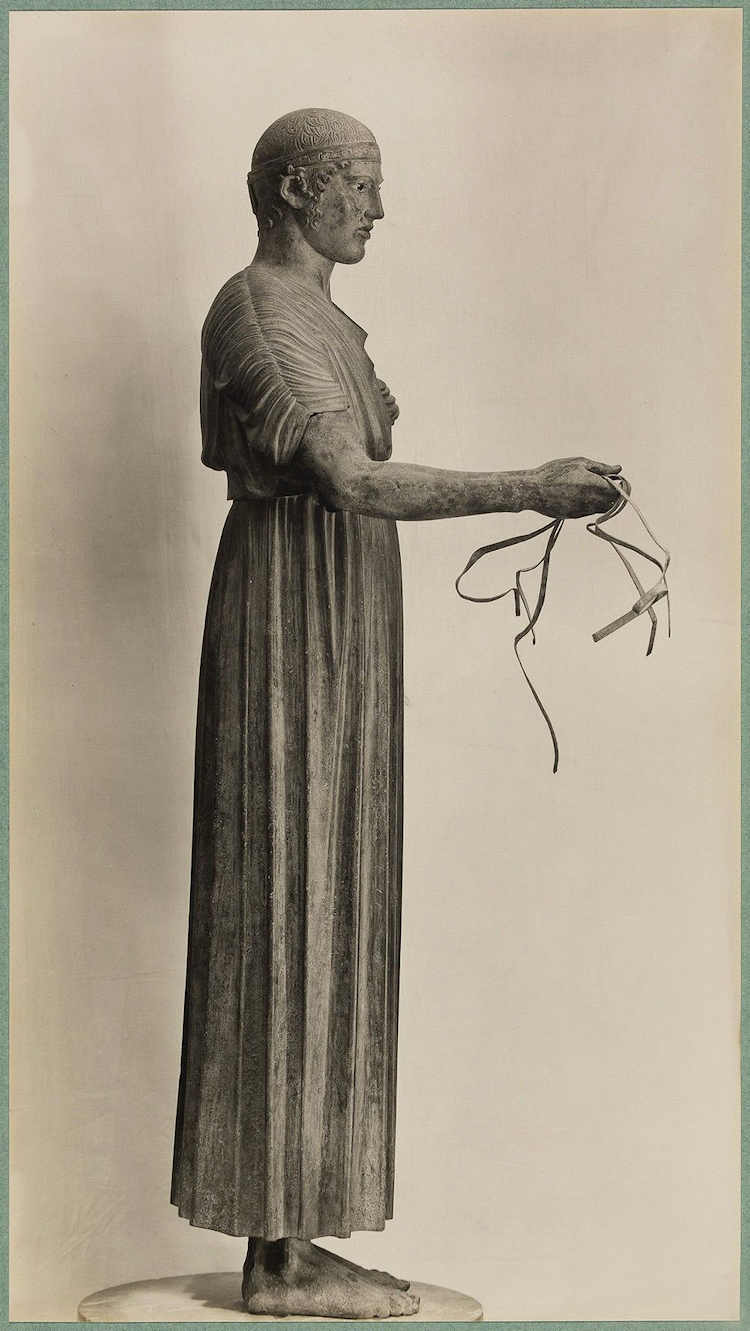
Eternal youth - the "Charioteer of Delphi", photographs by Clarence Kennedy, 1928


The Charioteer of Delphi, also known as Heniokhos - Greek: the rein-holder - is a bronze, life-size statue of a young chariot driver. Created circa 478-474 BCE and installed in the Sanctuary of Apollo in Delphi, it was buried in a rock-fall that destroyed the site a hundred years later, and was only rediscovered in 1896. 


Remarkably intact in spite of that, it is only missing its left arm and some of the copper and silver inlays on the face and headband. It's also one of the rare Greek bronzes that has preserved its inlaid glass eyes. Greek bronzes of the time were cast in sections and then assembled. When discovered, the statue had separated into three pieces: the head and upper torso, the lower torso down to the feet, and the right arm.


The figure is of a very young man. Like modern jockeys, chariot racers were chosen for their lightness, but they also needed to be tall, so were frequently teenagers. His full-length tunic has caused scholarly disagreement among those who've studied the piece. Some believe that the elegant figure represents a young man from a noble family; in the Panhellenic Games chariot racers selected their drivers from aristocratic families. But, citing the fact that Greek athletes nearly always competed and were depicted nude, others have speculated that he may have been modeled on a household slave, an individual whom, apparently, it would have been inappropriate to depict unclothed.


Some ten years after the figure's discovery, the Spanish-born, Venetian-resident artist and designer Mariano Fortuny y Madrazo first created a finely pleated silk dress that was said to be inspired by and named after the statue. His Delphos gown, which was produced for several decades and is widely collected to this day, has come to be seen as an important work of art in its own right. Read - and see - much more about the Delphos here:


The figure was originally part of a larger group of statuary, including the chariot, at least four horses, and possibly two grooms. Some various fragments of the chariot and horses were found with the statue and are also displayed, separately, in the Delphi Archaeological Museum.


*

Clarence Kennedy (4 September 1892, Philadelphia - 29 July 1972, Northampton, Massachusetts), American art historian and photographer.

From the Getty Museum website:

Trained as both an art historian and a photographer, Clarence Kennedy cautioned that "the photographer dare not allow himself to use the sculpture for spectacular effects of his own invention....He is not creating something of his own." He began to experiment with lighting and photographing sculpture while a student at the American School in Athens. Returning to the United States, in 1916 he took a position teaching art history at Smith College, where he remained for forty-four years. During this time Kennedy taught photography and made photographs, producing eight volumes of The History and Criticism of Sculpture to be used as teaching aids in his classes at Smith.

Beginning around 1930, Kennedy began a longtime friendship with Edwin Land, with whom he developed the Polaroid instant print process. In the late thirties Kennedy moved away from photography as he became interested in typography, founding the Cantina Press, which he ran out of his home. After assisting in the American Commission for the Protection and Salvage of Artistic and Historic Monuments in the War Area during World War II, he returned to photography, making landscape images in the 1950s.


Friday, October 4, 2019

Daisy, Princess of Pless, by Boleslaw von Szankowski, circa 1917


The internet dates this portrait to 1917. I wonder. Seems odd that a British-born German would take the time to pose right in the middle of World War I.

Daisy, Princess of Pless (Mary Theresa Olivia; née Cornwallis-West; 28 June 1873, Denbighshire, Wales - 29 June 1943,Waldenburg, Silesia - today Wałbrzych, Poland), noted society beauty of the Edwardian period and, by marriage, a member of one of Europe's wealthiest noble families. At eighteen she married Hans Heinrich XV, Prince of Pless, Count of Hochberg, Baron of Fürstenstein (1861–1938), the owner of large estates and coal mines in Silesia. The couple had three sons. (A daughter, their first child, died at a month old.) Daisy was a fixture at both the British and German courts prior to World War I, known for her style and extravagant lifestyle and much written about by the international press. By the end of the war and the fall of the German Empire, though, the family was heavily in debt, much of their wealth squandered. Her husband having divorced her in 1922, Daisy went on to publish a series of rather indiscreet memoirs between 1929 and 1936. The books were quite popular, but she died in relative poverty at the age of sixty.

Partly obscured by her gauzy red wrap, the Princess is wearing a gold-colored Fortuny Delphos.

*

Both her birth family, the Cornwallis-Wests, and the family she made with the Prince of Pless were known for their "marital irregularities." Her brother George Cornwallis-West married Jennie Churchill, the mother of Winston Churchill, as her second - twenty years her junior - husband, and only five days after their divorce in 1914, he married the actress Mrs. Patrick Campbell. Daisy's sister, Constance, married Hugh Grosvenor, 2nd Duke of Westminster, and a month after their divorce in 1919 - it was very amicable and he provided a record-setting alimony - she married her considerably younger private secretary and agent, James FitzPatrick Lewes.

Three years after divorcing Daisy, Hans Heinrich married a Spanish noblewoman and had two more children. The marriage was annulled in 1934 after it was discovered that Daisy and Hans Heinrich's youngest son, Bolko, had been seduced by his step-mother. Bolko and his ex-step-mother went on to marry that same year and had two children together - Daisy and Hans Heinrich's only grandchildren, as it turned out - but Bolko died only two months after the birth of his namesake son; he was just twenty-five.

*

And then the marriage that didn't happen. In the summer of 1929, Daisy and the Dowager Queen Marie of Romania, friends in the pre-war days, became reacquainted after Marie received a copy of Daisy's newly published memoirs. Marie invited Daisy to visit and the latter took her middle son, Alexander - "Lexel" - with her. There, Lexel met Queen Marie's youngest daughter, Ileana, and the two promptly fell in love and were soon secretly engaged. Both mothers were happily supportive of the idea. But news of the engagement had gotten out, and the Romanian public and press felt differently, not thinking that the middle son of a minor German prince good enough for their popular young princess. Plans for the wedding were already underway, when the government intervened and instigated an investigation into Lexel's personal life. Quickly enough it was discovered that he'd been at the center of a homosexual scandal. It seems that he'd had relationships with several other young men. This had become known, and criminal charges had been brought. But the chief witness against him committed suicide in prison, and Lexel had been acquitted. Daisy tried to pass this all off as no more than a "boyish prank", but this was news the Queen of Romania couldn't ignore, and so she took her daughter and left the country, taking the royal yacht for a cruise to Egypt. The Romanian press had a field day when the reason for the rupture leaked out. Even so, both Lexel and Ileana made statements to the press that the wedding was still on. But soon enough, under pressure from the Romanian Foreign Office, came the statement from Lexel that he had "consented" to the breaking of the engagement.

Princess Ileana married Archduke Anton of Austria-Tuscany the following year. They had six children, were exiled more than once, and divorced in 1954. The next month, she married again - and divorced again eleven years later. In the meantime, she'd become an Orthodox nun and later founded her own monastery in Pennsylvania. She died at the age of eighty-two. Lexel never married. He served "with distinction" in Italy and North Africa during the Second World War. He appears to have enjoyed a fairly active gay lifestyle and died on Majorca at the age of seventy-nine.


Friday, May 12, 2017

Fortuny. Delphos. Peplos.


Geraldine Chaplin in her mother's Delphos, 1979.

There are few garments more iconic, more treasured than Fortuny's "Delphos" and its variant "Peplos"; certainly no garment more collected and still worn. First appearing about 1907, they continued to be made until around 1950. Always more "wearable art" than fashion, since their "rediscovery" in the Seventies, they've become among the most desirable vintage garments, are avidly collected, and have garnered record prices at auction.

Natacha Rambova (Mrs. Rudolph Valentino), photograph by James Abbe, circa 1924.
Clarisse Coudert, wife of Condé Nast, circa 1919.
Nazimova, photographed by Wynn Richards for American Vogue, 1923.

Mariano Fortuny y Madrazo (11 May 1871, Granada – 3 May 1949, Venice), Spanish fashion and textile designer, artist, theatrical and lighting designer, born into a family of celebrated Spanish artists. Fascinated by textiles from childhood, by the first decade of the twentieth century, he was living with his paramour and muse, Henriette - they eventually married in 1918 - in a thirteenth-century Venetian palazzo, producing garments that Marcel Proust declared "faithfully antique but markedly original".

Lillian Gish, circa 1920s.
Same as above.
Actress and singer Régine Flory, Paris, 1910.
Same as above.
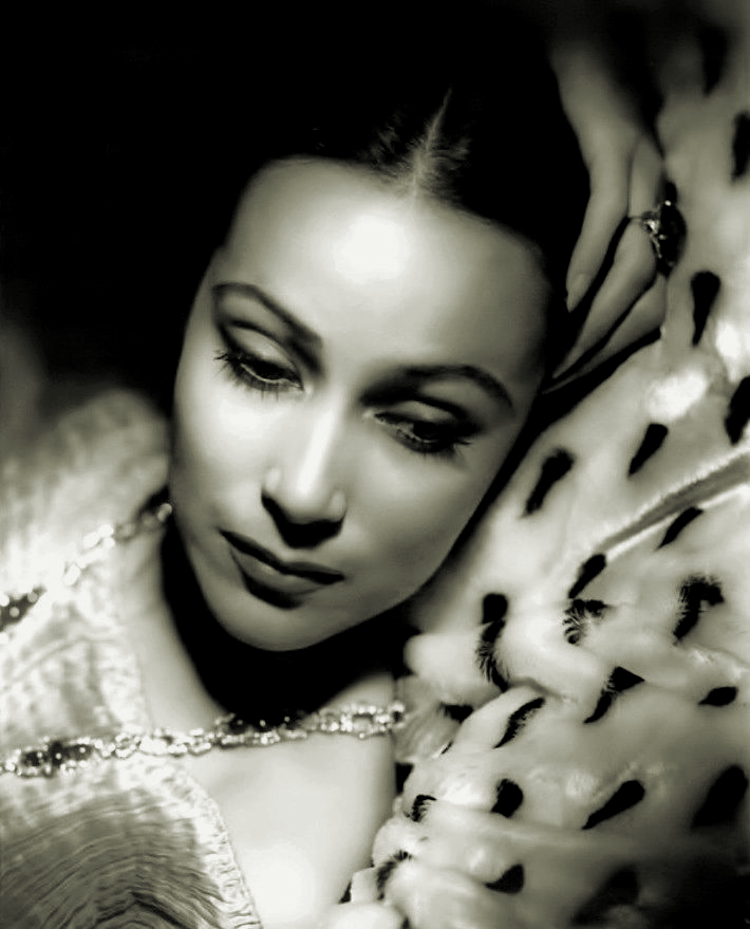
Dolores del Rio, photograph by George Hurrell, circa 1938-40.
Same as above.

He remains best known for his finely pleated Delphos dress and the similar, less common Peplos. The exact method of pleating was a closely guarded secret involving heat, pressure, and ceramic rods, and has never been successfully replicated. On both types of dresses, Murano glass beads are strung on a silk cord attached at the edge of each side seam. The beads serve a functional purpose as well as being decorative, as they weigh down the lightweight silk of the garment, subtly enhancing and flattering the human shape beneath.

Model, circa 1920.
Same as above.
Elsie McNeill Lee, Countess Gozzi, circa 1940.
Same as above. Countess Gozzi, a wealthy American businesswoman, took over the Fortuny Company at Fortuny's death in 1949.

The Delphos was a deliberate reference to the chiton of ancient Greece; designed to be worn with little in the way of undergarments, it was originally intended as a tea gown or as similarly informal clothing to be worn in the privacy of the home, but would eventually be seen more as evening wear. The gowns were often made with slight variations in length and shape. Some have sleeves, others have none. They were usually accessorized with block-printed ribbons and sashes, and were worn with all manner of silk and velvet scarves and cloaks, garments which utilized the rich and varied textiles Fortuny was also rightly famous for; an important inventor as well as designer, he also manufactured the pigments and dyes he used for his fabrics.

Peggy Guggenheim, Venice, 1975.
Charlotte, Lady Bonham Carter (in a Delphos she bought in Venice in 1922), photograph by David Montgomery, circa 1970s-80s.


The method of storage for Fortuny's pleated dresses was almost as revolutionary as the garment itself; twisted and coiled and popped into what resembled a small hatbox. At any rate, it was a method that worked remarkably well to preserve the artist's beautiful creations - and continues to do so.

Mrs. William Wetmore, photograph by Lusha Nelson. Originally published in Vogue, 15 December 1935.
Mrs. Selma Schubart (the sister of the photographer), photographed by Alfred Stieglitz, 1907.
Mai-Mai Sze, photograph by George Platt Lynes, 1934.