|
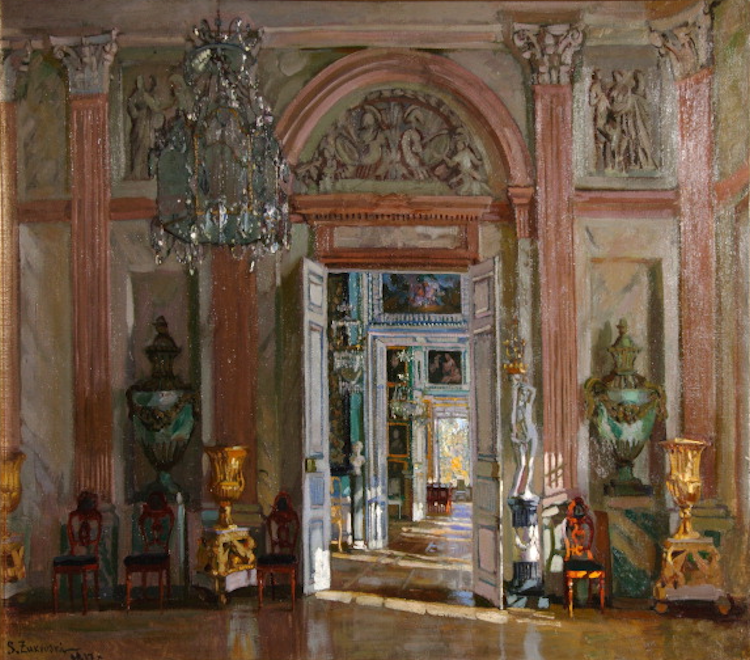
| Palazzo Contarini-Polignac, Venice, 2018. |
 |
| House in Fribourg, Switzerland, 2010. |
 |
| Passage in Newbridge House, Ireland, 2014. |
I suppose it's bad form to start off an appreciation of one artist by disparaging another. Especially when the latter greatly influenced the former, who now "follows in his footsteps." When the two even knew each other. But I've just never liked that other artist's work.
 |
| Hatchlands Park, library, 2017. |
 |
| House in Fribourg, Switzerland, 2011. |
 |
| Paris, 2016. |
Alexandre Serebriakoff (7 September 1907, Neskoutchnoye, in modern day Ukraine - 10 January 1995, Paris), was the twentieth century's most celebrated painter of interiors. He was born into a family of famous artists - his mother was Zinaïda Serebriakova; I don't like her work, either! - but, as a child, along with other family members, was forced to leave post-revolution Russia. As an adult, his starry clientele was drawn from the highest of Parisian and London high society, and the wealthy on both sides of the Atlantic. He portrayed the interiors of châteaux, mansions, luxe apartments, inhabited by the likes of the Duke and Duchess of Windsor, Mr. and Mrs. Arturo Lopez-Willshaw, baron Alexis de Redé, Charles de Beistegui, the Rothschilds.
 |
| Palazzo Contarini-Polignac, Venice, 2021. |
 |
| Chinese room in a French country house, 2011. |
 |
| Interior of a tower in Piedmont, 2013. |
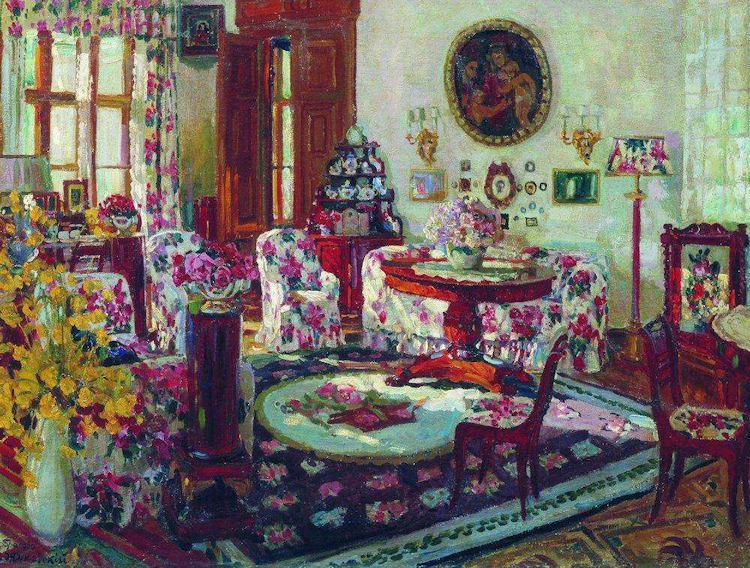
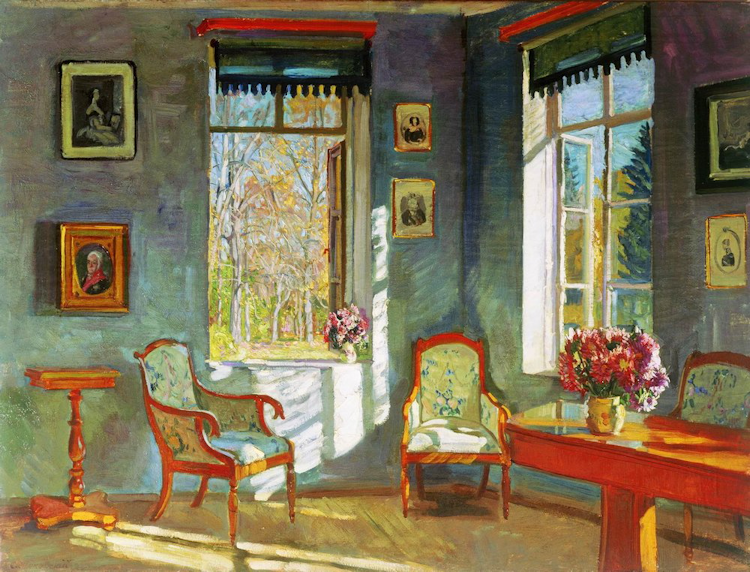
Much of his work is charming. But I can't help comparing his oeuvre with those who worked along similar lines, and in the country of his birth, pre-revolutionary Russia. I think foremost of Luigi Premazzi, Eduard Hau, and others who, during the nineteenth century, precisely portrayed the interiors of Romanov and aristocratic palaces and mansions. (In the meantime providing a quite priceless record, which proved indispensable after the devastation that would be dealt in following century.) They were able to achieve a quite remarkable exactitude, while still filling their watercolor portraits with atmospheric and realistic lighting, and a palpable feeling of life going on in the rooms portrayed. But I also think of other artists, more evocative in their work than exact. Painters like Stanislav Zhukovsky, whose paintings are quite loosely described, but still capture that same sense of grounded truth.
 |
| Paris, 2007. |
 |
| Two views of the same room. |
 |
| Based on the architecture and wall color, this is surely related to the two views of the room above. |
But all of the above succeed where I feel Serebriakoff too often failed. His lighting is nearly always generalized, flat. There is no sunlight streaming in, no feeling of LIFE in his work. But the thing that most disturbs me is how often his perspective is off, scale is confused. And the way, especially, furniture so frequently does not sit correctly on the visual plane; a chair will be seen to be leaning, its cushion looking ready to slide off onto the floor. Some apologists might make the argument that these "glitches" are whimsical, that it was a stylistic choice. But I really think he just got it wrong. And therefore I really don't think he earns the praise heaped upon his work, his status as a twentieth century "master."
.png) |
| 2011. Two more views of the house in Fribourg, Switzerland, seen above in the first and second sections. |
 |
| 2006. |
 |
| Two rooms in a French country house, 2007. |
On the other hand... I definitely feel that this contemporary artist working in interiors, Diego de Mora, is a worthy successor to Premazzi, Hau, et al. I've been able to find NOTHING about this artist other than what little he includes on his website -
Views of Interiors. - and on his
Instagram page, but I admire his work tremendously.
From his website:
Young Diego de Mora met Serebriakoff when he was a very old man, in his studio in Paris, and was soon producing his own paintings of interiors with commissions ranging from the Royal Palace in Madrid to a ski club in St Moritz, from an Ottoman house on the Bosphorus to a Georgian house on Green Park, from a harness room in Extremadura to an Art Déco bathroom in Paris.
 |
| Apsley House, Striped Room, 2019. |
 |
| Château d’Ussé, 2010. |
 |
| Palazzo Contarini-Polignac, Venice, 2021. |
*
And then... late in the game, I discovered that the artist is properly and more fully addressed as Diego de Mora-Figueroa Iturbe, 8th Marqués de Saavedra (13 November 1967, Cádiz). Married to Alejandra María de Salinas Harnden in 2002, they had a son and daughter together before divorcing in 2014.


.png)