
 |
| The first portrait by Mijtens, taken in 1623, when the then Earl of Arran was seventeen. |
James Hamilton, 1st Duke of Hamilton (19 June 1606, Hamilton Palace, Lanarkshire, Scotland – 9 March 1649, Old Palace Yard, Palace of Westminster, London), Scottish nobleman, controversial political leader, and unsuccessful military commander.

Born the son of James, Marquess of Hamilton and the Lady Ann Cunningham, following the death of his great-uncle James, Earl of Arran in 1609, the three-year-old was henceforth styled Earl of Arran. At the age of eleven he went with his family to live at court in London. At fifteen he was married off to a nine-year-old relative of the King's favourite, the Duke of Buckingham. (The union was only brought about to satisfy Buckingham's political aims, and it appears the young Hamilton was unhappy with the marriage. The couple nevertheless produced six children - of which only two survived childhood, both girls.)

His father died in 1625, and three weeks later so did King James VI. The new marquess was only nineteen, but inherited all his father's titles and privileges; at the coronation of the new king, Charles I, Hamilton bore the Sword of State at Westminster Abbey. He soon was made a Gentleman of the Bedchamber, Knight of the Garter, a Privy Councillor in both England and Scotland, and Master of the Horse, a post he retained until 1644.
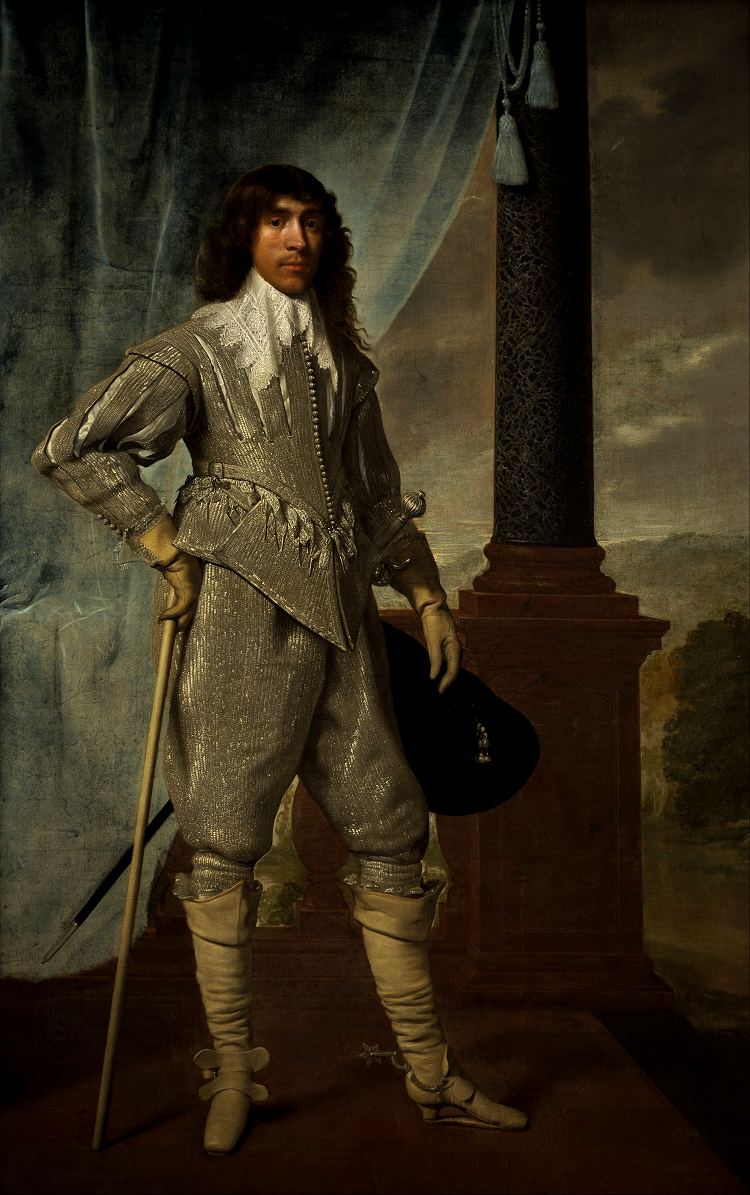 |
| The second portrait by Mijtens, painted in 1629, when the now-Marquess-later-Duke of Hamilton was twenty-three. |
In 1631, despite a lack of military training, he led an army of English and Scots to Germany to fight with the Swedish in the Thirty Years' War. Though Hamilton had to be propped up by more experienced officers, it appears he was no coward and was committed to his task. But his troops were never fully organized or well deployed and after disagreements with the Swedish king, he and many of his officers were discharged and returned to England.

On his return, Charles I appointed Hamilton his chief adviser in Scottish affairs. Six years later, with revolt breaking out in Scotland, Charles made him commissioner in an effort at appeasement, Hamilton being Scottish. There followed several years of political wrangling and intrigue, with Hamilton being attacked from both sides and his own sympathies fluctuating. Egotistical and probably not overly bright, he was also no stranger to intrigue, himself; toward the end of this period he was even accused of treason against the King by another Scottish nobleman.

He still held Charles' favor and confidence, though, and was further ennobled in 1643. The Marquessate of Hamilton was raised to that of a dukedom, and he was awarded the Marquessate of Clydesdale, the Earldom of Cambridge, the Baronies of Aven and Innerdale. In addition, he was also re-granted the Earldom of Arran. Though by this time the English Civil War had already broken out, Hamilton was still trying to control the Scottish political situation, foolishly antagonizing other powerful nobleman and even appearing to work against the interests of the king. Charles had finally had enough by the the end of 1643 and Hamilton was arrested. He spent three years in various places of confinement, but was liberated by Parliamentary troops in April of 1646.

Now returned to Charles' favor, the king conferred on Hamilton the heritable office of Keeper of Holyroodhouse. Then, after the King was delivered up to Parliamentary commissioners, Hamilton was able to temporarily gain authority in Scotland and, in July of 1648, he led a large army into England in defense of the King. He showed a complete inability as a military commander and, even with vastly superior numbers, was quickly defeated by Cromwell and his forces. He, himself, was taken prisoner at the end of August. His trial for treason began in February of the following year - seven days after the execution of the King. He was condemned on March 6 and beheaded three days later at the Old Palace Yard, Westminster. (A setting that had witnessed the executions of Sir Walter Raleigh and Guy Fawkes, among others.) He was forty-two.


