L a - b e a u t é - s a u v e r a - l e - m o n d e ~ D o s t o ï e v s k i

L a - b e a u t é - s a u v e r a - l e - m o n d e  ~  D o s t o ï e v s k i


Showing posts with label Grand Duchess Olga Nikolaevna. Show all posts

Friday, July 31, 2020

Bright day and gentle twilight - two images of Grand Duchess Olga Nikolaevna, Queen of Württemberg


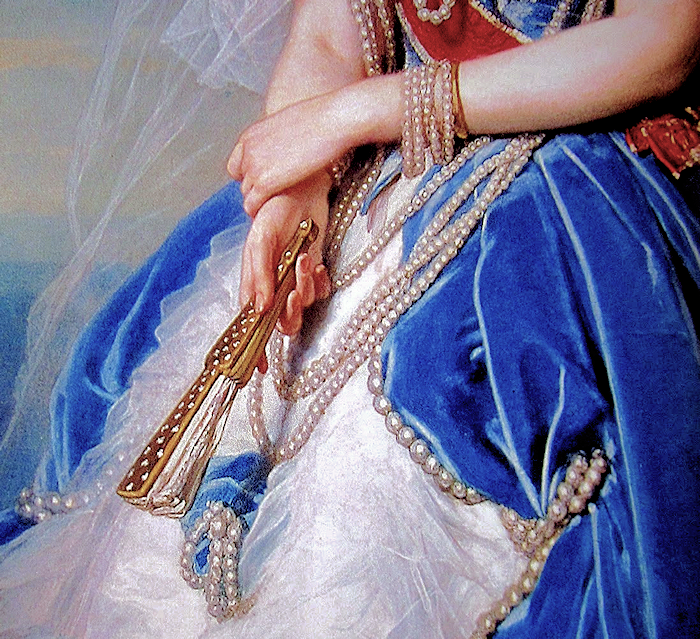
Portrait by Franz Xaver Winterhalter, 1856.

Grand Duchess Olga Nikolaevna of Russia (11 September 1822, St. Petersburg – 30 October 1892, Friedrichshafen, Württemberg), third child and second daughter of Tsar Nicholas I, sister of Tsar Alexander II, and later Queen consort of Württemberg. Raised within a close family of seven brothers and sisters, she grew up to be attractive, intelligent and cultured - she spoke several languages, and was fond of music and painting - and was considered one of the most eligible princesses in Europe. She eventually married Karl, Crown Prince of Württemberg - the royal houses of Romanov and Württemberg had intermarried several times before - and the lavish wedding was held at Peterhof on 13 July 1846, with the couple returning to Württemberg two months later. The marriage seems to have been congenial, but they would have no children, probably because of Karl's homosexuality; the crown prince and later king would become the object of scandal several times due to his affairs with various men. In 1863, a year before the couple ascended the throne, they adopted the nine-year old younger daughter of Olga's bother Grand Duke Konstantin Nikolaevich. Grand Duchess Vera Konstantinovna was a very troubled child, prone to violent fits of anger, and her parents had eventually been quite unable to manage her. But in spite of the difficulties, Olga was fully committed to the care of her niece, and for Vera, her aunt eventually assumed the place of her mother. The next several years were very difficult, but with the royal couple's perseverance, Vera grew into a cultured and intellectual - and stable, if unusual - adult, married and had children of her own. As crown princess and queen, Olga dedicated her public and private life to social causes. She was especially interested in the education of girls, also supporting wounded veterans and the handicapped. Various charitable organizations and hospitals were opened in her name. She was also keenly interested in agriculture and the natural sciences, and was an amateur mineralogist and collector. Karl died in 1891, after forty-five years of marriage, and she died a year later at the age of seventy.

Stuttgart, circa 1892. A widow, in the last year of her life, said to be accompanied here by her sixteen-year old adoptive granddaughters, Duchesses Olga and Elsa.
The twins, Olga and Elsa - if this is indeed them - were the daughters of Grand Duchess Vera Konstantinovna and her husband Duke Eugen of Württemberg.


Friday, January 10, 2020

From the architect's hand - watercolors of the Livadia Palace by Nikolai Krasnov, before 1917


*

The Livadia estate became a summer residence of the Russian imperial family in the 1860s, when architect Ippolito Monighetti built a large palace, a small palace, and a church there. In 1894, Alexander III died in the small palace, and his successor later decided to replace the large palace with a new construction. (The small palace was destroyed by retreating Germans during World War II.) The architect Krasnov began work on designs beginning in 1909, and construction on a new white limestone palace began in April 1910. After seventeen months, and at a cost of about four million rubles, the palace was inaugurated on 11 September 1911. The Imperial family was thrilled with their new home and remained in residence during the fall of 1911; Grand Duchess Olga Nikolaevna celebrated her sixteenth birthday there with a grand ball held in her honor. They stayed again during the spring of 1912, the fall of 1913, and the spring of 1914. History - war and revolution - precluded any other visits. After the Tsar's abdication and imprisonment, there was some talk of exiling the imperial family to the Livadia estate, but that was not to be their well-known fate. The palace was later used as, variously, a "rest home for the workers", a tuberculosis sanitarium, and a mental institution. Famously, it was the site of the Yalta Conference held in 1945. Today, the 116 room palace - in good condition, but almost entirely bereft of its original furnishings - houses a museum devoted to both the imperial family and to the Yalta Conference.

Pre-Revolution photographs.

*

Nikolai Petrovich Krasnov (23 November 1864, Khonyátino village, now Stupinsky District, Moscow Oblast - 8 December 1939, Belgrade), Russian architect and painter. He began attending the Moscow School of Painting, Sculpture and Architecture at the age of twelve and later became the protegé of Sergei Tretyakov. In 1887, at the age of only twenty-three, he took up the post of Chief Architect in Yalta, a position he held with great success for twelve years. Even before his tenure ended there, he had taken private commissions from members of the Romanov family and the aristocracy; his largest and most famous design was for the new Livadia Palace for Nicholas II, completed in 1911. After the Revolution, he eventually settled in Belgrade, where he continued his work, designing many prestigious buildings, and where he is still revered.

*

These images were sourced from the website of author and publisher Paul Gilbert.


Sunday, January 15, 2017

Great ladies of the north - Winterhalter and the Romanov women


Grand Duchess Maria Nikolaevna, daughter of Nicholas I, sister of Alexander II, 1857.
 Empress Maria Alexandrovna, née Princess Marie of Hessen und bei Rhein, wife of Alexander II, 1857.
The Dowager Empress Alexandra Feodorovna, née Princess Charlotte of Prussia, wife of Nicholas I, mother of Alexander II, 1856.
Vintage photograph of the study of Alexander II in the Winter Palace, the portraits of his wife and mother seen above hang on the wall.
Grand Duchess Anna Feodorovna, née Princess Juliane of Saxe-Coburg-Saalfeld, the former wife of Grand Duke Konstantin Pavlovich, 1848.
Grand Duchess Alexandra Iosifovna, née Princess of Saxe-Altenburg, wife of Grand Duke Konstantin Nikolaevich, 1859.
Grand Duchess Elena Pavlovna, née Princess Charlotte of Württemberg, widow of Grand Duke Mikhail Pavlovich, 1862.
Grand Duchess Olga Nikolaevna, Crown Princess of Württemberg, daughter of Nicholas I, sister of Alexander II, 1856.
Winterhalter's sketch of/for the above portrait.
The Grand Duchess, now Queen Olga of Württemberg, 1869.
Queen Olga of Württemberg, state portrait, 1865.
 Grand Duchess Maria Alexandrovna, daughter of Alexander II, 1871.

***

Lithograph of Winterhalter's portrait of Grand Duchess Olga Feodorovna, née Cäcilie Auguste,
Princess and Margravine of Baden, wife of Grand Duke Mikhail Nikolaevich, 1857.
The original painting has not been seen since World War II and is presumed lost.
Vintage photograph of the original portrait hanging in one of the rooms of Empress Maria Alexandrovna in the Gatchina Palace.
A lithograph of another portrait of Grand Duchess Olga Nikolaevna, at one time hanging in her mother's
bedroom in the Winter Palace, and also last seen at Gatchina and believed lost, circa 1856.
Vintage photograph of the Empress Maria Alexandrovna's dressing room in the Winter Palace. The 1871 portrait of her daughter hangs behind her
desk, center, while the portrait on the right looks to be another Winterhalter portrait of the Grand Duchess Olga Nikolaevna, location unknown.
This would appear to be a very poor copy of the painting seen above right.


Saturday, August 1, 2015

Teenage dress-up - the daughters of Nicholas II, circa 1916


Maria, Tatiana, Olga, and Anastasia.
Anastasia.
Maria.
Tatiana.
Olga.

***

Four teenage girls. Innocent to a degree unusual, even for the time. In a room they share, family photographs all around, books and papers, a bust of their father on the table. Just a happy evening playing dress-up. But is there something else about the poorly focused photographs, taken without sufficient light, bearing the scratches and fading of time? Are they more than casual snapshots; is there something other to the images? Or is it merely our inability to overlook their deaths, only two years later - shot and bayoneted in a basement - and see these as just five photographs of loving sisters at play?