L a - b e a u t é - s a u v e r a - l e - m o n d e ~ D o s t o ï e v s k i

L a - b e a u t é - s a u v e r a - l e - m o n d e  ~  D o s t o ï e v s k i


Showing posts with label Heinrich von Angeli. Show all posts

Friday, October 4, 2024

The Marquess and Marchioness of Lorne, by Heinrich von Angeli, 1875


In 1871, Princess Louise (Louisa Caroline Alberta; 18 March 1848, London - 3 December 1939. London), the sixth child and fourth daughter of Queen Victoria and Prince Albert, married John Campbell (John George Edward Henry Douglas Sutherland Campbell; 6 August 1845, London - 2 May 1914, Cowes), the Marquess of Lorne and, later, the 9th Duke of Argyll.


This was the first time since 1515 that a legitimate daughter of the sovereign had married a subject of the Crown. The pair shared a common love of the arts - Louise was a talented sculptor - but the marriage was childless and unhappy, and they spent much time apart. Lorne formed close friendships with men who were known to be homosexual or bisexual, and there has been conjecture that he may have been as well. Louise was an energetic supporter of the arts, higher education, and of the feminist cause.


*


Lorne was Governor General of Canada from 1878 to 1883, and the couple's tenure there was a success. On their return to England, Queen Victoria allocated them apartments in Kensington Palace where they would live for the remainder of their lives. Lorne succeeded to the title of Duke of Argyll in 1900. He suffered from dementia in his last years and Louise nursed him devotedly, the couple becoming closer than they had been before. Following his death in 1914 at the age of sixty-eight, Louise had a nervous breakdown, writing to a friend shortly afterwards: "My loneliness without the Duke is quite terrible. I wonder what he does now!" The Princess lived on for another twenty-five years, passing away at the age of ninety-one.
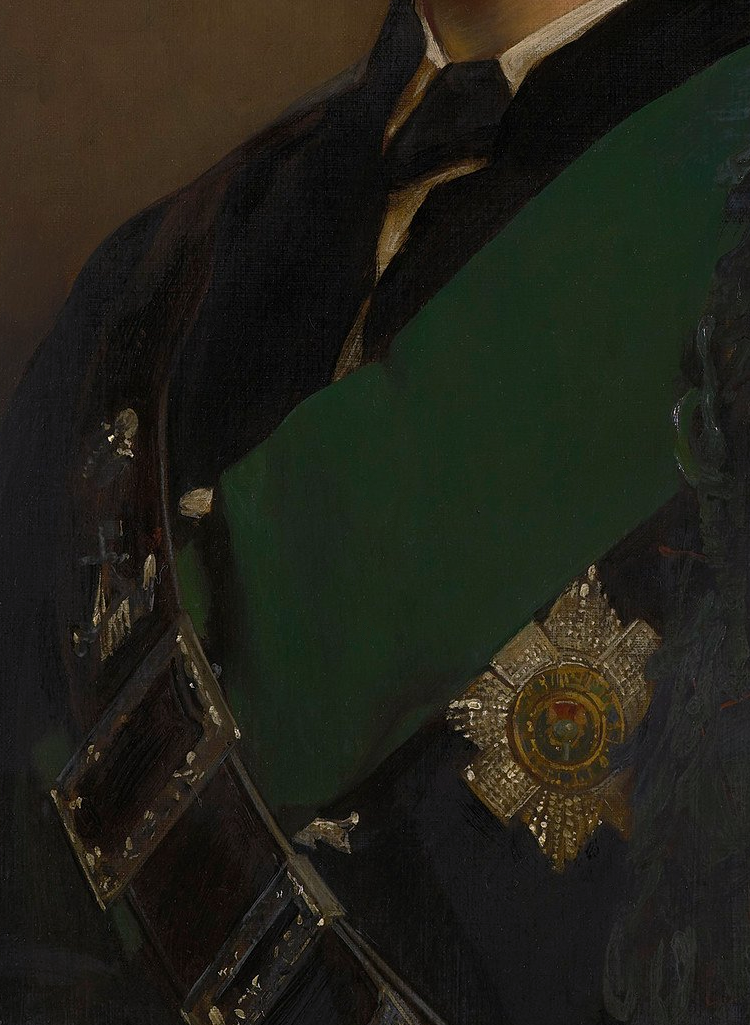
Lorne wears Highland dress in his portrait, along with the riband and star of the Order of the Thistle.

The portraits were commissioned by Queen Victoria who, on their delivery, was delighted with the results. She wrote to her eldest daughter, Victoria, Crown Princess of Prussia: "I have now got Louise's here and I own it is most exquisite. It is wonderfully, marvelously like, and there is a depth of feeling in the eye and mouth which are Louise herself and (as with all Angeli's pictures) you can look at it quite close by as though it were enamel - which is really what the surface is like…Lorne's is very good too and equally characteristic." 


*

Von Angeli was paid £150 for each of the portraits, the pair of which were placed in the Queen's drawing-room at Osborne House.


Sunday, September 15, 2024

Vingt-six dames, trois filles - female portraits

 
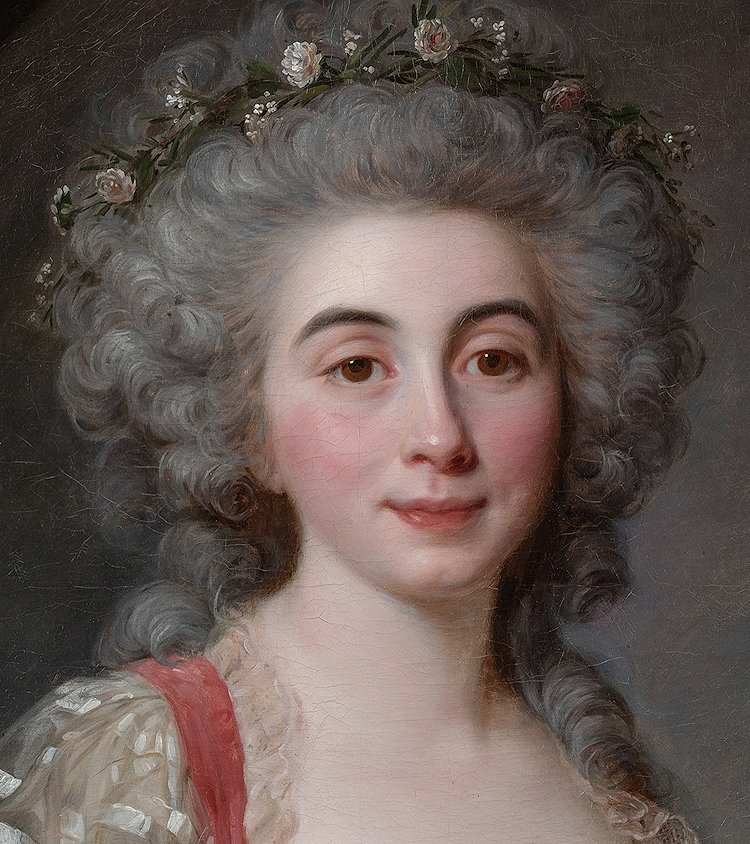
Caroline Lefebvre, vicomtesse de Fontanges, by Antoine Vestier, 1787.
Isabella of Portugal, workshop of Rogier van der Weyden, circa 1450.
Louise de Kérouaille, Duchess of Portsmouth, by Philippe Vignon, circa 1673.
Duchess Louise Charlotte of Mecklenburg-Schwerin, Hereditary Princess of Saxe-Gotha-Altenburg, unknown miniaturist, 1799.
Victoria, Princess Royal, Crown Princess Frederick William of Prussia, by Joseph Hartmann, 1858.
Portrait of a girl aged six holding a book of music, English School,1589.
Mrs. Mary Robinson, by Sir Joshua Reynolds, circa 1783-84.
Study for the above.
Princess Alexandra of Edinburgh, Princess of Hohenlohe-Langenburg, by Heinrich von Angeli, 1898.
Portrait of a Lady, traditionally identified as Louise de Lorraine, by Jean de Court (formerly attributed to François Clouet), circa 1570-79.
Matilde Juva Branca, by Francesco Hayez, 1851.
Selina, Lady Skipwith, by Joshua Reynolds, 1787.
Marie Dorothée Renouard, by Johann Friedrich August Tischbein, 1793.
Repòs, by Marisa Roësset Velasco, 1928.
Madame Hurault de Sorbée, née Elisabeth Kastner (called Lisbeth), by Alexandre-François Caminade, circa 1812.
 Princess Charlotte of Belgium, Archduchess of Austria, later Empress Carlota of Mexico, by Jean-François Portaels, 1857.
Her toilette is an interpretation of the regional costume of Brianza; her husband Maximilian was viceroy of the Kingdom of Lombardy-Venetia from 1857 to 1859.
Queen Elizabeth I, attributed to George Gower, possibly circa 1567.
 The actress Rachel (née Elisa-Félix) as Catherine the Great in Eugène Scribe's La Czarine, by Edmond-Aimé-Florentin Geffroy, 1855.
Princess Karoline Friederike Wilhelmine of Hesse-Kassel, by Friedrich Bury, 1820.
Elisabeth Alexandrine Maria Berthier, Princess of Wagram, by Franz Xaver Winterhalter, circa 1870.
Flora, a portrait of either Vittoria della Rovere from 1639, or of Isabella d'Este from circa 1650-60, by Justus Sustermans.
Tommasina Balbi Cambiaso, by Anton Raphael Mengs, 1771.
Wilhelmine Begas, the artist's wife, by Carl Joseph Begas, 1828.
A young princess (probably Dorothea of Denmark), by Jan Gossaert, circa 1530-32.
Portrait of a lady in green turban, by Aimée Brune-Pagès, 1834.
Anna Maria Vasa, daughter of King Sigismund III of Poland, by Martin Kober, 1596. Three years old in the painting, she died at seven.
Marie-Anne-Éléonore-Félicité le Planquois, by Alexander Roslin, circa 1769.
Creole in a Red Turban, by Jacques Guillaume Lucien Amans, circa 1840.
Virginie Lupin, the wife of prefect Achille François Bégé, by Louis Hersent, circa 1825-30.
Maria Leopoldine von Habsburg-Tirol, Holy Roman Empress, by Justus Sustermans, circa 1647-50.


Sunday, April 30, 2023

Baby brother - Archduke Ludwig Viktor of Austria


Archduke Ludwig Viktor Joseph Anton of Austria (15 May 1842, Vienna – 18 January 1919, Schloss Klessheim), the youngest child of Archduke Franz Karl of Austria and his wife Princess Sophie of Bavaria; his elder siblings were Emperor Franz Joseph I of Austria, Emperor Maximilian I of Mexico, and Archduke Karl Ludwig. Bearing the nicknames "Luziwuzi" and "Bubi" within the family circle, he was spoiled and indulged, and came to be known for his wit and sharp tongue. His open homosexuality was surprisingly well tolerated by his family, though kept a secret to the outside world, thanks to the strict censorship employed during his brother the emperor's rule. Like all Habsburg males, he was expected to pursue a military career but, unlike his brothers, he took no interest in politics, preferring to spent his time in social activities and art collecting. 

Since the irises of light colored eyes often seemed to disappear in early photography, they were often, as here, drawn back onto the print.

In spite of his quite obvious sexual proclivities, his mother tried to arrange a marriage for him with his first cousin Duchess Sophie Charlotte in Bavaria, youngest sister of Empress Elisabeth, but he declined. (Duchess Sophie would later endure a broken engagement with another homosexual cousin, Ludwig II of Bavaria.) In 1863, his brother Maximilian, soon to embark on his disastrous Mexican venture, tried to persuade Ludwig Viktor to marry Isabel, daughter and heir presumptive of Emperor Pedro II of Brazil, arguing that "such a marriage might found yet another Habsburg dynasty in Latin America." This union he also declined. 

With his immediate family, 1860.
Back row: Emperor Franz Joseph I, Archduke Maximilian and his wife Charlotte of Belgium, Archduke Ludwig Viktor, Archduke Karl Ludwig.
Front row: Empress Elisabeth with her children Rudolf and Gisela, Archduchess Sophie and her husband Archduke Franz Karl. 
The brothers: Archduke Karl Ludwig, Emperor Franz Joseph I, Archduke Maximilian, Archduke Ludwig Viktor.
The brothers: Archduke Ludwig Viktor, Emperor Franz Joseph I, Archduke Karl Ludwig, Archduke Maximilian.


That same year, at the age of twenty-one, Ludwig Viktor commissioned architect Heinrich von Ferstel to design and build a city palace. The Palais Erzherzog Ludwig Viktor, the first building to be erected on the new Schwarzenbergplatz, and now a subsidiary house of the Burgtheater, was completed three years later. Within its walls, the archduke began to fully indulge his great passion for art collecting and lavish entertaining. Photographs from this period exist showing him in women's clothes. I haven't been able to determine whether he was a regular "crossdresser", as he is often rather derisively described, or that he merely wanted a visual record of having dressed in that manner for a costume party or amateur theatrical. 

In the same dress and setting as the image above. The others are unidentified.
A double exposure, the archduke wearing both male and female attire.

Also in 1866, his brother the emperor ceded to him Schloss Klessheim, a Baroque palace four kilometers to the west of Salzburg; originally built as a summer palace, between 1880 and 1882 it was enlarged by the archduke's same architect, von Ferstel. He was popular in Salzburg and, as a member of the imperial family, he became one of the leaders of society, assuming the patronage of the Salzburg Society of Art, known for his philanthropy and his splendid parties. Apparently, however, officers stationed in Salzburg were soon forbidden to accept his invitations, his "inclinations" being the whispered explanation.


The fairly free hand the archduke was given regarding his personal life came to an end in 1904. (Or 1906, or some other date; the facts of Ludwig Viktor's life are hard to come by, the results often contradictory.) A frequent and familiar visitor to Vienna's Central Bathhouse - the Central-Bad Wien - where he was know to make assignations, often proffering gifts to likely young men, an incident occurred there that couldn't be entirely hushed up: he made unwanted advances to another man or a bath attendant resulting in the archduke being slapped or otherwise roughed up. The scandal leaked out, and his brother the emperor, remarkably tolerant up to this point, banished him from the capital, ordering him to retire to his Salzburg estate.

In addition to the retouching of his protuberant left ear, the medal on his chest has been crudely drawn on, probably on the negative.

He lived out his last fifteen years at Schloss Klessheim, surrounded by his vast collection of art, silver, jewelry, furniture, porcelain, etc. In 1915, due to "mental incapacity" - perhaps some form of dementia? - he was put under the care of a conservator. Only months after the end of WWI and the fall of the Austro-Hungarian empire, he died at the age of seventy-six, the last of his immediate family, on the same day as the commencement of the Paris Peace Conference in Versailles. As per his wishes, he was buried in Salzburg's Siezenheim cemetery rather than the Imperial Crypt in Vienna. The Schloss Klessheim was sold the same year by the Habsburg family, and his enormous collection of art and objects took nearly a full year to auction, in 1921-22.

Portrait by Heinrich von Angeli, 1874.