L a - b e a u t é - s a u v e r a - l e - m o n d e ~ D o s t o ï e v s k i

L a - b e a u t é - s a u v e r a - l e - m o n d e  ~  D o s t o ï e v s k i


Showing posts with label Benjamin-Constant. Show all posts

Sunday, October 9, 2022

Les Russes au soleil à la villa des Mimosas - Marina Sergeevna von Derviz by Benjamin-Constant, circa 1899


Now in the collection of the Musée des Beaux-Arts Jules Chéret in Nice - itself the former mansion built by the Russian Princess Elizaveta Vasilievna Kochubey in 1878 - it seems reasonable to assume that this portrait of madame von Derviz was originally installed in the von Derviz' Villa des Mimosas; its frame even looks as though it could be a surviving fragment of paneling which the painting had been let into, rather than a stand alone picture frame.


The von Derviz (or von Derwies, both transliterations from the russification of the German von der Wiese) family was of German extraction; originally from Hamburg, its members had been registered as bourgeois as far back as the fifteenth century. But by the eighteenth century they were resident in Russia and ennobled.* The most celebrated member of the family was Pavel Grigorievitch von Derviz (1826-1881), who made a great fortune as a  railroad magnate and financier. With lavish mansions in St. Petersburg and Moscow, estates in the Russian countryside, a château in Nice, he and his family were among the famous Russian "winterers" on the Côte d'Azur. 

The portrait - photographed before the top was concealed by its present frame - was reproduced in Figaro-Salon, 30th April 1899. 
Figaro-Salon was an annual review of French art, an off-shoot of Le Figaro, published 1881-1901.

By the second half of the nineteenth century, wealthy and/or aristocratic Russians - even members of the imperial family - who couldn't bear the cold of the winter months in their native land, frequently decamped to the perpetually warm south of France. Greatly appreciated by the locals for their extravagant lifestyles and profligate spending, they built well-appointed villas in Cannes, Nice, Menton, and gambled recklessly at Monte Carlo. 

A second Benjamin-Constant portrait said to be of Marina von Derviz, and also dated circa 1899. It entered the Hermitage collection in 1923 - obviously
after the family's Russian possessions had been nationalized - transferred from the Petrograd Art Treasures Department. (Since, to me, the sitter doesn't much
resemble that in the portrait above, either one or both portraits are a poor likeness, or this is someone else, perhaps a different member of the family.)

Pavel Grigorievitch von Derviz' elder surviving son, Sergei Pavlovich (1863 - 7 November 1943), and his second wife, Marina Sergeevna, née Schoenig (1875 - 1947), had a home in the Californie neighborhood of Cannes. The Villa des Mimosas was designed by Louis Hourlier and constructed in 1878. Of irregular plan with a steeply sloping roof and tall chimney stacks, the exterior surfaces were of a mixed design incorporating stone, brick, tile, half-timbering, and smooth plaster. I've been unable to discover when the von Derviz' residency ended, but the villa was sold to the Norwegian engineer and industrial entrepreneur Sam Eyde in the late 1920s.


Though the exterior décor has been much simplified, and the wooden balconies, oriel window, and the neo-Gothic porch to the north have disappeared, the building survives as a private residence at 10-12 Avenue de la Californie, the von Derviz coat of arms still prominently decorating the garden façade.


Not too far away, in the cimetière du Grand Jas, is the funeral chapel and tomb of Sergei and Marina von Derviz, its stylized Russian design the work of Dmitri Semenovich Stelletsky.


* Although addressed as baron and baronne in France, they may or may not have actually rated that title in their native Russia.

*

Jean-Joseph Benjamin-Constant (also known as Benjamin-Constant, né Jean-Joseph Constant;10 June 1845, Paris - 26 May 1902, Paris), French painter and etcher best known for his Oriental subjects and portraits. He studied at the Ecole des Beaux-Arts in Toulouse, where he was a pupil of Alexandre Cabanel. A journey to Morocco in 1872 strongly influenced his early artistic development and the choice of Orientalist subjects which brought him his early success. After the 1880s, he devoted himself more to mural decorations and to portraits. With the latter, especially in England, he was a favorite of the aristocracy. He was also a respected writer, contributing a number of studies on contemporary French painters, and taught at the Académie Julian. He died at the age of fifty-six from the aftereffects of the flu.


Sunday, September 25, 2022

The power in turning away - portraits of the female profile

 
Eugénie Ritter, by Benjamin-Constant, 1903. 
Une femme de chez nous au cheveux crépus (A local woman with curly hair), by Takou D’Assié, circa 2020.
Portrait of a Lady in Red, Florentine School, circa 1460-70.
Portrait of Woman Turned, by Coolidge Ozaki, circa 1942-45.
The Orchid, by Fujishima Takeji, 1926.
Woman or goddess, nicknamed “La Parisienne”, from the western wing of the palace at Knossos, circa 1350 BCE.
Portrait of a Woman in Profile, Turned to the Left, by William Sommer, 1890.
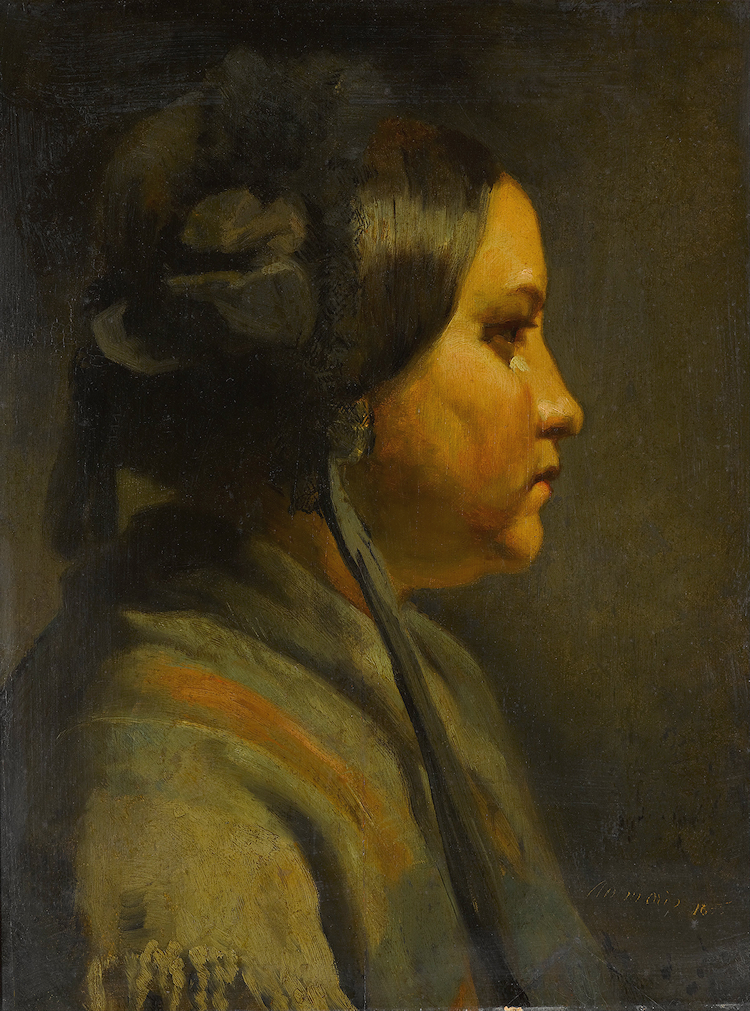
Study of the Head of a Young Woman in Profile, by Matthijs Maris, 1855.
Medallion, double portrait of the artist and her lover Nesta Obermer, also called the "YouWe" painting, by Gluck, 1936.
Profile Portrait of a Lady, American School, circa 1835-40.
Tomb wall depicting Queen Nefertari, consort of Rameses II, circa 1298-1235 BCE.
Portrait Study in Profile, by Marion L. Pooke, circa 1911.
Head in Profile, by Emil Nolde, 1919.
Profilo di donna, by Charles Lefèbvre, nineteenth century.
Profile Portrait of a Woman to the Left, unknown pastellist, circa 1800-20.
Supposed posthumous portrait of Cleopatra VII of Egypt, from Herculaneum, circa first century AD.
Profile of an Italian Woman by Mary Cassatt, 1873.
Portrait of a Young Woman, by Sofonisba Anguissola, circa 1580s.
A Young Woman, by Friedrich von Amerling, 1834.
Noia Tangerina (Girl from Tangiers), by Josep Tapiró i Baró, circa 1900-10.
Portrait of a Young Girl, by Philip Wilson Steer, 1932.
Classical Head in Profile, by William Hoare, circa second half of the eighteenth century.
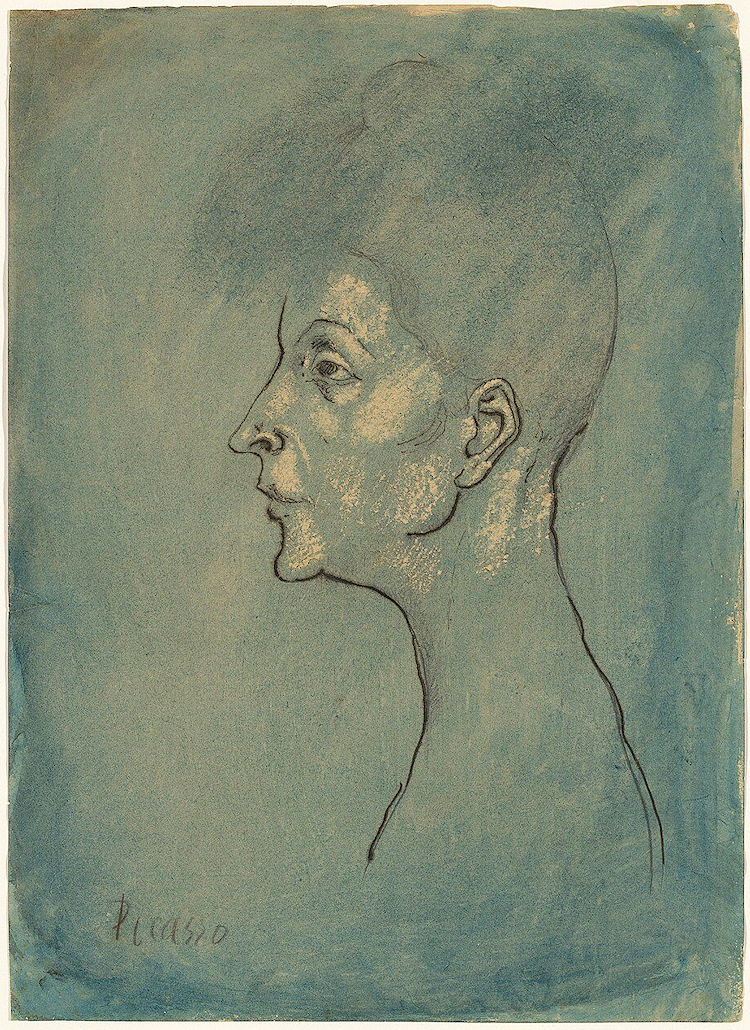
Profil de femme au chignon (Profile of a woman with a chignon), by Pablo Picasso, 1904.
Nanna, Profile to Right, by Anselm Feuerbach, 1864.
Profile of a Blonde Woman on a Blue Background, by Francis Picabia, circa 1941-1942.
Portrait of Lady Vivien, by Konstantin Makovsky, 1900.
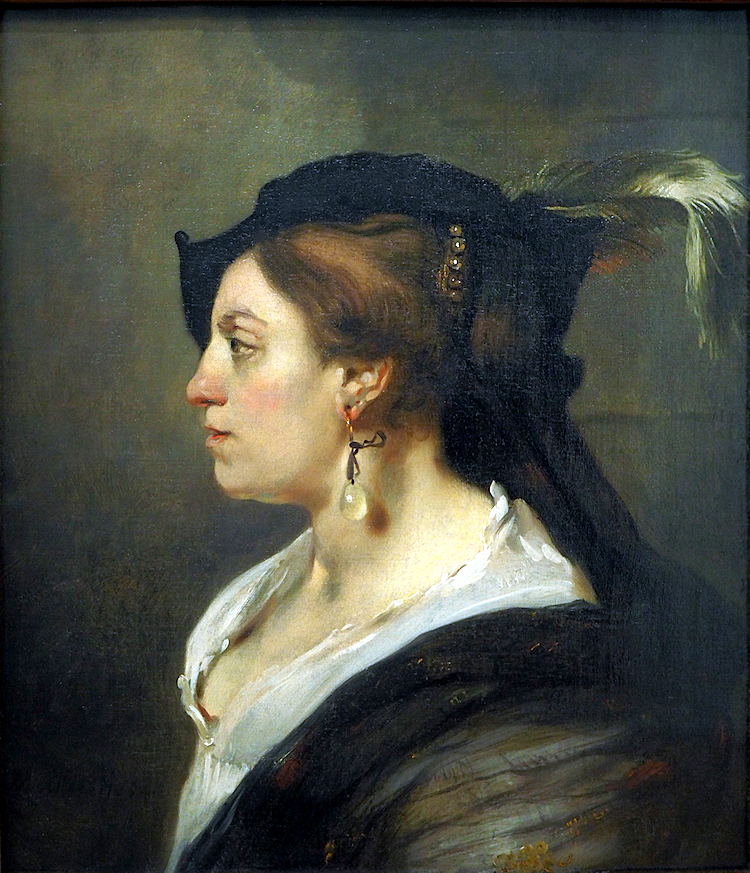
Portrait of a Lady in Profile, by Carel Fabritius, 1654.
Head of a Woman Seen in Profile, by Bartolomeo Passarotti, circa second half of the sixteenth century.
Profile of a Woman, by Fujishima Takeji, 1926-27.
Profile of a Young Woman, by Giovanni Boldini, circa 1880s (?).
Portrait of a Young Woman in Profile with a Mask in her Right Hand, by Giambattista Piazzetta, circa 1720-30.
Porträtt av Ung Kvinna i profil (Portrait of young woman in profile), by Emilie Mundt, circa 1880s.
Profile Portrait of a Young Lady, by Piero del Pollaiuolo, circa 1465.
Young Girl in Profile, by Alexei Alexeevich Harlamoff, circa 1880s.
Blackfoot Woman, by Joseph Henry Sharp, 1905.
Profile of a woman, India, Delhi, circa first half of the nineteenth century.
Rembrandt’s Mother, by Jan Lievens, circa 1629.
Bathsheba, by Philip Wilson Steer, circa 1919-21.
Profile of a Nubian Girl, by Franz Xavier Kosler, before 1905.