|
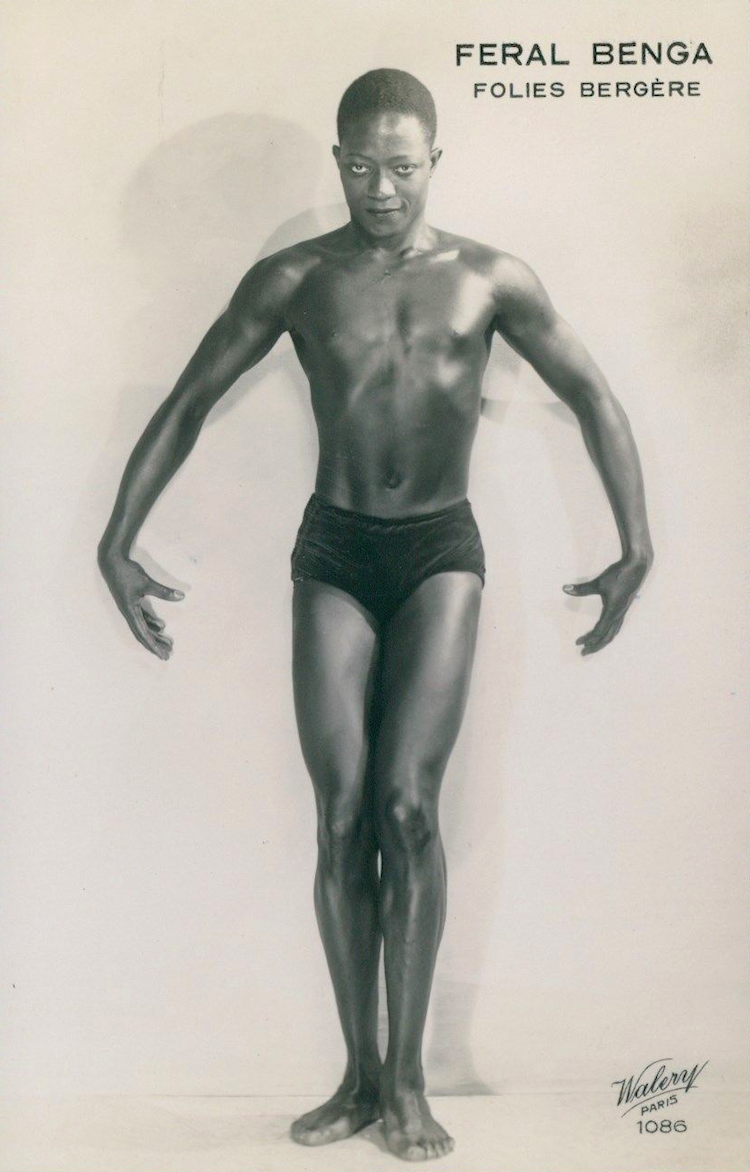
| These first images are all by Waléry, Paris, circa 1930. |
Féral
(François) Benga (1906, Dakar - 4 June, 1957,
Paris), Senegalese dancer and model. He was the illegitimate grandson of one of the richest landowners
in Dakar, his father had been educated by Catholic missionaries in France, and his uncle was a successful lawyer in Paris. He emigrated to Paris in the early Twenties, adopting the stage name of Féral (wild beast); he was promptly disinherited by his father for "living disgracefully and embracing whiteness". In 1925 he auditioned for and was given a contract by the
Folies Bergère and, by the next year, he was one of the group of semi-nude young men playing the drums while Joséphine
Baker danced in her infamous banana skirt; the revue was
La Folie Du Jour, and Baker and Benga were both only twenty years old. The latter soon became well known as a dancer, himself, an exotic and erotic male counterpart to Baker. It appears that he, like Baker, well understood the commodification of black culture and the black body and his marketability as an object of desire, in his case, particularly in artistic and homosexual circles. He performed successfully in revue after revue, well into the Thirties. While his career didn't have the length and breadth of Baker's, his image survives in the work of photographers Carl Van Vechten and George Platt Lynes, the painter Pavel Tchelitchew, the well known African-American sculptor, Richmond Barthé, and others. He also appeared in a handful of films, most famously as the
ange noir in Cocteau's great, surrealist
Le Sang d'un Poète of 1930. He accompanied the English anthropologist and author Geoffrey Gorer on a tour of Africa in 1935; the two may have been lovers. (Most of the the artists he collaborated with were gay or bisexual, and his own love life was fairly active.) Up until World War II, it seems he enjoyed a rather lavish and showy lifestyle: a large apartment near the
Champs-Élysées, a custom-made Delahaye convertible, a small army of poodles. Not much is known of his life during the war, and what there is is contradictory. At the Olympia Theatre in 1943 he performed in the ballet "Tam Tam", part of which he choreographed. But it's also said that he suffered greatly - physically and emotionally - during the Occupation and had to go into hiding. Having had his own small cabaret before the war, from 1946 he worked at then owned and operated
La Rose Rouge, a popular and fashionable cabaret-restaurant on the Left Bank. But eventually, changing times and his lack of business acumen meant that, after ten years, he was forced to close in 1956. At this point, only a year before his death, his family in Senegal decided to welcome him back into the family circle. There, he submitted to familial pressure and - quite unexpectedly - married a cousin, and is even said to have fathered a son. Still, he soon returned to Paris where he died of a pulmonary embolism at the age of only fifty-one.
 |
| In costume for his Danse du Sabre. |
 |
| Costumed for the Folies Bergère "Un coup de Folie", 1930. |
 |
| Four photographs by George Platt Lynes, circa 1934. |
 |
| Ten photographs by Carl Van Vechten, 1937. |
***
 |
| Advertisement for the Folies Bergère "Un coup de Folie", 1930. |
 |
| Impersonating Joséphine Baker in Tout Pour Joséphine (?), by Studio V. Henry, 1926. |
 |
| Unknown dance, by Studio V. Henry, circa 1926. |
 |
| Backstage at the Folies. A scene and an image that would be unimaginable - for so many reasons - in the United States at that time. |
 |
| As the ange noir in Cocteau's Le Sang d'un Poète, 1930. (Here, his makeup is being touched up.) |
 |
| Deposition (Féral Benga), by Pavel Tchelitchew, 1938. |
 |
| Ink wash sketch, by Pavel Tchelitchew, 1938. |
 |
| "Féral Benga, Senegalese Dancer", by Richmond Barthé , 1935. |
 |
| At La Rose Rouge, circa 1950. |
 |
| Signed and dated 1936. |
 |
| Unknown photographer, ND. |