L a - b e a u t é - s a u v e r a - l e - m o n d e ~ D o s t o ï e v s k i

L a - b e a u t é - s a u v e r a - l e - m o n d e  ~  D o s t o ï e v s k i


Showing posts with label Charles I. Show all posts

Sunday, September 29, 2019

The Favourite - portraits of George Villiers, 1st Duke of Buckingham


Portrait by Michiel van Mierevelt, circa 1625.

George Villiers, 1st Duke of Buckingham, (28 August 1592, Brooksby, Leicestershire – 23 August 1628, Portsmouth, Hampshire), English courtier, statesman, patron of the arts, he was the last and greatest favourite - and very possibly also the lover - of King James I of England. Born the son of a minor aristocrat, he was later groomed by his widowed mother for a life at court. Well trained in all the "manly arts", he was also charming and strikingly handsome. In 1614, at the age of twenty-one, placed in the right place at the right time, he first caught the eye of the King. He began to appear in court masques the following year, the perfect setting to display his fine figure and his grace as a dancer.

Attributed to William Larkin and his studio, circa 1616.

With James' favor, he quickly moved up the ranks of the nobility; he was knighted and made a Gentleman of the Bedchamber that same year. A year later, 1616, appointed King's Master of the Horse, he was elevated to the peerage, created Baron Whaddon and Viscount Villiers, and made a Knight of the Garter. The following year, he was made Earl and the next year Marquess of Buckingham. Finally, in 1623, his title was further promoted and he became the Duke of Buckingham. 

After Daniel Mytens, circa 1620s.
Paul van Somer, circa before 1621.
Studio of Daniel Mytens, circa 1620s.
Daniel Dumonstier, 1625.
Studio of Daniel Mytens, circa 1620s.

His new rank allowed him great proximity to the Royal Family, and he developed a close friendship with James' heir, the future Charles I. In 1620 he married Lady Katherine Manners, a daughter of the 6th Earl of Rutland. They had four children - the last born posthumously - three of whom achieved majority.

"Venus and Adonis", an allegorical portrait of Buckingham and his wife, by Anthony van Dyck, circa 1620.
With his wife and their children Mary and George - later 2nd Duke of Buckingham - after Gerrit van Honthorst, circa 1628.
Detail of above.
Studio of Gerrit van Honthorst, circa 1628.
Miniature by John Hoskins, after Honthorst, circa 1628-29.

Like many royal favourites, before and since, he was given many privileges and responsibilities for which he was quite unsuited. He was a great patron of the arts though, frankly, much of the work he commissioned was designed for his self-aggrandizement. But as Lord Admiral and as - in effect if not title - foreign minister, his career was a series of diplomatic and military blunders. Despite his record of incompetency, he remained at the height of royal favor, a position which, after James' death in 1625, would continue for the first three years of Charles' reign. 

Peter Paul Rubens, circa 1625.
Sketch for an equestrian portrait - since destroyed - by Peter Paul Rubens, 1625.
"Apollo and Diana" or "The Liberal Arts Presented to King Charles and Queen Henrietta Maria", by Gerrit van Honthorst, 1628.
The King and Queen, together on their cloud, represent Apollo and his sister Diana, while Buckingham appears below as Mercury.

But the public and Parliament loathed his influence and had long since turned against him, a sentiment and situation echoed in so many other instances throughout the history of kings and favourites. And he was assassinated by an army officer, John Felton, in 1628. Felton was later hanged, the public display of his corpse becoming an object of veneration by an approving public, while Buckingham was buried in a lavish tomb in Westminster Abbey. He had died at the age of thirty-five.

Katherine Villiers, Duchess of Buckingham with Lady Mary Villiers, later Duchess of Lennox and Duchess of Richmond, George Villiers, 2nd Duke of
Buckingham, and Lord Francis Villiers, studio of van Dyck, circa 1633. The late Duke is depicted both in a portrait and in the miniature that the Duchess holds.
After Daniel Mytens, circa 1620s or after.


Saturday, January 30, 2016

James Hamilton, 1st Duke of Hamilton - two portraits by Daniël Mijtens


The first portrait by Mijtens, taken in 1623, when the then Earl of Arran was seventeen.

James Hamilton, 1st Duke of Hamilton (19 June 1606, Hamilton Palace, Lanarkshire, Scotland – 9 March 1649, Old Palace Yard, Palace of Westminster, London), Scottish nobleman, controversial political leader, and unsuccessful military commander.


Born the son of James, Marquess of Hamilton and the Lady Ann Cunningham, following the death of his great-uncle James, Earl of Arran in 1609, the three-year-old was henceforth styled Earl of Arran. At the age of eleven he went with his family to live at court in London. At fifteen he was married off to a nine-year-old relative of the King's favourite, the Duke of Buckingham. (The union was only brought about to satisfy Buckingham's political aims, and it appears the young Hamilton was unhappy with the marriage. The couple nevertheless produced six children - of which only two survived childhood, both girls.)


His father died in 1625, and three weeks later so did King James VI. The new marquess was only nineteen, but inherited all his father's titles and privileges; at the coronation of the new king, Charles I, Hamilton bore the Sword of State at Westminster Abbey. He soon was made a Gentleman of the Bedchamber, Knight of the Garter, a Privy Councillor in both England and Scotland, and Master of the Horse, a post he retained until 1644.
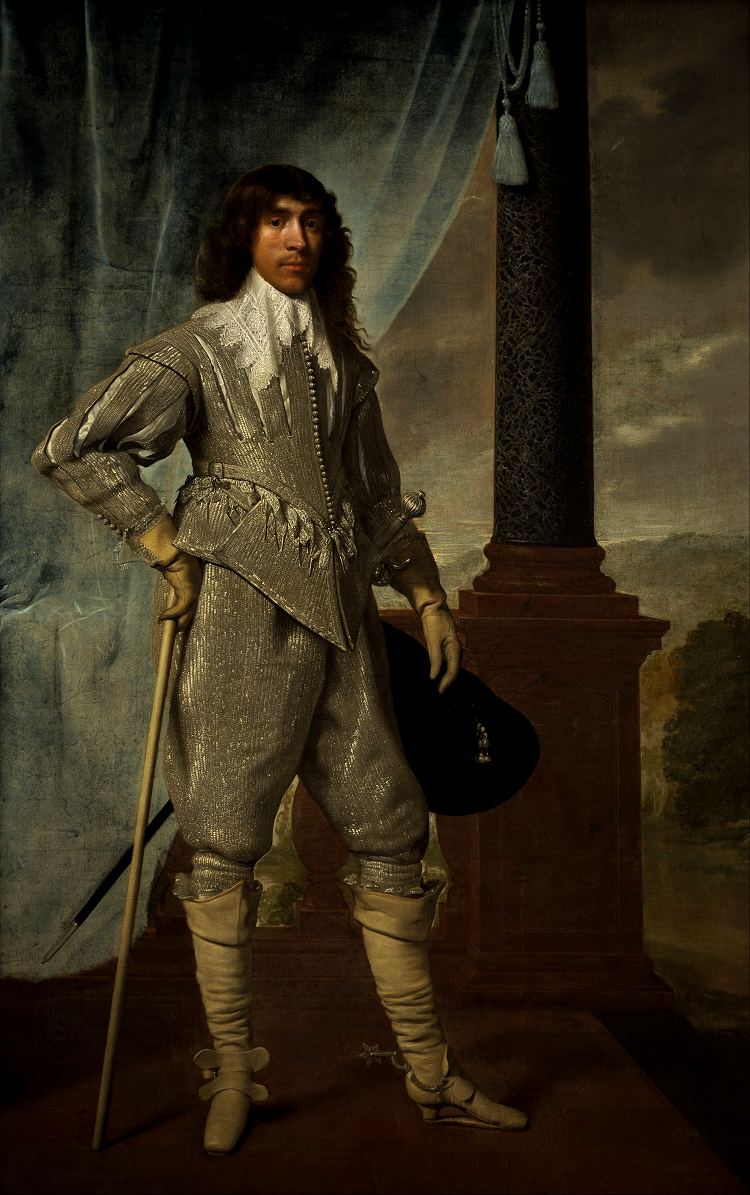
The second portrait by Mijtens, painted in 1629, when the now-Marquess-later-Duke of Hamilton was twenty-three.

In 1631, despite a lack of military training, he led an army of English and Scots to Germany to fight with the Swedish in the Thirty Years' War. Though Hamilton had to be propped up by more experienced officers, it appears he was no coward and was committed to his task. But his troops were never fully organized or well deployed and after disagreements with the Swedish king, he and many of his officers were discharged and returned to England.


On his return, Charles I appointed Hamilton his chief adviser in Scottish affairs. Six years later, with revolt breaking out in Scotland, Charles made him commissioner in an effort at appeasement, Hamilton being Scottish. There followed several years of political wrangling and intrigue, with Hamilton being attacked from both sides and his own sympathies fluctuating. Egotistical and probably not overly bright, he was also no stranger to intrigue, himself; toward the end of this period he was even accused of treason against the King by another Scottish nobleman.


He still held Charles' favor and confidence, though, and was further ennobled in 1643. The Marquessate of Hamilton was raised to that of a dukedom, and he was awarded the Marquessate of Clydesdale, the Earldom of Cambridge, the Baronies of Aven and Innerdale. In addition, he was also re-granted the Earldom of Arran. Though by this time the English Civil War had already broken out, Hamilton was still trying to control the Scottish political situation, foolishly antagonizing other powerful nobleman and even appearing to work against the interests of the king. Charles had finally had enough by the the end of 1643 and Hamilton was arrested. He spent three years in various places of confinement, but was liberated by Parliamentary troops in April of 1646.


Now returned to Charles' favor, the king conferred on Hamilton the heritable office of Keeper of Holyroodhouse. Then, after the King was delivered up to Parliamentary commissioners, Hamilton was able to temporarily gain authority in Scotland and, in July of 1648, he led a large army into England in defense of the King. He showed a complete inability as a military commander and, even with vastly superior numbers, was quickly defeated by Cromwell and his forces. He, himself, was taken prisoner at the end of August. His trial for treason began in February of the following year - seven days after the execution of the King. He was condemned on March 6 and beheaded three days later at the Old Palace Yard, Westminster. (A setting that had witnessed the executions of Sir Walter Raleigh and Guy Fawkes, among others.) He was forty-two. 


Wednesday, January 13, 2016

One bust, not two, then none - multiple views of Charles I and Henrietta Maria by van Dyck


By the middle of the 1630s the great Italian sculptor and architect Gianlorenzo Bernini was at the height of his powers, his name known throughout Europe, already recognized as the greatest sculptor of his time; he was what we'd now call an "art superstar". The current King of England, Charles I, could think of no one better to immortalize his royal image in marble. And so he commissioned a portrait bust, writing to Bernini that the artist's name was "exalted above those of all men of talent who have exercised your profession." Since the king had no intention of traveling to Rome, and the sculptor wouldn't come to England, Charles had his court painter van Dyck paint a now-famous triple portrait of the king that Bernini would work from to capture his subject's likeness.

Van Dyck's triple portrait of Charles I is dated circa 1635-36.

The painting was delivered to Rome in 1636. The marble bust was soon completed and was very well received on its arrival at the English court; Charles would pay the sculptor quite lavishly for the commission.The portrait was so admired that plans were made for the queen to be portrayed by Bernini as well. Toward the same purpose, van Dyck painted three views of Henrietta Maria, though on three separate canvases. As it turned out, the English Civil War intervened and the second bust was never begun.

The Queen's portraits are dated 1638; the full-face view and the left-facing profile are in the Royal Collection.
The right-facing profile view is in the Memphis Brooks Museum in Memphis, Tennessee.

The King's bust would have a fate as unfortunate as its subject's. Sold off after the fall of the monarchy, it was returned to the Royal Collection at the Restoration, only to be destroyed in a fire at Whitehall Palace in January of 1698. There were copies believed made of Bernini's original, but those still existing and thus attributed are of differing design and some appear to have been made sometime after the destruction of the original.

One of the busts traditionally believed to be a copy after Bernini. Attributed to Jan Blommendael, circa 1700.
Another bust thought to be after Bernini. The sculptor is unknown, but it has been suggested that it is John Bushnell. Circa 1675.


Wednesday, December 16, 2015

A lady, lost. And found.


Languishing in storage, having been part of the collection of the Bowes Museum in northeast England since that establishment/s opening in 1892, this portrait was considered “a copy after Sir Anthony Van Dyck.” Purchased in Paris in 1866 by the museum's founder, John Bowes, the sitter at first went unidentified. The museum later determined that the subject was Olivia Boteler Porter, wife of Endymion Porter - who was a good friend of Van Dyck’s - and lady-in-waiting to the Queen. Until recently, its poor condition and less than stellar attribution resulted in its banishment to a storeroom.


Only a few years ago, searching online, art historian, dealer, and van Dyck specialist, Bendor Grosvenor found an image of the painting - dirty, damaged, and covered in layers of yellowed varnish - and felt that it might actually be a work of the master himself. After a careful cleaning and conservation, the portrait is now acknowledged to be by the hand of van Dyck, and is once again - rightfully - on display in the museum.

***

Olivia Boteler Porter was a lady-in-waiting to Queen Henrietta Maria, wife of Charles I. She had adopted the Queen’s Catholicism in 1637 and was a zealous adherent of her new faith, converting several of her fellow noblewomen, and even kidnapping her dying father - brother of the Duke of Buckingham - in a brazen attempt to save his soul before time ran out. She and the Queen openly defied Parliament, publicly flaunting their conversions; Parliament was not amused. They saw Olive as a dangerous agitator, maybe even a spy for Catholic Spain, and their suspicion would also fall on her husband, even though he had never converted. The couple fled the country in 1646 during the English Civil War, when the Royalist cause appeared lost and Parliament was in control of the country. It seems likely they took the painting with them and later sold it in France; it is recorded as being in the collection of the ducs de Montbazon not long after that date.


Wednesday, December 2, 2015

Portraits of King Charles I by Daniël Mijtens


1628.
1631.
1626.
1629.
1633. (Copy?)
With his wife, Queen Henrietta Maria, 1631.
As Prince of Wales, 1624.
1632.

***

Daniël Mijtens (circa 1590, Delft – 1647, The Hague), known in England as Daniel Mytens the Elder, Dutch portrait painter who spent most of his career in England. Born into a family of artists, he trained in The Hague, possibly with Van Mierevelt. No paintings are known to survive from his early Dutch period. By 1618, he had moved to London, where he found patronage with the important art collector Thomas Howard, 21st Earl of Arundel. He was soon commissioned to paint King James I and his son, Charles, Prince of Wales. In 1625, at the accession of Charles I, he was appointed painter to the king.

He was kept extremely busy with portraits of the royal family and the British aristocracy, also making copies of earlier works by other artists. But in 1626 and 1630 he made visits to the Netherlands, most likely to familiarize himself the latest advancements in his field, most particularly with the work of Rubens and Rubens' former pupil van Dyck.

Mijtins can be credited with bringing a far greater naturalism to English portraiture, but with van Dyck's arrival in England in 1632, he was soon supplanted as court painter by the latter artist, the suaveness and glamour of whose work he couldn't approach. He appears to have returned permanently to the Netherlands around 1634. From that point he would work primarily as an art dealer in the Hague; only four paintings survive from this second Dutch period.