L a - b e a u t é - s a u v e r a - l e - m o n d e ~ D o s t o ï e v s k i

L a - b e a u t é - s a u v e r a - l e - m o n d e  ~  D o s t o ï e v s k i


Showing posts with label Emperor Franz Joseph. Show all posts

Sunday, April 28, 2024

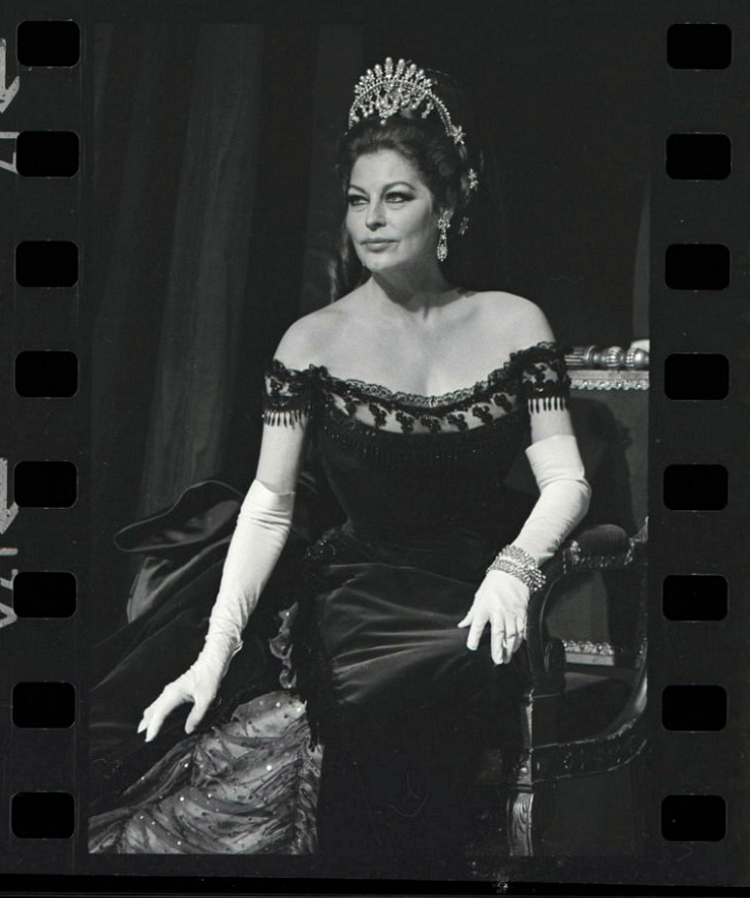
Laughing empress - Ava Gardner as the Empress Elisabeth of Austria, on the set of "Mayerling", 1968


Photographs by Terry O'Neill.


The phantom gloved hand appearing in many of these images was attached to the person of the great James Mason who played Gardner's husband in the film, Austrian Emperor Franz Joseph. The lead roles in "Mayerling" were played by Omar Sharif and Catherine Deneuve as the tragic lovers Archduke Rudolf and his mistress, Baroness Mary von Vetsera. A handful of images of the three can be seen in O'Neill's contact sheets.


Friday, June 9, 2023

Endlich die charmante Kaiserin - the Empress Elisabeth of Austria, by Franz Xaver Winterhalter, 1865


Other than my wife, the painter Franz Winterhalter is the most frequently mentioned name on this blog. And yet, I'm just now getting 'round to focusing on one of his most famous works, the celebrated "stars in her hair" portrait of the Empress Elisabeth. This very famous painting, the pinnacle of mid-nineteenth-century beauty and glamour, has been the inspiration for countless interpretations - film, fashion and costume design, portraiture - both directly related to its subject or having nothing at all to do with her, the interpreter merely hoping to capture a reflection, a fraction of her timeless allure. 


The pose and lighting are incredibly effective; as she turns back to smile at the viewer, the spangled tulle of her gown - thought to be the work of the great couturier Worth - both diaphanous and sparkling, trails romantically back into the shadows. The lighting and the structure of the composition leads everything back to the delicate face, crowned by her own mass of luxurious chestnut hair and the diamond stars nestled there. 


Considered one of the greatest beauties of the nineteenth century, that perception has remained intact while others in that lofty category have not so endured; the Empress Eugénie, for example, looks distinctly odd to most people now. It's certainly because the Austrian empress' beauty more properly aligns with our present tastes. She was very thin and fine-featured, with a small head, her proportions rather like what we'd expect of a present fashion model. (Of course, the comparison doesn't end there, as her eating disorders are very well documented.) And her face - nothing like the pale, long-nosed, drooping faces the age usually glorified - is appealing, a natural, healthy looking beauty. 


In reality, a very complicated, very troubled and unhappy woman, the artist has yet captured the side of her personality that was able to, at least momentarily, transcend that, and has left us with proof of her very real charm and her self-confidence in her own beauty, an exquisite image of elegance and feminine grace whose magic has proved indelible.


*

The portrait was, of course, a pendant to that of her husband, the Emperor Franz Joseph I, by the same artist. Today both hang in Vienna's Hofburg Palace.

An 1879 bust of the empress by Victor Tilgner is rather unfortunately wedged into the space between the portraits.


Sunday, April 30, 2023

Baby brother - Archduke Ludwig Viktor of Austria


Archduke Ludwig Viktor Joseph Anton of Austria (15 May 1842, Vienna – 18 January 1919, Schloss Klessheim), the youngest child of Archduke Franz Karl of Austria and his wife Princess Sophie of Bavaria; his elder siblings were Emperor Franz Joseph I of Austria, Emperor Maximilian I of Mexico, and Archduke Karl Ludwig. Bearing the nicknames "Luziwuzi" and "Bubi" within the family circle, he was spoiled and indulged, and came to be known for his wit and sharp tongue. His open homosexuality was surprisingly well tolerated by his family, though kept a secret to the outside world, thanks to the strict censorship employed during his brother the emperor's rule. Like all Habsburg males, he was expected to pursue a military career but, unlike his brothers, he took no interest in politics, preferring to spent his time in social activities and art collecting. 

Since the irises of light colored eyes often seemed to disappear in early photography, they were often, as here, drawn back onto the print.

In spite of his quite obvious sexual proclivities, his mother tried to arrange a marriage for him with his first cousin Duchess Sophie Charlotte in Bavaria, youngest sister of Empress Elisabeth, but he declined. (Duchess Sophie would later endure a broken engagement with another homosexual cousin, Ludwig II of Bavaria.) In 1863, his brother Maximilian, soon to embark on his disastrous Mexican venture, tried to persuade Ludwig Viktor to marry Isabel, daughter and heir presumptive of Emperor Pedro II of Brazil, arguing that "such a marriage might found yet another Habsburg dynasty in Latin America." This union he also declined. 

With his immediate family, 1860.
Back row: Emperor Franz Joseph I, Archduke Maximilian and his wife Charlotte of Belgium, Archduke Ludwig Viktor, Archduke Karl Ludwig.
Front row: Empress Elisabeth with her children Rudolf and Gisela, Archduchess Sophie and her husband Archduke Franz Karl. 
The brothers: Archduke Karl Ludwig, Emperor Franz Joseph I, Archduke Maximilian, Archduke Ludwig Viktor.
The brothers: Archduke Ludwig Viktor, Emperor Franz Joseph I, Archduke Karl Ludwig, Archduke Maximilian.


That same year, at the age of twenty-one, Ludwig Viktor commissioned architect Heinrich von Ferstel to design and build a city palace. The Palais Erzherzog Ludwig Viktor, the first building to be erected on the new Schwarzenbergplatz, and now a subsidiary house of the Burgtheater, was completed three years later. Within its walls, the archduke began to fully indulge his great passion for art collecting and lavish entertaining. Photographs from this period exist showing him in women's clothes. I haven't been able to determine whether he was a regular "crossdresser", as he is often rather derisively described, or that he merely wanted a visual record of having dressed in that manner for a costume party or amateur theatrical. 

In the same dress and setting as the image above. The others are unidentified.
A double exposure, the archduke wearing both male and female attire.

Also in 1866, his brother the emperor ceded to him Schloss Klessheim, a Baroque palace four kilometers to the west of Salzburg; originally built as a summer palace, between 1880 and 1882 it was enlarged by the archduke's same architect, von Ferstel. He was popular in Salzburg and, as a member of the imperial family, he became one of the leaders of society, assuming the patronage of the Salzburg Society of Art, known for his philanthropy and his splendid parties. Apparently, however, officers stationed in Salzburg were soon forbidden to accept his invitations, his "inclinations" being the whispered explanation.


The fairly free hand the archduke was given regarding his personal life came to an end in 1904. (Or 1906, or some other date; the facts of Ludwig Viktor's life are hard to come by, the results often contradictory.) A frequent and familiar visitor to Vienna's Central Bathhouse - the Central-Bad Wien - where he was know to make assignations, often proffering gifts to likely young men, an incident occurred there that couldn't be entirely hushed up: he made unwanted advances to another man or a bath attendant resulting in the archduke being slapped or otherwise roughed up. The scandal leaked out, and his brother the emperor, remarkably tolerant up to this point, banished him from the capital, ordering him to retire to his Salzburg estate.

In addition to the retouching of his protuberant left ear, the medal on his chest has been crudely drawn on, probably on the negative.

He lived out his last fifteen years at Schloss Klessheim, surrounded by his vast collection of art, silver, jewelry, furniture, porcelain, etc. In 1915, due to "mental incapacity" - perhaps some form of dementia? - he was put under the care of a conservator. Only months after the end of WWI and the fall of the Austro-Hungarian empire, he died at the age of seventy-six, the last of his immediate family, on the same day as the commencement of the Paris Peace Conference in Versailles. As per his wishes, he was buried in Salzburg's Siezenheim cemetery rather than the Imperial Crypt in Vienna. The Schloss Klessheim was sold the same year by the Habsburg family, and his enormous collection of art and objects took nearly a full year to auction, in 1921-22.

Portrait by Heinrich von Angeli, 1874.