L a - b e a u t é - s a u v e r a - l e - m o n d e ~ D o s t o ï e v s k i

L a - b e a u t é - s a u v e r a - l e - m o n d e  ~  D o s t o ï e v s k i


Friday, November 18, 2022

Ihre grünen Augen - a portrait of Katharina Kern von Sterzing, by Rudolph Friedrich Wasmann, 1842


*

Rudolph Friedrich Wasmann (8 August 1805, Hamburg - 10 May 1886, Merano), German-born painter of the Biedermeier period, who spent most of his life in the region of the Tyrol that is now part of Italy. At the age of seventeen, he began an apprenticeship with the painter Christoffer Suhr. Then, after several years of study at the Dresden Academy of Fine Arts and the Academy of Fine Arts, Munich, he spent two years in Merano. From 1832 to 1835 he lived in Rome, where he came under the influence of members of the Nazarene movement. He eventually converted to Catholicism. After six more years spent in Merano and Bolzano, where he worked as a portrait painter, he returned to Hamburg. He married in 1846 and returned once again to Merano. In addition to portraits, he produced landscapes and religiously-themed works in Nazarene style. His son was the Jesuit priest and entomologist, Erich Wasmann.


Sunday, November 13, 2022

Der Teufel ist eine Frau - Dietrich in German postcards and publicity portraits for "The Devil is a Woman, 1935


Most if not all of the images here are credited to Don English... portraits taken, no doubt, in exhausting "collaboration" with the director and star.

*

Alright, this one isn't actually German. Latvian, to be precise.

*


*

In my old age, Dietrich - here at her most extreme - has assumed the position of my favorite of the "Old Hollywood" film stars. (The proof is in how often my posts here relate to her.) She was barely on my radar when I was very young; then, it was all Garbo and, later, Shearer. But my admiration for her - her perfectionism, her self-control, her drive; her daughter’s remarkable, exquisite biography of her mother makes me feel I know the woman - has steadily grown. It didn’t matter that she was never much of an actress, or that she wasn’t actually a singer at all. That she appeared to wholly believe in her abilities, never acknowledged their limitations, somehow never allowed those limitations to seem a liability, but more like rare gifts. But more than anything, I think she was a very great artist of the IMAGE. Whether on film, on stage, or in still photography, she always KNEW the picture she was creating. She worked with great filmmakers, musicians, and photographers, but she knew better than probably any of the them the power of gesture, of costume, of LIGHTING to create a visual magic that will never fade, that will never age.


Friday, November 11, 2022

Stylish young Franconians - three siblings of the von Holzhausen family, by Georg Karl Urlaub, 1789

 
Johann Georg von Holzhausen (1771-1846).
Henriette von Holzhausen (1773-1834).
Friedrich Adolph Carl von Holzhausen (1776-1811).

For almost seven hundred years, from 1245 until 1923, the von Holzhausens were one of Frankfurt's most important patrician families as well as prominent members of the Imperial City's town council; more than thirty members of the family, on some seventy occasions, served as mayor. Until about 1500 the family were merchants on a large scale, but then concentrated on administering their country properties and feudal lands. The death of Adolph Freiherr von Holzhausen in1923 marked the end of the older patrilineal branch of the family. He bequeathed the family's ancestral portrait gallery - with work dating back to the time of the Renaissance - to Frankfurt's Städel art museum - officially the Städelsches Kunstinstitut und Städtische Galerie - where these three paintings remain as part of the collection. Each of the portraits is approximately twenty-one by seventeen inches.

*
*

*

Georg Karl Samuel Urlaub (3 October 1749, Ansbach - 26 October 26, 1811 in Darmstadt ), German painter, the younger son of the painter Georg Christian Urlaub. He thus came from the well-known Franconian family of painters Urlaub, of which he was the most important member alongside his older brother Georg Anton Abraham, his uncle Georg Anton, and his grandfather Georg Sebastian. He initially received training from his father and, after his father's death, from his older brother. He lived in Würzburg until 1773, then later in Schweinfurt, before spending two years at the comital court in Wertheim am Main from 1779. He was then employed at the court in Hanau, and remained in the city long after being relieved of his duties as a painter at court. Known for his work as a portrait, genre, and landscape painter, later in his career he turned increasingly to history painting. He lost his sight in 1803 and, sometime before his death, he and his wife moved to Darmstadt to live with their son Jeremias August Urlaub, who also worked as a painter; their second son, Anton, also worked as an engraver and painter. 


Sunday, November 6, 2022

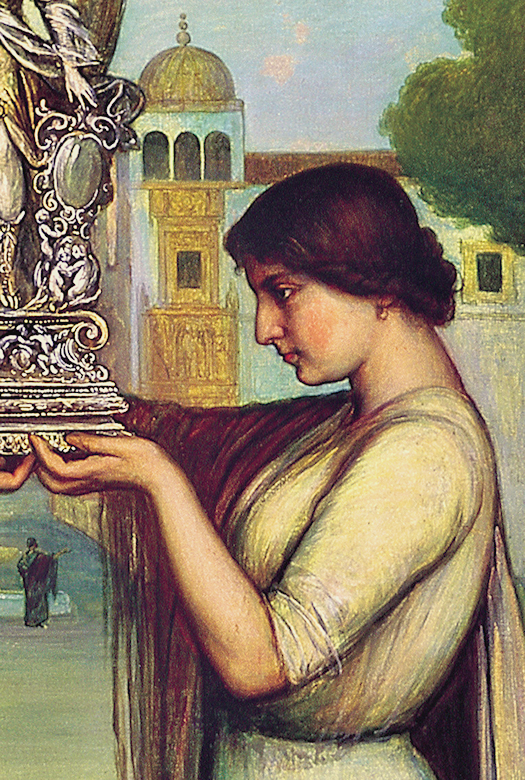
Poema de Córdoba - an allegorical polyptych by Julio Romero de Torres, 1913

 
Córdoba guerrera.
Córdoba barroca.
Córdoba judía.
Córdoba cristiana.
Córdoba romana.
Córdoba religiosa.
Córdoba torera.

Designed as a sort of secular altarpiece, Poema de Córdoba, is an expression, a reinterpretation, of spiritual, psychological, and historical themes associated with Córdoba, told through allegory; the artist himself explained the seven panels as the reincarnation of the past in the present. The series consists of six panels of equal size, along with a larger central panel. With the eight full-length figures that appear in the polyptych, and in the varied idealized or invented landscapes that serve as backgrounds, Romero de Torres interprets the spirit of Córdoba, the ancient city in which the artist was born, lived, and died. 

I'm not certain as to how the group is currently framed.

The polyptych is in the collection of the Museo Julio Romero de Torres in Córdoba, Spain. 

*

Córdoba guerrera: an allegory of the Córdoba of El Gran Capitan. "The Great Captain" was Gonzalo Fernández de Córdoba, the general and statesman who led successful military campaigns during the Conquest of Granada and the Italian Wars. In the background appears a fictional landscape in which the monument to the "Great Captain", the western façade of the Mosque-Cathedral and the portal of the Paez de Castillejo palace can be distinguished. The model was Dolores Castro, known as "Pirola, the gypsy".


Córdoba barroca: an allegory of the Córdoba of Luis de Góngora. In the background, a fictional landscape in which stands, atop a pedestal, a sculpture of the poet and priest Luis de Góngora y Argote. The model was Encarna Rojas.


Córdoba judía: an allegory of the Córdoba of Maimonides. The background is a landscape based mainly on the Plaza de la Fuenseca and in which stands a fictitious statue representing the famous Jewish philosopher and doctor. At the end of the street can be seen the Arco del Portillo. The model was Amalia Fernández Heredia.


Córdoba cristiana: an allegory of San Rafael, the guardian angel of the city. It is the central panel and the largest. Two women hold between them a silver statuette of the archangel Saint Raphael, its design based on the well-known painting by Juan de Valdés Leal, El arcángel San Rafael. Outside, behind a semicircular arch, is visible a fictional landscape made up of two buildings and a fountain. The models were Adela Portillo and Rafaela Torres.


Córdoba romana: an allegory of the Córdoba of Seneca. In the background appears the Puerta del Puente and a fictitious statue that is meant to represent the philosopher Seneca. The model was Adela Moyano.


Córdoba religiosa: an allegory of the Córdoba of San Pelayo Mártir. Saint Pelagius was a Christian boy martyr, put to death in Córdoba in 926. In the background is seen a landscape based on the Plaza de Capuchinos, featuring an imaginary tomb of Bishop Osio, an early Christian leader. The model was Rafaela Ruiz.


Córdoba torera: an allegory of the Córdoba de Lagartijo. In the background can be seen the Plaza de la Corredera as well as a fictitious monument to the bullfighter Lagartijo (Rafael Molina Sánchez; his fighting name, Lagartijo, means "lizard".) The model was Ángeles Muñoz.


*

Off-topic, Romero de Torres seems to have had a bit of a fetish for ladies' shoes; dainty, silken pumps feature prominently in so much of his work. And not only fine ladies, but even barmaids, gitanas, and (otherwise naked) nudes are all thus incongruously shod. I admit I find his little obsession rather charming.