L a - b e a u t é - s a u v e r a - l e - m o n d e ~ D o s t o ï e v s k i

L a - b e a u t é - s a u v e r a - l e - m o n d e  ~  D o s t o ï e v s k i


Friday, October 21, 2022

"A study in contrasts" - two portraits, two ladies prominent in their respective milieux

 
Cäcilie, Baroness von Eskeles, by Friedrich von Amerling, 1832.
Alice Regnault, by Giovanni Boldini, 1880.

*

Cäcilie, Baroness von Eskeles, née Zippora Itzig (1760-1836), a leading Viennese salonnière at the beginning of the nineteenth century.


*

Alice Regnault (née Augustine-Alexandrine Toulet; 5 February 1849 - 12 July 1931), French actress and courtesan.


Sunday, October 16, 2022

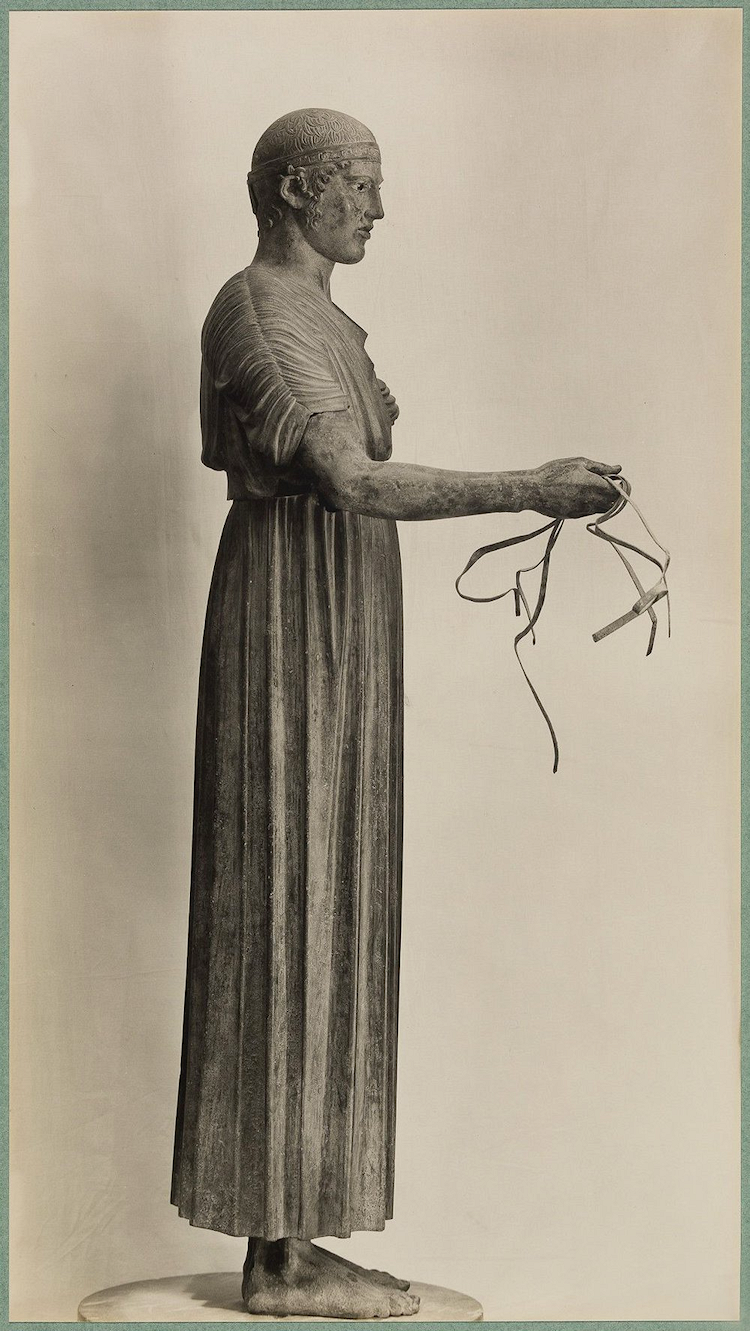
Eternal youth - the "Charioteer of Delphi", photographs by Clarence Kennedy, 1928


The Charioteer of Delphi, also known as Heniokhos - Greek: the rein-holder - is a bronze, life-size statue of a young chariot driver. Created circa 478-474 BCE and installed in the Sanctuary of Apollo in Delphi, it was buried in a rock-fall that destroyed the site a hundred years later, and was only rediscovered in 1896. 


Remarkably intact in spite of that, it is only missing its left arm and some of the copper and silver inlays on the face and headband. It's also one of the rare Greek bronzes that has preserved its inlaid glass eyes. Greek bronzes of the time were cast in sections and then assembled. When discovered, the statue had separated into three pieces: the head and upper torso, the lower torso down to the feet, and the right arm.


The figure is of a very young man. Like modern jockeys, chariot racers were chosen for their lightness, but they also needed to be tall, so were frequently teenagers. His full-length tunic has caused scholarly disagreement among those who've studied the piece. Some believe that the elegant figure represents a young man from a noble family; in the Panhellenic Games chariot racers selected their drivers from aristocratic families. But, citing the fact that Greek athletes nearly always competed and were depicted nude, others have speculated that he may have been modeled on a household slave, an individual whom, apparently, it would have been inappropriate to depict unclothed.


Some ten years after the figure's discovery, the Spanish-born, Venetian-resident artist and designer Mariano Fortuny y Madrazo first created a finely pleated silk dress that was said to be inspired by and named after the statue. His Delphos gown, which was produced for several decades and is widely collected to this day, has come to be seen as an important work of art in its own right. Read - and see - much more about the Delphos here:


The figure was originally part of a larger group of statuary, including the chariot, at least four horses, and possibly two grooms. Some various fragments of the chariot and horses were found with the statue and are also displayed, separately, in the Delphi Archaeological Museum.


*

Clarence Kennedy (4 September 1892, Philadelphia - 29 July 1972, Northampton, Massachusetts), American art historian and photographer.

From the Getty Museum website:

Trained as both an art historian and a photographer, Clarence Kennedy cautioned that "the photographer dare not allow himself to use the sculpture for spectacular effects of his own invention....He is not creating something of his own." He began to experiment with lighting and photographing sculpture while a student at the American School in Athens. Returning to the United States, in 1916 he took a position teaching art history at Smith College, where he remained for forty-four years. During this time Kennedy taught photography and made photographs, producing eight volumes of The History and Criticism of Sculpture to be used as teaching aids in his classes at Smith.

Beginning around 1930, Kennedy began a longtime friendship with Edwin Land, with whom he developed the Polaroid instant print process. In the late thirties Kennedy moved away from photography as he became interested in typography, founding the Cantina Press, which he ran out of his home. After assisting in the American Commission for the Protection and Salvage of Artistic and Historic Monuments in the War Area during World War II, he returned to photography, making landscape images in the 1950s.


Friday, October 14, 2022

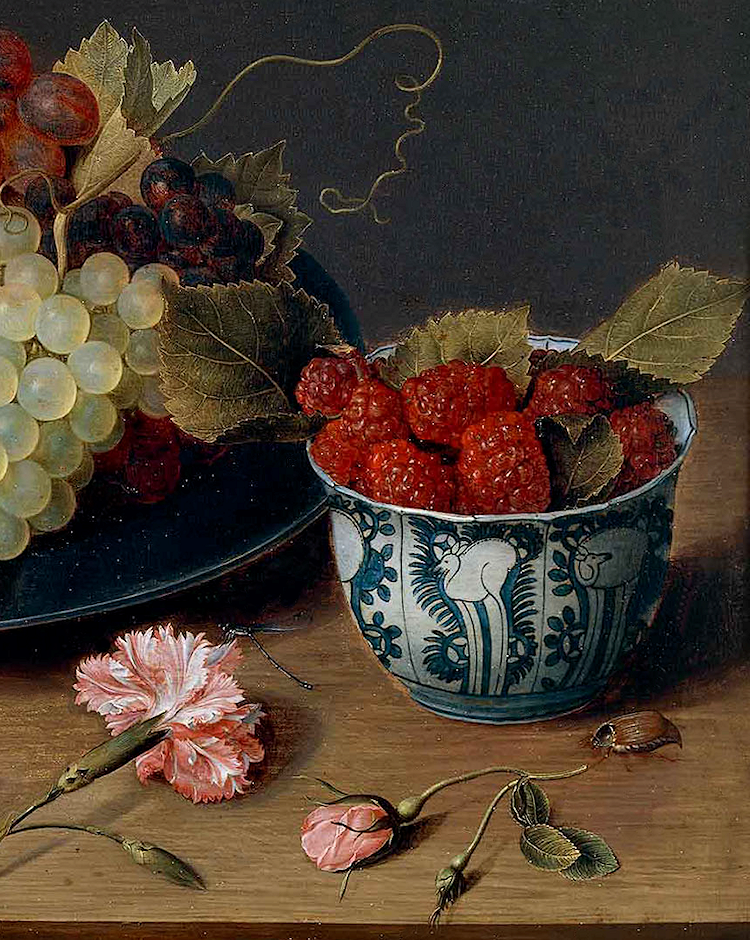
As the season ends - a selection of paintings of flowers and fruit

 
The Nasturtiums, No. 2, by Thaddeus Welch, circa 1861-1897.
Still Life with Fruit, by Isaac Soreau, circa 1638.
Autumn Bouquet, by Vanessa Bell, 1912.
An Imaginary Carnation, Aurangabad, North Deccan, 1669 AD.
Still Life with a Carafe, Flowers, and Fruit, by Henri Fantin-Latour, 1865.
Basket of Fruit, by Caravaggio, circa 1599.
Tulips, Rose, Honeysuckle, Apple Blossom, Poppies and Other Flowers in a Glass Vase, with Butterflies, on a Marble Ledge, by Rachel Ruysch, circa early 1690s.
Bouquet of Peonies, by Édouard Manet, 1882.
Still Life with Fruit, by Jacob van Walscapelle, 1675.
Pomegranates, by John Singer Sargent, 1908.
Floral Arrangement with Berries, by Fernand Renard, circa second half of the twentieth century.
The Basket of Wild Strawberries, by Jean-Siméon Chardin, circa 1761.
Basket of Flowers, by Juan de Arellano, circa mid-seventeenth century.
Still Life with Roses, by Félix Vallotton, 1920.
A Glass Compote with Peaches, Jasmine Flowers, Quinces, and a Grasshopper, by Fede Galizia, circa 1600.
Guelder Roses and the Venus de Milo, by Édouard Vuillard, 1905.
Strawberries, by  William Hammer, 1874.


Sunday, October 9, 2022

Les Russes au soleil à la villa des Mimosas - Marina Sergeevna von Derviz by Benjamin-Constant, circa 1899


Now in the collection of the Musée des Beaux-Arts Jules Chéret in Nice - itself the former mansion built by the Russian Princess Elizaveta Vasilievna Kochubey in 1878 - it seems reasonable to assume that this portrait of madame von Derviz was originally installed in the von Derviz' Villa des Mimosas; its frame even looks as though it could be a surviving fragment of paneling which the painting had been let into, rather than a stand alone picture frame.


The von Derviz (or von Derwies, both transliterations from the russification of the German von der Wiese) family was of German extraction; originally from Hamburg, its members had been registered as bourgeois as far back as the fifteenth century. But by the eighteenth century they were resident in Russia and ennobled.* The most celebrated member of the family was Pavel Grigorievitch von Derviz (1826-1881), who made a great fortune as a  railroad magnate and financier. With lavish mansions in St. Petersburg and Moscow, estates in the Russian countryside, a château in Nice, he and his family were among the famous Russian "winterers" on the Côte d'Azur. 

The portrait - photographed before the top was concealed by its present frame - was reproduced in Figaro-Salon, 30th April 1899. 
Figaro-Salon was an annual review of French art, an off-shoot of Le Figaro, published 1881-1901.

By the second half of the nineteenth century, wealthy and/or aristocratic Russians - even members of the imperial family - who couldn't bear the cold of the winter months in their native land, frequently decamped to the perpetually warm south of France. Greatly appreciated by the locals for their extravagant lifestyles and profligate spending, they built well-appointed villas in Cannes, Nice, Menton, and gambled recklessly at Monte Carlo. 

A second Benjamin-Constant portrait said to be of Marina von Derviz, and also dated circa 1899. It entered the Hermitage collection in 1923 - obviously
after the family's Russian possessions had been nationalized - transferred from the Petrograd Art Treasures Department. (Since, to me, the sitter doesn't much
resemble that in the portrait above, either one or both portraits are a poor likeness, or this is someone else, perhaps a different member of the family.)

Pavel Grigorievitch von Derviz' elder surviving son, Sergei Pavlovich (1863 - 7 November 1943), and his second wife, Marina Sergeevna, née Schoenig (1875 - 1947), had a home in the Californie neighborhood of Cannes. The Villa des Mimosas was designed by Louis Hourlier and constructed in 1878. Of irregular plan with a steeply sloping roof and tall chimney stacks, the exterior surfaces were of a mixed design incorporating stone, brick, tile, half-timbering, and smooth plaster. I've been unable to discover when the von Derviz' residency ended, but the villa was sold to the Norwegian engineer and industrial entrepreneur Sam Eyde in the late 1920s.


Though the exterior décor has been much simplified, and the wooden balconies, oriel window, and the neo-Gothic porch to the north have disappeared, the building survives as a private residence at 10-12 Avenue de la Californie, the von Derviz coat of arms still prominently decorating the garden façade.


Not too far away, in the cimetière du Grand Jas, is the funeral chapel and tomb of Sergei and Marina von Derviz, its stylized Russian design the work of Dmitri Semenovich Stelletsky.


* Although addressed as baron and baronne in France, they may or may not have actually rated that title in their native Russia.

*

Jean-Joseph Benjamin-Constant (also known as Benjamin-Constant, né Jean-Joseph Constant;10 June 1845, Paris - 26 May 1902, Paris), French painter and etcher best known for his Oriental subjects and portraits. He studied at the Ecole des Beaux-Arts in Toulouse, where he was a pupil of Alexandre Cabanel. A journey to Morocco in 1872 strongly influenced his early artistic development and the choice of Orientalist subjects which brought him his early success. After the 1880s, he devoted himself more to mural decorations and to portraits. With the latter, especially in England, he was a favorite of the aristocracy. He was also a respected writer, contributing a number of studies on contemporary French painters, and taught at the Académie Julian. He died at the age of fifty-six from the aftereffects of the flu.