L a - b e a u t é - s a u v e r a - l e - m o n d e ~ D o s t o ï e v s k i

L a - b e a u t é - s a u v e r a - l e - m o n d e  ~  D o s t o ï e v s k i


Friday, June 17, 2022

Bukolischer kleiner Gott - Cupid with bow and arrow in a landscape, two versions by Carl Josef Alois Agricola, 1827

 
Oil on canvas, approximately 53x39 inches.

*

Watercolor on paper, approximately 10.5x7.75 inches.

*

Karl Joseph Aloys Agricola (18 October 1779, Bad Säckingen, Baden - 15 May 1852, Vienna), German artist, best remembered as a miniaturist. After a preliminary course of instruction in Karlsruhe, he went in 1798 to Vienna and enrolled at the Academy, where he studied under Heinrich Füger. He soon became known for his mythological pictures in oil and watercolor, and for his etchings and lithographs, but he was most noted for his miniature portraits. After a prosperous career he died in Vienna at the age of seventy-two.


Sunday, June 12, 2022

To gaze upon the privileged world - two interiors by Henry Sargent, 1821-24

 
The Dinner Party, oil on canvas, 61 5/8 x 49 3/4 inches, circa 1821.

Text is adapted from the Museum of Fine Arts Boston's website:

Henry Sargent’s painting gives us a glimpse of a fashionable dinner party in 1820s Boston. The dishes for the main course have been cleared, the tablecloth has been removed, and nuts, fruit, and wine are being offered for dessert. The single candle on the table is provided to enable the diners to light their tobacco. The shutters are drawn to keep out the sun, for during this period dinner parties were held in the middle of the afternoon. This gathering may represent a meeting of a specific group: the Wednesday Evening Club, which met weekly for dinner and discussion at members’ houses. The club, which survives today, consisted in Sargent’s time of four clergymen, four doctors, four lawyers, and four “merchants, manufacturers or gentlemen of literature and leisure.” Guests were sometimes included at the dinners, which would explain why there are more than sixteen in attendance here. Sargent, possibly the third figure on the right side of the table, was a successful politician and inventor as well as a talented painter, and he may well have belonged to the club. However, no membership records were kept at this time. Therefore, it's also impossible to be certain what specific gathering is represented here.


In addition to being an invaluable document of social customs among Federal Boston’s elite, the painting preserves the appearance of an upper-class interior. This elegant room was most likely Sargent’s own dining room at 10 Franklin Place on Tontine Crescent, a handsome row of townhouses - no longer extant - built by celebrated architect Charles Bulfinch in 1793-94. The contents of the room - the sideboard, the expensive Wilton carpet (here protected by a green baize “crumb cloth”), paintings, a large looking glass, and a dining table big enough to accommodate many guests comfortably - conform to those recommended by Thomas Sheraton, the English designer and tastemaker. The cellaret in the foreground, used to cool bottles of wine, was a new form; it remained in Sargent’s family and was given to the Museum by one of the artist’s descendants.


Although the painting records a private event, it was created for exhibition. In the 1820s, visitors willing to pay twenty-five cents could see it in a gallery operated by the drawing master David Brown. Business was brisk; presumably the picture was enjoyed not only by Sargent’s social circle but also by those who could not afford such luxurious surroundings yet enjoyed getting a glimpse into such an elite world.

It should be noted that an African American servant or servants are featured in both paintings. Slavery was effectively
abolished in Massachusetts in the 1780s, though not formally so until the passage of the 13th Amendment in 1865.

*

The Tea Party, oil on canvas, 64 3/8 x 52 3/8 inches, circa 1824.

Because of the commercial success of the public display of Sargent’s The Dinner Party, David Brown commissioned the artist to paint The Tea Party, hoping this second interior would prove equally popular. The two paintings were first shown together in Boston around May 1824, and over the next decade the entrepreneur toured the pair of canvases repeatedly, bringing them to New York, Philadelphia, and Montreal.


The casual deportment of mixed company in The Tea Party makes this composition an appropriate pendant to the more formal arrangement of The Dinner Party. Like The Dinner Party, The Tea Party may well represent Sargent’s own home. One contemporary critic noted: “The rooms and furniture [are] delightfully painted, and with the most minute fidelity.” This is an upper-class interior, with two richly appointed parlors filled with fashionably attired figures. The women wear stylish Empire gowns. The furnishings reflect the latest styles, following the recommendation of English designers who, like Sheraton, advised that the drawing room should feature the finest furniture and decorations in the house. Sargent carefully delineated the French-styled Empire armchairs and a marble-topped center table toward the middle of the first parlor; the table may be one that descended in the Sargent family and is now in the collection of the Walters Art Gallery in Baltimore. Other imported and domestic goods are displayed around the two rooms, including a pair of alabaster vases on pedestals in both corners of the first room, mirrors that help to reflect the warm artificial light in both spaces, and vases and urns on the mantelpiece. The walls of the room are lined with paintings - likely landscapes, a subject that Americans were just beginning to collect.


Both The Tea Party and The Dinner Party were reacquired by the artist from Brown before 1842, when Sargent displayed one of them in the first exhibition to be held at Chester Harding’s Boston gallery. The two paintings remained in the Sargent family after the artist’s death and were given to Boston's Museum of Fine Arts in 1919.


*

Henry Sargent (baptized 25 November 1770, Gloucester, Massachusetts - 21 February 1845, Boston), American painter and military officer. The son of a prosperous and public-spirited merchant, he apprenticed with his father, but reaching adulthood announced his intention to become an artist. When he was twenty, the artist John Trumbull, visiting Boston, saw some of his work and found it promising. Three years later, he went to London, where he studied with Benjamin West and met John Singleton Copley. Returning to Boston in 1799 he took a commission in the national army then being raised under the command of Alexander Hamilton. This service was brief, but it gave Sargent a taste for military life which motivated his long connection with the Massachusetts militia. Shortly after, he joined the Boston Light Infantry, which had been organized the year before and of which his brother, Daniel Sargent, was captain. By 1804 he was promoted to first lieutenant and by 1807, captain. In 1807 he also married. He and his wife would have four children, the two boys surviving to adulthood. During the War of 1812, his company aided in the fortification of Fort Strong, and in 1815, he was appointed aide-de-camp to the governor. Also, in 1812 and from 1815 to 1817 he was a member of the Massachusetts Senate. During the following decade, due to his increasing deafness, he gradually withdrew from public service and devoted himself entirely to his painting and to mechanical inventions. Continuing to paint at intervals down into old age, he was elected in 1840 an honorary member of the National Academy of Design. And he was made president of the newly organized Boston Artists' Association in 1845, the same year he died at the age of seventy-four. 


Friday, June 10, 2022

Dancing in stone - the right foot of Fanny Elssler, by Félicie de Fauveau, marble, 1847


Fanny Elssler (born Franziska Elßler; 23 June 1810, Gumpendorf - 27 November 1884, Vienna), Austrian ballerina, one of the most celebrated dancers of the Romantic Period. Born into a family of musicians who had fallen on hard times, she was performing on stage from the age of seven. At seventeen she and her elder sister Thérèse were finding success in Naples and then in Berlin three years later. Discretely giving birth to an illegitimate son and daughter along the way, she was now a star in Berlin and Vienna, but her debut in Paris, where Maria Taglioni reigned supreme, was long delayed. By this point Elssler had developed her staccato, or taqueté, style, in contrast with Taglioni's floating, ballonné method. And in the fall of 1834, she appeared at the Opéra in Paris, the result of her appearance being another triumph, the temporary eclipse of Taglioni, and enormous celebrity. In the pink and black lace costume she later wore in her performance of the Spanish Cachucha, Elssler's image graced prints and statuettes, snuffboxes and fans. She began a two year tour of the United States in 1840. Returning to Europe, she appeared in Germany, Austria, Italy, England, and Russia. In France, however, Carlotta Grisi had replaced her in the hearts of a fickle public. In 1845, having amassed a fortune, she retired from the stage after a farewell performance at La Scala. Three years later, though, she traveled to St. Petersburg and appeared as an actress in Giselle; the play ran for over two years. She then settled near Hamburg for some time, before spending her last days in Vienna with her son Franz. Her son committed suicide in 1873, at the age of forty-seven. But her daughter Theresa, who had married a baron, remained devoted to her mother. Elssler died of cancer at the age of seventy-four.

After Carl Agricola, circa 1831.
After Friedrich Jentzen, 1831.
After Carl Agricola, 1831.
After Joseph Kriehuber, 1830.
 After Henri Grevedon, 1835.
An N. Currier lithograph of Elssler in probably her most famous dance, the Cachucha. ("N. Currier" only became Currier & Ives in 1857.)
Dancing the Cachucha, by or after Achille Devéria, circa 1836.
A much reproduced statuette by Jean-Auguste Barre, which was clearly based on the illustration by Devéria.
After her retirement, circa 1870.

*

Félicie de Fauveau (1801, Livorno – 1886, Florence), French sculptor. Born in Tuscany, she moved to France at the peak of the Restoration, after having spent her childhood in Florence. In Paris, she studied painting and sculpture and established a studio in Paris from 1826 to 1830, at 18 Rue de la Rochefoucauld. Her participation at the Paris Salon of 1827, brought her great acclaim. She received many important commissions and became close to members of the royal family. Following the fall of the Bourbon monarchy in 1830, as a dedicated Legitimist she became involved in ultimately unsuccessful resistance efforts, eventually spending six months in prison. In 1834 she joined her mother in Florence, vowing to remain in voluntary exile until the Bourbons were once again restored, a hope that never materialized.

De Fauveau, by Ary Scheffer, 1829.

*

De Fauveau's brother Hippolyte, for many years her assistant, studio manager, and one of her practiciens, is understood to have participated in the creation of the model of Elssler's foot, which was achieved with the aid of a preliminary casting.


Sunday, June 5, 2022

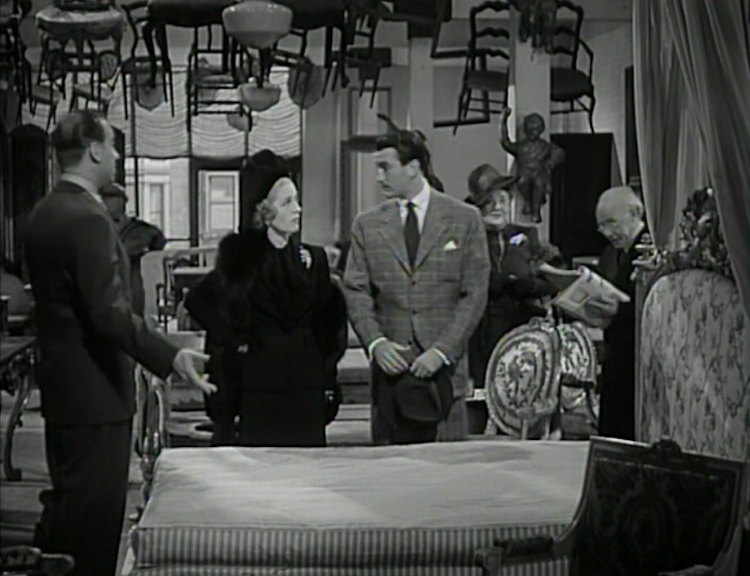
Just a sofa and some armchairs - prestige props from the golden age of MGM


So far, this post would look to be about that film - of course one of my absolute favorites, and not because of my dear wife's name - but it isn't. It's actually about the furniture. Specifically, the sofa and two matching armchairs - nineteenth century or later, but made in a Louis Seize style - that were well chosen, quite appropriate adornments to the Paris salon of Gigi's Aunt Alicia. We see them very frequently throughout the film, in many separate scenes. I've become so familiar with them that, long ago, I started to notice them in other MGM films. Here are the examples I've found so far; in the future I hope to be able to add other instances of their use.

I have to apologize in advance for the poor quality of some of the images here, particularly the screen captures. I'm always very careful to share the best quality images on this blog but, in this case, I often didn't have any other options if I wanted to include the film.

*

"Marie Antoinette", 1938. The first image I found marks an appearance that didn't actually happen. This is a camera set-up for a scene that was perhaps shot and then not included in the finished film. As the slate shows, this is meant to be madame du Barry's salon. But the only time this set is seen in the film, while most everything else in this corner of the room is visible, the sofa and chair are not. (The slate also mentions French director Julien Duvivier who directed scenes in the film, though sole directing credit went to W. S. Van Dyke.) 


"Ninotchka", 1939. With Greta Garbo and Melvyn Douglas.


"New Moon", 1940. Publicity portraits of Jeanette MacDonald and a very poor screen capture featuring Mary Boland and company.


"We Were Dancing", 1942. With Norma Shearer, Melvyn Douglas, Lee Bowman, Florence Bates, and Barlowe Borland.


"Reunion in France", 1942. With Joan Crawford and Morris Ankrum.

At the left, partly hidden by Ankrum, is a stool that looks like it could be part of the suite or at least covered in matching fabric.

"Meet Me in St. Louis", 1944. With Judy Garland, Harry Davenport, and Tom Drake.


"Madame Bovary", 1949. With Jennifer Jones, Frank Allenby, Gene Lockhart, Henri Letondal, Alf Kjellin (as Christopher Kent), and Gladys Cooper.

Jones as Emma Bovary admires a bit of embroidered (woven? printed?) fabric that we'll soon see on the back of a chair.

"An American in Paris", 1951. With Gene Kelly and Nina Foch.

More than once we see one of the armchairs flanking the front door of the Paris apartment of Milo Roberts (Foch).
Later, we see another on the other side of the door.

"Scaramouche", 1952. With Nina Foch (again) and Mel Ferrer.

This shot begs the question: just how many chairs were there? I'd always assumed there were only two, as I've never seen more than a pair
featured elsewhere. But there appears to be at least five here. Are they all part of the same suite, or are they just covered in the same fabric?

"The Swan", 1956. With Grace Kelly, Alec Guinness, Louis Jourdan, Jessie Royce Landis, Brian Aherne, and Estelle Winwood.


And the one, "Gigi", 1958. With Leslie Caron, Hermione Gingold, and the wonderful Isabel Jeans as Aunt Alicia.


*

The sofa and two armchairs were featured in the catalogue of MGM's famous/infamous 1970 studio auction. I wonder what became of them...?


*

If anyone knows of additional film appearances of this suite, please let me know. I'd really appreciate it.