Adapted from the Tate's website:
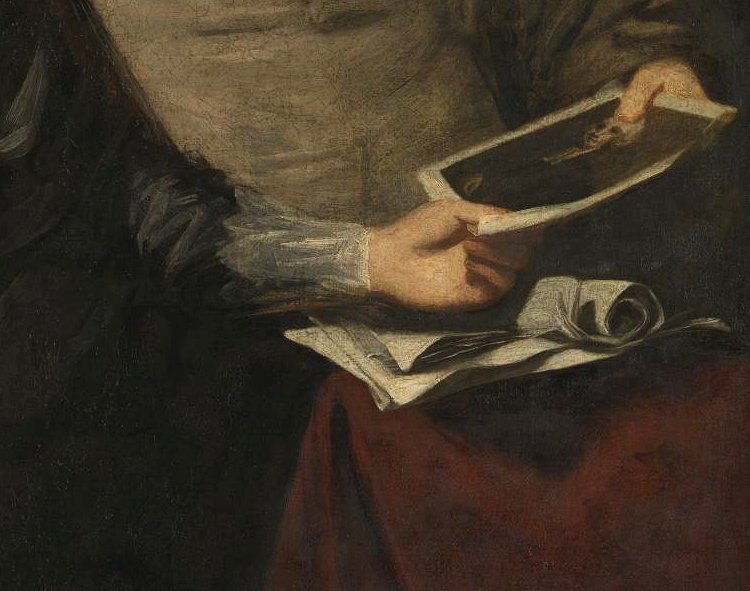
This double portrait is a poignant record of the friendship between two young men, George Huddesford (1749-1809), at left, and John Bampfylde (1754-97). It is not known exactly when this portrait was painted, although Huddesford paid Reynolds one hundred guineas in October 1778, by which time the picture was probably complete. Huddesford, who is dressed in a black silk van Dyck costume, looks towards the viewer while proffering his companion an engraving, presumably selected from the bundle beneath his hand. Bampfylde examines the print, which he takes in his left hand, while holding the neck of his violin in his right. The print in question, which is also based upon a portrait by Reynolds, depicts Joseph Warton, a close friend of the artist, and Master of Winchester College, where both Huddesford and Bampfylde had been pupils. The inclusion of Warton's image lends a suitably scholastic air to a portrait that seeks to emphasize the friends' common interest in the pursuit of learning and the fine arts. Reynolds's composition is a deliberate evocation of the Renaissance friendship portrait, celebrating the fraternal bond between two young men. However, shortly after the portrait was completed their relationship was disrupted by Bampfylde's encroaching mental illness.
Huddesford was baptized on 7 December 1749 and, after leaving Winchester, enrolled at Trinity College, Oxford, where his father was President. In 1771 he was granted a fellowship at New College, although he gave it up the following year, having "married his girl friend hastily in London, carried away by youthful passion." Shortly afterwards he studied painting under Reynolds. However, it was his satirical poem Warley, published in two parts between October and December 1778, that first gained him notoriety as a wit, and which must have been written at the very time the present portrait was being painted. He subsequently trained as a clergyman. He died in London on 7 October 1809, aged fifty-nine.
John Codrington Warwick Bampfylde was born on 24 August 1754, the younger son of Sir Richard Warwick Bampfylde, 4th Baronet, of Poltimore, Devon. John Bampfylde was a gifted poet and musician, his ability to improvise at the keyboard being regarded as "most original and most extraordinary" by the composer and music teacher William Jackson. According to Jackson, Bampfylde expressed a romantic wish to live in solitude in the country, dedicating his life to his music and poetry. However, under pressure from his family Bampfylde moved to London, where he fell desperately in love with Reynolds's niece, Mary Palmer. In 1778 Bampfylde dedicated a volume of sonnets to her and, in 1779, a poem entitled To Miss Palmer's Pet Monkey, whose privileged position he contrasted to his own wretched state. Sadly, Miss Palmer rejected his advances, and he lapsed into insanity. Bampfylde spent the remainder of his life in a "private madhouse" in Sloane Street, recovering his mind briefly, just before his death from tuberculosis in December 1797.




_01.png)


.png)


,%20later%20Countess%20Demidova,%20circa%201794-5.png)


