L a - b e a u t é - s a u v e r a - l e - m o n d e ~ D o s t o ï e v s k i

L a - b e a u t é - s a u v e r a - l e - m o n d e  ~  D o s t o ï e v s k i


Friday, August 21, 2020

Evening gown from the Maison Margaine-Lacroix, circa 1913


From the Metropolitan Museum:

"This rare and sumptuous gown of pale pink satin reflects the subtle move toward a slender, more naturalistic figure prior to WWI and foreshadows the dramatic shifts that would occur in fashion during the following decade. The elegant symbiosis between the placement of metallic lace, silk net, incandescent sequins, and beaded black passementerie is both typical of the period and emblematic of the refinement and skill of the couture house."


*

Maison Margaine-Lacroix (French, active 1868–1929), was founded - as Maison Margaine - by Armandine Fresnais-Margaine (1835-1899), and, following her death, continued by her daughter Jeanne Victorine Margaine-Lacroix (1868–1930). Although frequently overlooked by fashion historians, the house's innovations were quite influential during the early twentieth century. Most notable were their ideas about undergarments. They introduced their robe Tanagréenne, a gown worn with its own modified corset, in 1899 and, a few years later, their robe Sylphide, advertising that the dress removes the corset which "it makes up for with an ingenious combination of lining." The house patented several versions of the robe Sylphide and corset Sylphide, and produced other groundbreaking designs, all in the service of producing and promoting a more natural look, using soft, stretchy knitted silk fabrics to help shape the figure - some of them closely resembling modern "body shapers" like Spanx - and doing away with the rigid lines of the period's corset. As expressed by Jeanne Margaine-Lacroix, “Suppleness is demanded by women, because that alone gives ‘line.’ Stiff, hard bands cannot meet their wishes.”


Sunday, August 16, 2020

An astonishing painting and a mystery solved - a portrait of Laure Hayman by Federico de Madrazo y Ochoa, circa 1900-1910


I found an image of this outrageous painting some time ago. I saved it to one of my blog files, intending to use it in a "Randomly" post, posts I like to fill with odd or surprising things to go along with those that are merely beautiful. But at the last moment, intrigued by the painting - a decidedly middle-aged woman posed undraped to the waist and clearly enamored of her own prodigious breasts, a work beautifully painted and obviously a portrait, but with the sitter unidentified - I had to try and find out more. I hunted for other appearances of the painting on the internet, but only found one, from when the painting was being auctioned in Barcelona three years ago. Again, only the painter was identified, and there was no other information listed on the site. But... the auction house included pictures of the back of the painting, not an uncommon thing, often included to show the overall condition of a piece to potential bidders. And on the back of the frame were scrawled, one over the other, two names: "Gladys Harvey" and "'O--- de Crécy."


The first meant nothing to me but, even though I've never read La Recherche - embarrassed to say! - the name de Crécy was familiar to me as one of Proust's characters. I thought perhaps this Gladys Harvey might be the author's model for Odette, the future madame Swann. After hunting a bit more I came to understand that Gladys Harvey was also a fictional character, one in a short story of the same name by Paul Bourget. (It's said that soon after meeting the teen-aged Proust, the model for both characters gave the writer a copy of Bourget's story bound in the silk of one of her petticoats.) After just a bit more searching I came upon the name of the real woman - Laure Hayman - who had inspired the two writers. And comparing other images of Hayman with the subject of the painting I feel quite certain that this is the celebrated courtesan, herself. Now, as to when exactly the portrait was painted and, more, why, I don't expect I'll ever know.

*

Portrait by Raimundo de Madrazo y Garreta - father of the featured artist - circa 1880s.

Laure Hayman (11 June 1851 Valparaiso -1932 or 1939 Monaco), famous demi-mondaine of the Belle Epoque. Of Belgian, French, Creole, and English origins and a descendant of the painter Francis Hayman, the master of Thomas Gainsborough, she was born in Chile, the daughter of an engineer. After her father's death, and apparently encouraged by her mother, she became a courtesan. Numbered among her reputed lovers were the duc d'Orléans, Charles de La Rochefoucauld, King George I of Greece, Charles-Egon IV zu Fürstenberg, Louis Weil - great-uncle of Marcel Proust - and Adrien Proust, father of the writer. But it's said that her only true love was Prince Alexis Karageorgevich, a pretender to the throne of Serbia, living in exile in Paris. For many years she lived on the generosity of the Dutch-born French banker Raphaël Bischoffsheim, and the salon she gathered at her hôtel particulier at 4 rue Lapérouse - she would later move to 34 avenue du Président-Wilson - became known for its brilliance. In 1888 the seventeen year old Marcel Proust first met her there, soon becoming an habitué of her salon and a close friend. If she is remembered now it is really only because she served as the main model for Proust's Odette de Crécy in his À la recherche du temps perdu. But she also had a real talent as a sculptor; she exhibited at the Salon d'Automne in 1905, gaining much positive notice, and showed her work at the Galerie Georges Petit in 1913. Many well-known artists - including Isadora Duncan - served as her models. Information about her life, particularly her later life, seems to be scarce, even as to the date of her death when she was either eighty-one or eighty-eight.

Photograph by Nadar, 1879
Pastel portrait by Julius Leblanc Stewart, 1882.
Photograph by Benque et Cie, circa 1880s.
Circa 1905-10.

*

Federico de Madrazo y Ochoa (1875, Rome - 1934, Madrid), Spanish painter who worked mostly in Madrid and Paris. He was part of a famous family of Spanish artists which included his father Raimundo de Madrazo y Garreta, his uncle Ricardo de Madrazo y Garreta, his grandfather, Federico de Madrazo y Kuntz, and his great-grandfather José de Madrazo y Agudo.


Friday, August 14, 2020

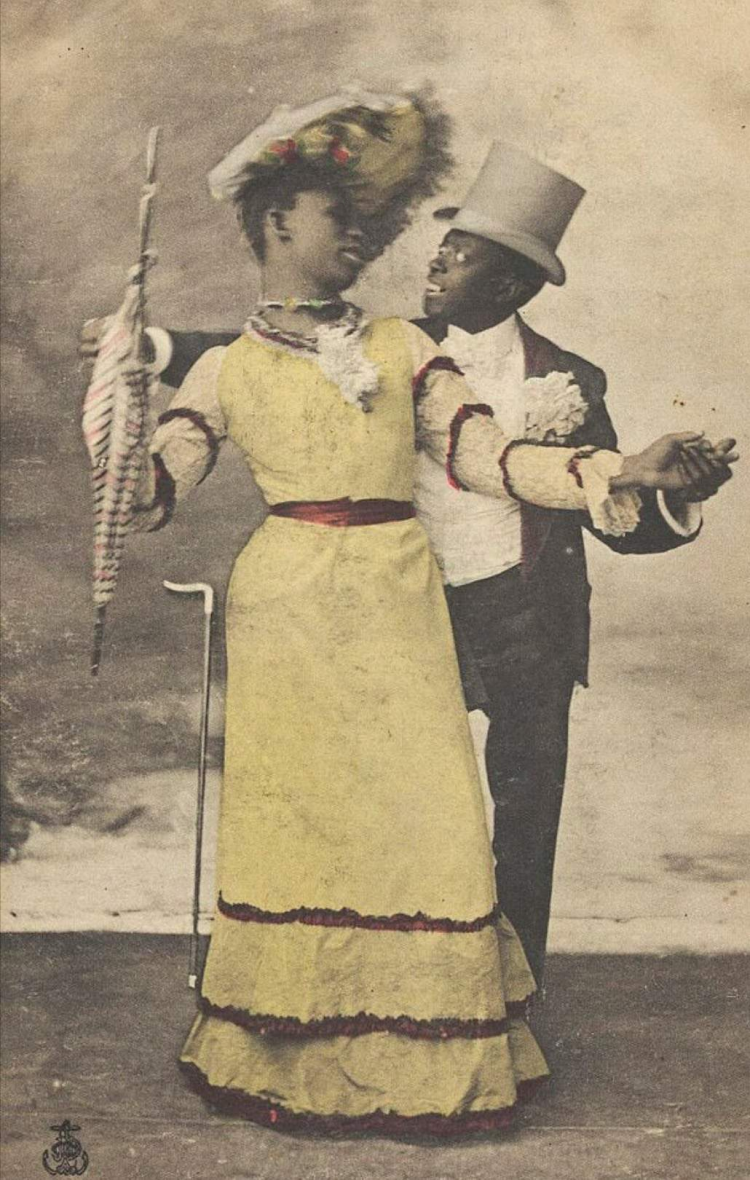
"Les Nègres" in Paris - Jack Brown and Charles Gregory, postcards publicizing their engagement with the Nouveau Cirque, 1902


*

Jack Brown (5 March 1875 - after 1920), African-American female impersonator and dancer. Born in Petersburg, Virginia the son of Alfred Brown - who was later institutionalized in an insane asylum - and a mother whose name is unknown, he arrived in Europe sometime between 1900 and 1902. In October 1902, he was engaged by Jean Houcke for his "Les Joyeux Nègres" spectacle at the Nouveau Cirque in Paris. Opening on 24 October 1902, the show ran for eleven months, and was a huge commercial success. During the run of the production, Jack performed as a female impersonator alongside his partner, Charles Gregory, together dancing the then-wildly-popular Cake-Walk. During the winter of 1902-03, the production was filmed by the Cinématographe Lumière company. In 1904, Brown visited Moscow, and we find him in Paris again in April of 1910 with a partner, a Miss Carslyle, again dancing the Cake-Walk. He performed in Paris, London, and toured Russia during the next four years. At the beginning of 1914, he returned to the United States for eight months before returning to England at the outbreak of WWI; he spent the next five years living in London and touring around the British Isles. Early in 1917, he married a Scottish woman, Vera MacFarlane, and in the fall of 1919, he returned to Paris with a contract to appear at Ciro's. Apparently, there is no information about him beyond that. (Biographical date courtesy of Dulce Jennings.)

I haven't been able to find any information on Charles Gregory other than he had been a member of the Florida Blossoms minstrel troupe.


*

I came across these images because some of them had been used in publications related to William Dorsey Swann, the self-proclaimed first "Queen of Drag." And with the internet being the internet, these pictures of Jack Brown are now generally identified as being of Swann. William Dorsey Swann is a very interesting historical character -  Channing Gerard Joseph’s article in the 31 January 2020 edition of The Nation is entitled “The First Drag Queen was a Former Slave” - and you can read more about him here.


Sunday, August 9, 2020

A singular and mutable beauty - portrait photographs of Merle Oberon


Three images from the same sitting. This first looks to be inscribed to Oberon's best friend of many years, Norma Shearer.
Two images from the same sitting.
Two images from the same Beaton sitting.
Two images from the same sitting.

*

The photographers here include Steichen, Hurrell, Beaton, and others.