Detail of Baron Gérard's coronation portrait of Charles X.
The French crown jewels having been stolen during the Revolution, a new crown had to be made for Louis XVIII. Napoléon had finally left the stage - again - and the Bourbon Restoration was successfully established, but Louis still thought it politically imprudent to go through with a coronation. So, after modifications, the crown was used for the first and last time at the coronation of his brother and successor, Charles X, at Reims in 1825. The crown went into storage at the fall of Charles in 1830; his cousin, the new "Citizen King", Louis-Philippe, also thought that a coronation would set the wrong tone with the French populace. After he was overthrown, eighteen years later, the Bonapartes came back to power, and Napoléon III - who would also eschew a coronation - had the crown dismantled in 1854, the stones re-used in new jewelry. Then, sixteen years after the collapse of the Second Empire, the frame itself was melted down. A year later came the famous sale of the French Crown Jewels; republican France would never again have use for a crown.
The écrin-couronne; made of stamped and gilded Morocco leather on a wooden base, the crown's fitted case survives.
Gérard's scene of the coronation of Charles X, circa 1827.
Detail of above.
There are many copies and variations of Gérard's coronation portrait, circa 1825.
Detail of above.
A large-scale miniature of Gérard's portrait, the work of Henry Bone, 1829.
Detail of above.
Detail of the Bone miniature.
***
Lastly, a plaster cast of the crown; casts of finished work were very frequently made by jewelers, especially in the case of important commissions. The crown was originally executed and later adapted by Christophe-Frédéric Bapst to the
design of his uncle, Evrard Bapst. The base is in the shape of a
band surmounted by sixteen fleur-de-lys alternating in size, the eight largest of which form the bases of arches which gather in the center and are surmounted by a
finial in the shape of a fleur-de-lys. The entire surface of the crown was set with diamonds and sapphires - while the surface of the plaster cast is still covered in pencil markings, notes to specify the location of each particular stone.
Guido Cagnacci (19 January 1601, Santarcangelo di Romagna – 1663, Vienna), Italian painter of the Baroque period. From the National Gallery's website:
Little documentation about Cagnacci survives, so it is often through the scandalous elements of his personal life rather than his artistic practice that we are able to locate him.
Cagnacci was born in Santarcangelo [di] Romagna, seventy miles southeast of Bologna. He perhaps trained there with a local artist, but by 1618 he was in Bologna, where he may have studied briefly with Ludovico Carracci. Cagnacci made two visits to Rome between 1618 and 1621, and on Easter Day 1622 he was documented there in the house of fellow artist, Guercino. From 1622 until 1627 no records about Cagnacci survive at all.
Cagnacci’s first documented work dates from 1627, when he was commissioned by the Confraternity of the Holy Sacrament of Saludecio, a small town between Urbino and Rimini, to decorate a chapel in a parish church. He is described in this contract as ‘Guido Cagnacci pittore di Rimini’ (‘painter from Rimini’), where he appears to have lived for much of the 1620s. Indeed, in 1628 he was recorded in the criminal records for attempting to run away with a rich widow in Rimini. In 1636, he is again documented in Rimini, this time when an unmarried woman with whom he’d had a relationship signed over all her belongings to him.
Around 1640, Cagnacci was again in Bologna, where he began to paint the seductive, half-length female figures for which he is best known. These paintings are indebted to Bolognese artist Guido Reni, but Cagnacci went further than Reni in the overt sensuality of his figures. From 1649, Cagnacci was resident in Venice, working entirely for private patrons, amongst whom these sensual half-lengths were very popular. Contemporaries joked at Cagnacci’s expense that he only produced half-lengths because he could not paint feet.
Cagnacci was called to Vienna in 1658. [...] Dying in Vienna in 1663, Cagnacci was largely forgotten until the 1960s, when the rehabilitation of his reputation began in earnest. He is now recognised as one of the most accomplished and unconventional artists of the Italian Baroque.
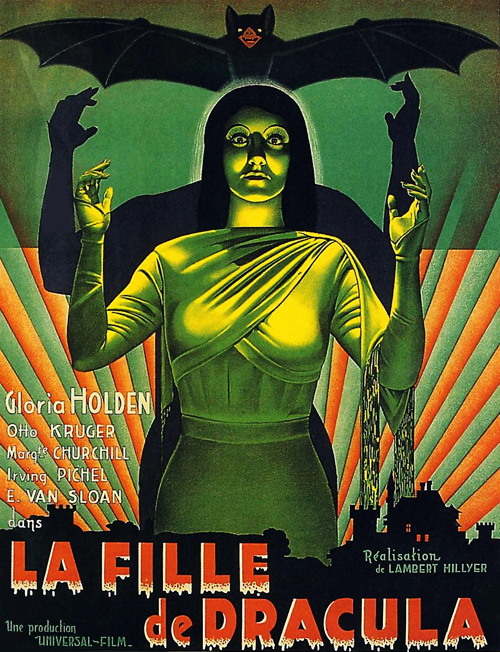
Fantastic photography, lighting, set and costume design, really fabulous promotional graphics; we haven't seen this film, but I have my doubts that it would stand up, filmically, to the promise of its imagery. So few of these early horror films do. They're usually disappointingly slow-paced and/or awkward and/or dull. No matter how celebrated they're become, how much scholarly film writing they've inspired, when one finally gets down to watching them, typically they're pretty flat. These images are so wonderful, though that, before long, I expect we'll have to give Dracula's Daughter a chance to prove herself.
***
***
With Nan Gray.
***
Gloria Anna Holden (5 September 5 1903, London – 22 March 1991, Redlands), American film actress. Born in England to a German mother and British father, she emigrated to the United States as a child. She attended school in Pennsylvania, and later studied at New York's American Academy of Dramatic Arts. She went on to small parts on Broadway, understudying others, and with an occasional leading role. She has a filmography of forty films, almost all in supporting roles. Her best-known came right at the beginning of her film career: the starring role in Dracula's Daughter and, the following year, the role of Madame Zola in The Life of Emile Zola.
She was married three times. She married Harry Dawson Reynolds in 1921. They had a son the following year; later, taking the name Glen Corbett, he was also an actor, and the father of actress Laurie Holden. She and Reynolds later divorced, and from 1932 to 1937 she was married to actor, promoter, film scout and dialogue director Harold A. Winston. (Holden stated during their divorce proceedings that Winston "said he didn’t like the state of
marriage - in fact, that he didn’t believe in it for artists." But he would apparently carry a torch for his ex- subsequent to their split; two years later, when just-signed William Franklin Beedle, Jr. needed a new name before his first big starring role, Winston suggested the last name of his former wife - and Bill Beedle became William Holden.)
She wed for the third and final time in 1944, and remained married to William Hoyt until her death. They had a son, William Christopher Hoyt, born in 1948 and killed in an
automobile accident - listed as a homicide - when he was just twenty-six. More than two decades later, Holden would die of a heart attack in Southern California at the age of eighty-seven.
Addendum: I couldn't help it. I concocted this post more than a month ago and, in the meantime, we rented the movie. Quite fun; actually, there's at least as much humor in the thing as there is horror. Well made, well acted, and it's a very nice looking film, with much better production values than one might expect from a "monster movie" from Universal Studios. Gloria Holden is a very interesting presence. I expected someone heavy-voiced and dripping with evil, à la Judith Anderson, but there is something vague and almost tender about Holden's Countess Zaleska. And, actually, in looks and voice, she reminded me a lot of a dark-wigged Meryl Streep. It's a very slight film, but much better than I would have expected.
Stephen O’Donnell is a mid-career fine artist, writer, and singer/performer. His paintings are widely collected, both in this country and abroad. Entirely self-taught, he is perhaps best known for his self-portraits, work which most often exemplifies the portrait historié - in which a recognizable subject is portrayed in period costume or mythological guise, to dramatic or comic effect - as well as his small paintings of animals. His premier collection of short fiction, Half-Light, appeared in July of 2023. His work – both literary and visual – has appeared in the literary magazines/journals Nailed, Menacing Hedge, Buckmxn Journal, and Gertrude. He is married to writer and graphic designer Gigi Little, with whom he sometimes performs. Their book, The Untold Gaze – a collection of Stephen’s paintings paired with short fiction by thirty-three authors – was published in October of 2018. They live in Portland, Oregon.
The UNTOLD GAZE
The UNTOLD GAZE is a large format fine art book - 11x11 inches hardbound, 160 pages, full color - a collection of almost ninety of Stephen's paintings paired with short fiction and poetry inspired by his work. Included among the thirty-three authors are Lidia Yuknavitch, Tom Spanbauer, Monica Drake, Sam Roxas-Chua, and Whitney Otto. Click on the image above if you'd like more information on how to purchase the book.