L a - b e a u t é - s a u v e r a - l e - m o n d e ~ D o s t o ï e v s k i

L a - b e a u t é - s a u v e r a - l e - m o n d e  ~  D o s t o ï e v s k i


Sunday, December 18, 2016

The gilding of perfection - the work of Pierre Gouthière


"Each to his own taste", as the saying goes. And the designs of the rarefied objects that Gouthière contributed to are certainly not pleasing to every viewer. "Over the top", "gaudy", "fussy", etc., might be some of the expected, disapproving reactions. But to his original clients and to his latter-day "fans" - count me in, whole-heartedly - he was truly a great artist, a genius, one of the greatest craftsmen of all time.

Pair of candelabra, circa 1780-1785. (Four images.)
From the collection of the duc d'Aumont. (Five images.) Pair of incense burners, circa 1775.
One of a pair of vases, 1782.
One of a pair of vases, circa 1770–75.
Pair of Candelabra, 1782.
Vase, circa 1775–80.
Pair of firedogs, circa 1780-85.
Pair of vases, circa 1785. (Three images.)
Pair of vases, circa 1775.
One of a pair of candelabra, circa 1785-90.
From the collection of Marie Antoinette. (Two images.) Pair of ewers, from the cabinet de la méridienne, Versailles, circa 1785.
Pair of firedogs, from the boudoir turc, Fontainebleau, 1777.
Clock, circa 1785-90.
Footed bowl, attributed to Gouthière, circa 1785.
From the collection of the duchesse de Mazarin. (Two images.) Pair of wall lights, circa 1780.
Side table, 1781.
Pair of wall lights, attributed to Gouthière, circa 1785.
From the collection of the duc d'Aumont. (Two images.) Pair of vases, circa 1770–75.
Vase, circa 1775–80.
Pair of candelabra, circa 1785-90.
Pair of vases, circa 1775. (Two images.)
From the collection of the comtesse du Barry. (Two images.) Window knob, circa 1770.
Firedogs from the grand salon carré in the pavilion at Louveciennes, 1771.
One of a pair of candelabra, attributed to Gouthière, circa 1785-90.
From the collection of Marie Antoinette. Secrétaire à abattant, designed by Jean-Henri Riesener, 1783. (Four images.) Additional post HERE.

***

The Hôtel Gouthière, his mansion in the 10th arrondissement of Paris; built in 1780, he was forced to sell it eight years later.

Pierre Gouthière (1732, Bar-sur-Aube - 1813, Paris), French metal worker, specifically a ciseleur-doreur, considered to be the greatest of his time. Adapted from the Getty Museum website:

The son of a saddlemaker, Pierre Gouthière rose to become the most famous Parisian bronze chaser and gilder of the late 1700s, receiving commissions from some of the leading connoisseurs of his day. Like many successful apprentices, he married the widow of his first employer and took over his establishment. Success came quickly, and in November 1767 he received the title of doreur seul ordinaire or doreur du roi (gilder to the king) from Louis XV. He also supplied works to the comte d'Artois, the duc de Penthièvre, the duc d'Aumont, the marquis de Marigny, and the marchand-mercier Dominique Daguerre, among others.

Gouthière was a master of chasing and invented a new type of gilding that left a matte finish, la dorure au mat. He combined polished with matte finishes to create varied effects on the surfaces of his bronzes. He made many types of objects, including furniture mounts, ornaments for mantelpieces and coaches, and mounts for porcelain or marble vases.

Gouthière was successful and enjoyed an extravagant lifestyle. By the middle of the 1780s, however, after the deaths of two of his major patrons, unwise financial speculations on his part and, mostly, due to the unpaid bills of the comtesse du Barry, mistress of the late Louis XV - she owed him some 750,000 livres for nearly twenty years' work - he was finally forced into bankruptcy in 1787. The Revolution completed his ruin. He died in poverty, still trying to make her heirs repay him. (She, herself, had been executed at the height of the Reign of Terror in 1793.) The case was finally resolved twenty years later, when his son received a small fraction of the original debt as reimbursement.


Friday, December 16, 2016

Gently polished ladies - six portraits by Jacques de Lalaing


Countess Louise de Baillet, 1902.

Better remembered as a sculptor - if, frankly, remembered at all - the Belgian Lalaing also produced calm, coolly elegant, and very smoothly finished portraits; of the examples I've been able to find, the vast majority are of aristocratic - or at least very genteel - ladies. Most if not all of those featured here appear to have been done in pastel.

Mrs. William Barrett Ridgely, née Kate Deering, 1896.
Mlle. Hélène de Burlet, 1894. (The young lady later became a nun and endured imprisonment during both world wars.)
"Lady Saphire", circa 1910s.
Countess Maximilien de Lalaing, née Julia Vibart, mother of the artist, 1896.
Countess Charles de Lalaing, née Baroness Christine du Tour van Bellinchave, sister-in-law of the artist, 1906.


Sunday, December 11, 2016

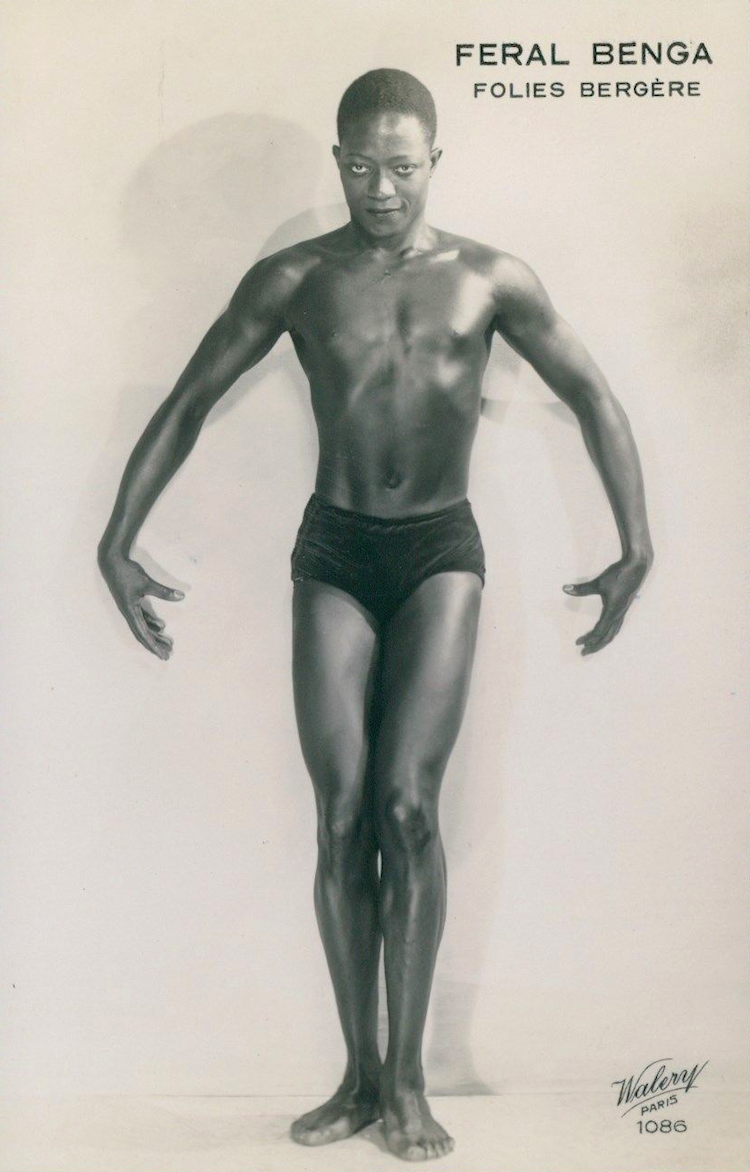
L'Ange noir aux Folies Bergère - dancer Féral Benga


These first images are all by Waléry, Paris, circa 1930.

Féral (François) Benga (1906, Dakar - 4 June, 1957, Paris), Senegalese dancer and model. He was the illegitimate grandson of one of the richest landowners in Dakar, his father had been educated by Catholic missionaries in France, and his uncle was a successful lawyer in Paris. He emigrated to Paris in the early Twenties, adopting the stage name of Féral (wild beast); he was promptly disinherited by his father for "living disgracefully and embracing whiteness". In 1925 he auditioned for and was given a contract by the Folies Bergère and, by the next year, he was one of the group of semi-nude young men playing the drums while Joséphine Baker danced in her infamous banana skirt; the revue was La Folie Du Jour, and Baker and Benga were both only twenty years old. The latter soon became well known as a dancer, himself, an exotic and erotic male counterpart to Baker. It appears that he, like Baker, well understood the commodification of black culture and the black body and his marketability as an object of desire, in his case, particularly in artistic and homosexual circles. He performed successfully in revue after revue, well into the Thirties. While his career didn't have the length and breadth of Baker's, his image survives in the work of photographers Carl Van Vechten and George Platt Lynes, the painter Pavel Tchelitchew, the well known African-American sculptor, Richmond Barthé, and others. He also appeared in a handful of films, most famously as the ange noir in Cocteau's great, surrealist Le Sang d'un Poète of 1930. He accompanied the English anthropologist and author Geoffrey Gorer on a tour of Africa in 1935; the two may have been lovers. (Most of the the artists he collaborated with were gay or bisexual, and his own love life was fairly active.) Up until World War II, it seems he enjoyed a rather lavish and showy lifestyle: a large apartment near the Champs-Élysées, a custom-made Delahaye convertible, a small army of poodles. Not much is known of his life during the war, and what there is is contradictory. At the Olympia Theatre in 1943 he performed in the ballet "Tam Tam", part of which he choreographed. But it's also said that he suffered greatly - physically and emotionally - during the Occupation and had to go into hiding. Having had his own small cabaret before the war, from 1946 he worked at then owned and operated La Rose Rouge, a popular and fashionable cabaret-restaurant on the Left Bank. But eventually, changing times and his lack of business acumen meant that, after ten years, he was forced to close in 1956. At this point, only a year before his death, his family in Senegal decided to welcome him back into the family circle. There, he submitted to familial pressure and - quite unexpectedly - married a cousin, and is even said to have fathered a son. Still, he soon returned to Paris where he died of a pulmonary embolism at the age of only fifty-one.

In costume for his Danse du Sabre.
Costumed for the Folies Bergère "Un coup de Folie", 1930.
Four photographs by George Platt Lynes, circa 1934.
Ten photographs by Carl Van Vechten, 1937.

***

Advertisement for the Folies Bergère "Un coup de Folie", 1930.
Impersonating Joséphine Baker in Tout Pour Joséphine (?), by Studio V. Henry, 1926.
Unknown dance, by Studio V. Henry, circa 1926.
Backstage at the Folies. A scene and an image that would be unimaginable - for so many reasons - in the United States at that time.
As the ange noir in Cocteau's Le Sang d'un Poète, 1930. (Here, his makeup is being touched up.)
Deposition (Féral Benga), by Pavel Tchelitchew, 1938.
Ink wash sketch, by Pavel Tchelitchew, 1938.
"Féral Benga, Senegalese Dancer", by Richmond Barthé , 1935.
At La Rose Rouge, circa 1950.
Signed and dated 1936.
Unknown photographer, ND.