L a - b e a u t é - s a u v e r a - l e - m o n d e ~ D o s t o ï e v s k i

L a - b e a u t é - s a u v e r a - l e - m o n d e  ~  D o s t o ï e v s k i


Saturday, February 6, 2016

Portraits d'hommes


Andrew Copland, by George Watson, 1802.
Portrait of a Man, by Domenico Tintoretto, circa 1586-1589.
Unknown, nd.
Portrait of a Man, by William Allan, 1814.
Colonel George Douglas, later 13th Earl of Morton, by John Smibert, 1727.
Self-Portrait as a Child, by Alexandre Cabanel, 1836. (He was thirteen when this was painted.)
A Young Man Wearing a Wreath of Vine Leaves, by Jacob Adriaensz Backer, 1630.
Portrait of a Middle-Aged Man, by Karl Wilhelm Bardou, 1821.
Paul Swan - "The Most Beautiful Man in the World", circa 1910.
Man Wearing Laurels, by John Singer Sargent, circa 1874-80.
Francis Greville, Baron Brooke, later 1st Earl of Warwick, by Jean-Marc Nattier, 1741.
Raden Syarif Bustaman Saleh, attributed to Friedrich Carl Albert Schreuel, circa 1840.
James Schuyler, by Fairfield Porter, 1955.
Self-Portrait, by Frank Holl, 1863. (He was eighteen when this was painted.)
Benjamin Tevis, by Thomas Sully, 1822.
Andries Stilte as a Standard Bearer, by Johannes Cornelisz Verspronck, 1640.
Unknown, nd.
Self-Portrait in Hell, by Edvard Munch, 1903.
Anne Louis Goislard de Montsabert, comte de Richbourg-le-Toureil, by Nicolas de Largillière, 1734.
August Semeleder, by August Xaver Carl von Pettenkofen, 1840.
Portrait of a Man, by Diego Velázquez, circa 1630.
Portrait of a Man, by François-Xavier Fabre, 1809.
Unknown Japanese, nd.
David Johnston, by Pierre-Paul Prud'hon, 1808.


Wednesday, February 3, 2016

Grand Duchess Olga Alexandrovna, by Pyotr Neradovsky, 1905


The last Tsar's younger sister at home, looking very elegant and retiring; she was neither. Rather, she was kind, very down to earth, and a talented artist herself - the sale of her watercolors would later help sustain her immediate family in exile. Four years before this portrait was painted, she'd been pushed/stumbled into a marriage which was the great mistake of her life. (It was a marriage that would also remain unconsummated; her husband, Duke Peter of Oldenburg, was almost certainly homosexual.) Two years before this portrait was painted, she'd met the man who would be the great love of her life, Nikolai Kulikovsky, a fellow officer of her brother Grand Duke Michael and a commoner. She soon asked her husband for a divorce, but he refused. The couple would have to wait for thirteen years until, in the thick of World War I, with Olga nursing with the Red Cross in the Ukraine, her brother the Tsar finally agreed to annul Olga's marriage. On her wedding day in November of 1916, she took off her nurse's uniform, put on a simple gown and, surrounded by only her mother, a brother-in-law, four officers from the regiment, and two of her fellow nurses, she and Nikolai were married in Kiev. They would have two sons and were devoted to each other through all their years of exile in Denmark and, later, Canada. Kulikovsky died in 1958, Olga two years later.


***

Pyotr Ivanovich Neradovsky (1875 - 1962), Russian painter, graphic artist, art historian, and museum curator. He studied at the Moscow School of Painting, Sculpture, and Architecture under Korovin and Leonid Pasternak, and at the Academy of Arts under Repin. Becoming a member of the New Society of Artists in 1903, he was known for his fine pencil portraits of his contemporaries. From 1909, he worked as curator of the arts department of the Russian Museum, later becoming director of the department and, following that, a member of the Russian Museum Board. In the Twenties and early Thirties, he also worked at the State Hermitage, the Academy of Material Culture History, and the State Tretyakov Gallery. For several years, during the Thirties and again in the early Forties, he was imprisoned on false charges. (I don't know what those charges were; under the Stalin régime, many were imprisoned - or worse - based on trumped up charges.) Later he worked in the Zagorsk Museum.


Saturday, January 30, 2016

James Hamilton, 1st Duke of Hamilton - two portraits by Daniël Mijtens


The first portrait by Mijtens, taken in 1623, when the then Earl of Arran was seventeen.

James Hamilton, 1st Duke of Hamilton (19 June 1606, Hamilton Palace, Lanarkshire, Scotland – 9 March 1649, Old Palace Yard, Palace of Westminster, London), Scottish nobleman, controversial political leader, and unsuccessful military commander.


Born the son of James, Marquess of Hamilton and the Lady Ann Cunningham, following the death of his great-uncle James, Earl of Arran in 1609, the three-year-old was henceforth styled Earl of Arran. At the age of eleven he went with his family to live at court in London. At fifteen he was married off to a nine-year-old relative of the King's favourite, the Duke of Buckingham. (The union was only brought about to satisfy Buckingham's political aims, and it appears the young Hamilton was unhappy with the marriage. The couple nevertheless produced six children - of which only two survived childhood, both girls.)


His father died in 1625, and three weeks later so did King James VI. The new marquess was only nineteen, but inherited all his father's titles and privileges; at the coronation of the new king, Charles I, Hamilton bore the Sword of State at Westminster Abbey. He soon was made a Gentleman of the Bedchamber, Knight of the Garter, a Privy Councillor in both England and Scotland, and Master of the Horse, a post he retained until 1644.
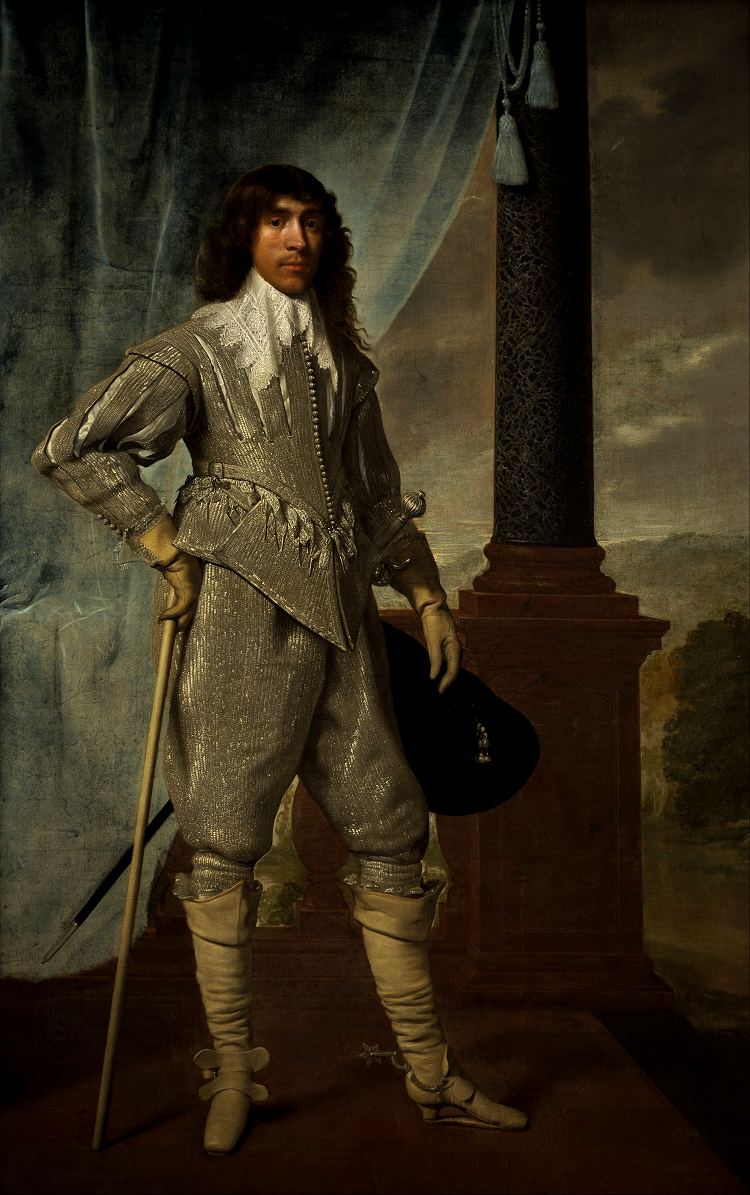
The second portrait by Mijtens, painted in 1629, when the now-Marquess-later-Duke of Hamilton was twenty-three.

In 1631, despite a lack of military training, he led an army of English and Scots to Germany to fight with the Swedish in the Thirty Years' War. Though Hamilton had to be propped up by more experienced officers, it appears he was no coward and was committed to his task. But his troops were never fully organized or well deployed and after disagreements with the Swedish king, he and many of his officers were discharged and returned to England.


On his return, Charles I appointed Hamilton his chief adviser in Scottish affairs. Six years later, with revolt breaking out in Scotland, Charles made him commissioner in an effort at appeasement, Hamilton being Scottish. There followed several years of political wrangling and intrigue, with Hamilton being attacked from both sides and his own sympathies fluctuating. Egotistical and probably not overly bright, he was also no stranger to intrigue, himself; toward the end of this period he was even accused of treason against the King by another Scottish nobleman.


He still held Charles' favor and confidence, though, and was further ennobled in 1643. The Marquessate of Hamilton was raised to that of a dukedom, and he was awarded the Marquessate of Clydesdale, the Earldom of Cambridge, the Baronies of Aven and Innerdale. In addition, he was also re-granted the Earldom of Arran. Though by this time the English Civil War had already broken out, Hamilton was still trying to control the Scottish political situation, foolishly antagonizing other powerful nobleman and even appearing to work against the interests of the king. Charles had finally had enough by the the end of 1643 and Hamilton was arrested. He spent three years in various places of confinement, but was liberated by Parliamentary troops in April of 1646.


Now returned to Charles' favor, the king conferred on Hamilton the heritable office of Keeper of Holyroodhouse. Then, after the King was delivered up to Parliamentary commissioners, Hamilton was able to temporarily gain authority in Scotland and, in July of 1648, he led a large army into England in defense of the King. He showed a complete inability as a military commander and, even with vastly superior numbers, was quickly defeated by Cromwell and his forces. He, himself, was taken prisoner at the end of August. His trial for treason began in February of the following year - seven days after the execution of the King. He was condemned on March 6 and beheaded three days later at the Old Palace Yard, Westminster. (A setting that had witnessed the executions of Sir Walter Raleigh and Guy Fawkes, among others.) He was forty-two. 


Wednesday, January 27, 2016

The Belvédère - Petit Trianon, Versailles


Between 1788 and 1781, to the designs of her personal architect, Richard Mique, a music salon was built for Marie Antoinette on a small artificial hill at Trianon, part of the new "English" garden on the estate. Called the Belvédère du Petit Trianon, or the Pavillon du rocher - after the adjacent artificial rock formation, waterfall, and grotto - it is a small octagonal stone "folly" in the neoclassical style. The four overdoors - incorporating attributes of gardening and hunting - and the carvings above the four windows - representing the Seasons - as well as the eight sphinxes flanking the pavilion are the work of the sculptor Joseph Deschamps, assisted by the young Pierre Cartellier. The interior is richly decorated with arabesques painted in oil on stucco by Sébastien François Leriche, while the ceiling painting was created by Jean-Jacques Lagrenée le Jeune, and the floor is a beautiful mosaic of white, red, green, and bleu turquin marble. In fine weather, the pavilion was furnished with eight armchairs - fauteuils en bergère - and eight chairs - chaises à dossier - the work of François II Foliot, and based on the models of architect Jacques Gondouin. (Delivered in 1781, the costly chairs were sold off during the Revolution; just one has been returned to Versailles.) After a year of meticulous restoration, the renewed and preserved Belvédère was inaugurated in June of 2012.

An anonymous watercolor made soon after the construction of the Belvédère.
One of the original chairs. The original upholstery was of painted blue and white silk, luxuriously trimmed.
Apparently, the embroidered fabric on this chair - not the one at Versailles - was modeled after the design of the original.

***

Most of the images in this post were adapted from those on the Andrewhopkinsart blogspot, whose own post on the subject tells the story of the Belvédère expertly!