L a - b e a u t é - s a u v e r a - l e - m o n d e ~ D o s t o ï e v s k i

L a - b e a u t é - s a u v e r a - l e - m o n d e  ~  D o s t o ï e v s k i


Sunday, July 19, 2015

Barbara Stanwyck and Gary Cooper, publicity for "Ball of Fire", photographs by George Hurrell*, 1941


***

Simply put, "Ball of Fire" is one of our favorite movies of all time...!

While putting together this group of publicity pictures, I noticed that Stanwyck's makeup in some of the photographs is very light, giving her a much softer look than she has in the film. Probably too soft for a character named "Sugarpuss" O'Shea. Hurrell was known for asking his actresses to wear little or no makeup during his shoots - he supplied the Hollywood perfection in the retouching process - so perhaps that's the reason for her lack of glamorous varnish.

* I'm not entirely certain that all of these are by Hurrell; aside from makeup inconsistencies, there are stylistic ones as well.


Saturday, July 18, 2015

Les autres dans l'atelier - how does one get any work done...?


In the studio of the artist, by Wilhelm August Golicke, 1832. The model is in the background,
dressing or undressing, but her little shoe is in the foreground by the posing platform.
The artist in his studio, by Gerrit Dou, circa 1628. I wonder about the rather ominous fellow in the doorway....
Frith in his studio painting Alexandra, Princess of Wales for "The Marriage of the Prince of Wales", by John Ballantyne, 1863.
Ballantyne's likeness of the Princess is no better than Frith's turned out to be.

Tsar Nicholas I and the artist, by Bogdan Willewalde, 1883. Painted almost thirty years after the death of the
Tsar, who appears to be actively "assisting" the artist; if the Tsar wants to help, who's going to tell him no?
The artist in his studio and his man Gibbs, by George Morland, 1802. What a dreary studio! But the drawings above the grate are charming.
L'Atelier de Houdon (Houdon modelant le buste de Laplace dans son atelier), by Louis-Léopold Boilly, 1804.
The painter in his studio, by Jan Miense Molenaer, circa 1633.
Im Atelier, by Moritz Stifter, 1890. Whose children have been brought in by the babushka'd crone?
Im Atelier des Malers, by Jan Josef Horemans II, circa mid-eighteenth century. The fellow at center is grinding pigment to make paint.
Atelier of the artist Venetsianov, by Alexander Alexeyevich Alexeyev, 1827. A young serf girl looks to have been put to work as a model.
The studio of Ingres in Rome, by Jean Alaux , 1818. The painter holds a violin rather than a paint brush, and a cat sleeps by the open door.


Wednesday, July 15, 2015

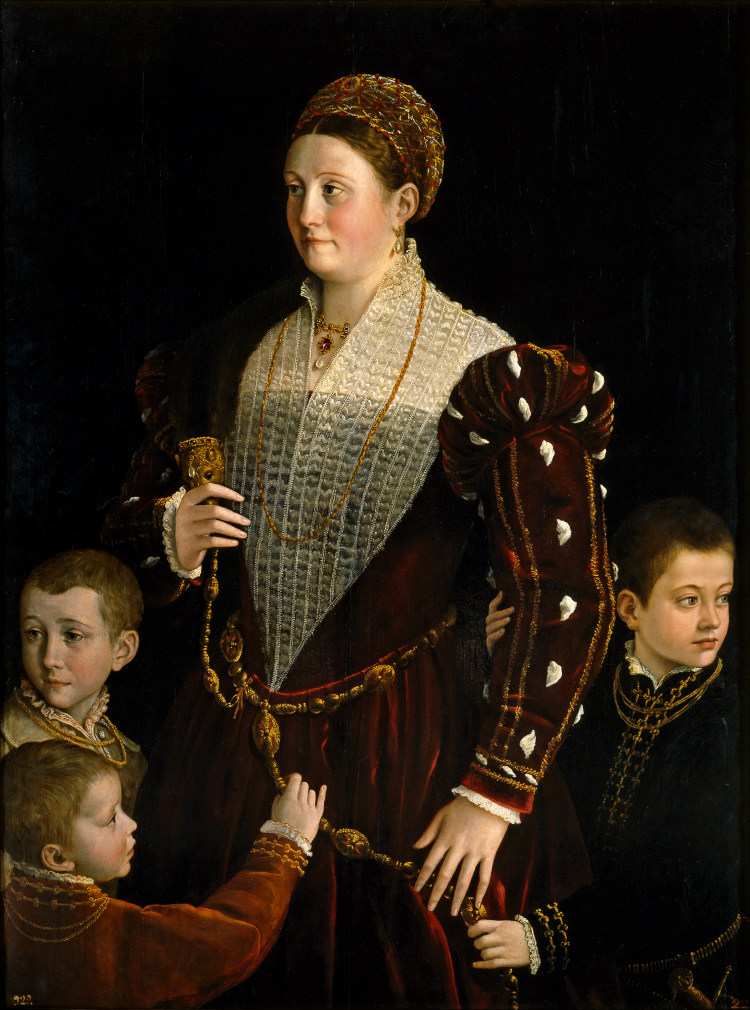
Portrait of Camilla Gonzaga and her three sons, attributed to Parmigianino, circa 1535-1540


Ritratto di Camilla Gonzaga coi tre figli, Museo Nacional del Prado, Madrid.

Camilla Gonzaga (1500, Vescovato – 1585, San Secondo Parmense), daughter of Giovanni Gonzaga, signore di Vescovato and Laura Bentivoglio. Lavishly dowried, she married the imperial general Pier Maria III de' Rossi conte di San Secondo in 1523. The marchesa consorte di San Secondo appears to have been a power in her own right, adept at deal-making and diplomacy while her husband was frequently off at war.

The pair had ten children together and she is shown here with three of their six sons, most likely Troilo, Ippolito, and Federigo. Parmigianino is the undisputed author of a portrait of the conte di San Secondo, this painting's pendant. But there is speculation that he only sketched out the design for this work, and that it was completed by other hands; an artist from the studio of Bronzino has been been put forward as one of the possibilities. Additionally, it is thought that the three boys were added later than the portrait of their mother, and by different artists and at different times. The faces of the two boys on the left, with what looks to be the dark background visible beneath the flesh tones, would appear to support that argument.

All that said, what would this painting be without the beautiful, pensive faces of the children, the three opposing and poetic depictions of gaze, the graceful compositional pattern of interconnection, the tender, clinging dance of the three boys around their beautiful, formidable mother?


***

Girolamo Francesco Maria Mazzola, most commonly known as Parmigianino: "the little one from Parma" (11 January 1503, Parma – 24 August 1540, Casalmaggiore), important Italian Mannerist painter and printmaker. Raised by his uncles, who were modestly talented artists, he was successful from an early age. Active in Florence, Rome, Bologna, and his native city of Parma, he died of a fever at the age of only thirty-seven.


Sunday, July 12, 2015

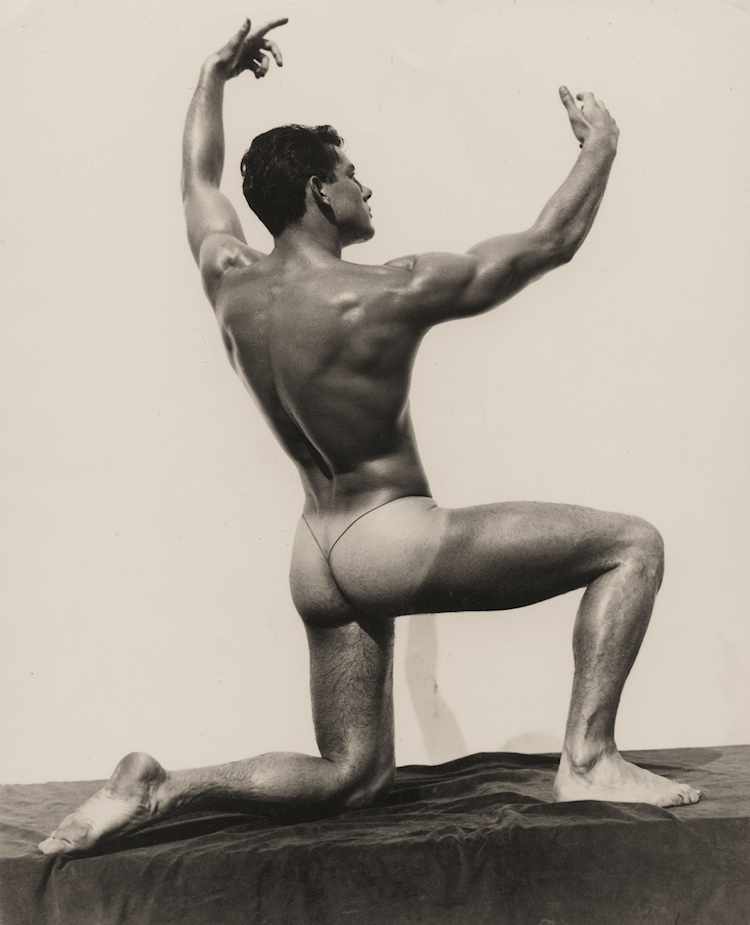
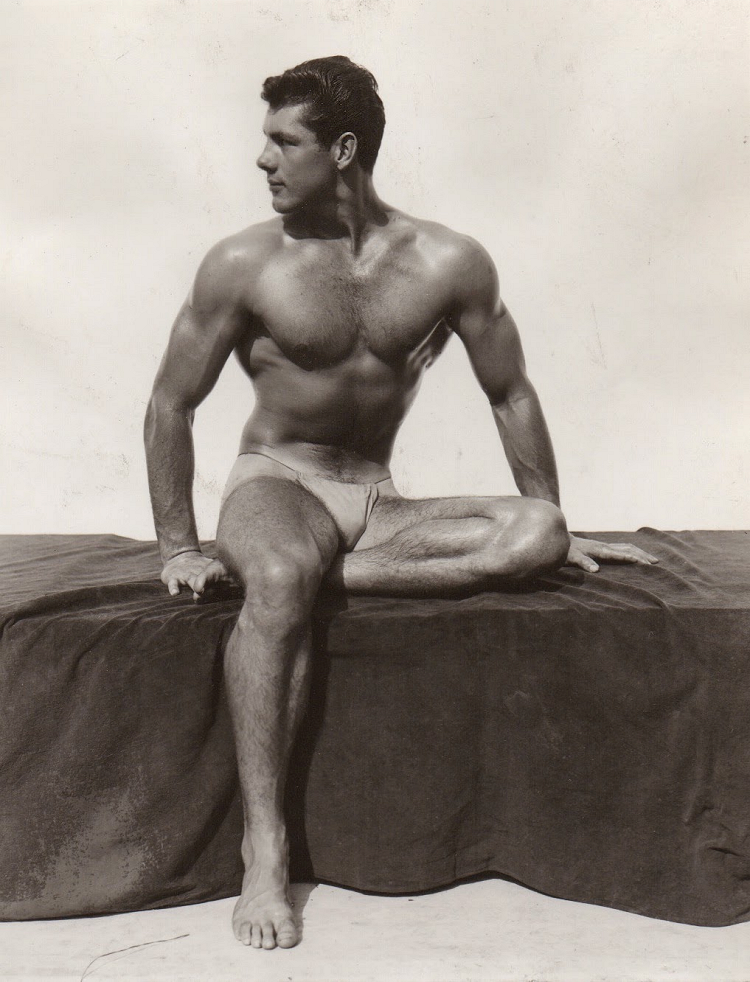
Gilded Youth - Bob Jensen, photographs by Bob Mizer for AMG, circa 1966


In Physique Pictorial Volume 16, Number 1, published December 1966, Bob Mizer writes about his model, Bob Jensen, who was about eighteen years old when he posed for these photographs:

"His is a build developed from natural sports rather than from formal training. Though a cooperative model, he was quite indifferent to physique display, and it was only through the efforts of his attractive mother (since passed away) that he was persuaded to pose for these photographs." *


Whenever I see pictures like these, of a young man in the sunlit perfection of his youth and beauty, I can't help but wonder what became of him in the years that followed. I wonder what he thought about posing nude or nearly nude, at the time and in later life. Was he proud or embarrassed? Did he bring out old copies of photographs or magazines, or was it a secret he kept? Though many of the names of physique models from this period have come down to us, most of them are still otherwise anonymous; Google their names - if their names are sufficiently particular, if they even used their real names - and it's very unlikely you'll find anything at all.

That was certainly the case with this "Bob Jensen". Other than the quotation from the photographer, I've found nothing. What became of him? Did he marry and have a family, is he still living? Is he a different form of beautiful now? I find a certain degree of poignancy in the fact that we'll never know. That his youthful image - handsome and tanned, perfectly proportioned - is to be seen by thousands on the internet, all across the world, while the person he was and who he became, doesn't really exist in any other public way.


***

* The quotation and its context was found on the Male Models Vintage Beefcake blog.


Saturday, July 11, 2015

Randomly II


Miniature attributed to Jean-Baptiste Isabey. subject unknown, circa 1790.
Unknown.
Portrait of a Lady with a Squirrel, by Francesco Montemezzano, circa 1565.
Prince Nikolai Saltykov, by Franz Kruger, 1850.
Vivien Leigh, publicity for "Lady Hamilton" ("That Hamilton Woman"), 1940-1.
The marquise de Pompadour at her dressing table, by François Boucher, circa 1750-58.
John Smith the Engraver, by Sir Godfrey Kneller, 1696.
 Napoleon the Lawmaker, by Jean-Baptiste Mauzaisse, 1833.
Orson Welles, by Horst P. Horst, 1938.
The Spree waterside at Stralau, by Karl Friedrich Schinkel, 1817.
Apollo and Marpessa, by John Flaxman, circa 1790–94.
Bacchanal, by John Koch, 1952.
Rex Whistler, by Cecil Beaton, 1927.
Portrait of Marie Stuck (the artist's daughter), by Franz von Stuck, 1913.
Princess Victoria Alexandra Olga Mary of Wales, daughter of Edward VII and Queen Alexandra, by Philip de László, 1907.
Silversmith Thomas Germain and his wife Anne-Denise Gauchelet, by Nicolas de Largillière, 1736.
Portrait of a Man, by Andrea del Sarto, circa 1517.
Lady Ann Somerset, Countess of Northampton at the age of about 14, attributed to Jean-Étienne Liotard, circa 1755.
Portrait of Don Andrés de Andrade y la Cal, by Bartolomé Esteban Murillo, circa 1665-72.
Charles Coote, 1st Earl of Bellomont, on the occasion of his elevation to the Earldom, by Sir Joshua Reynolds, circa 1767.
Michel Fokine and Tamara Karsavina (or Vera Fokina?) in Fokine's L'Oiseau de feu ("The Firebird"), circa 1910.
Miniature by Louis-Lié Périn-Salbreux, subject unknown, circa 1780s.
Venus and Cupid, attributed to Roeloff van Zijl, circa 1625.