L a - b e a u t é - s a u v e r a - l e - m o n d e ~ D o s t o ï e v s k i

L a - b e a u t é - s a u v e r a - l e - m o n d e  ~  D o s t o ï e v s k i


Wednesday, June 24, 2015

From my collection - Cartes de visite


Princess Alice, second daughter of Queen Victoria and Prince Albert, and her husband, Prince Louis, later Grand Duke of Hesse.
(Actual size.)

A carte de visite was a type of small photograph patented in Paris in 1854 by photographer André-Adolphe-Eugène Disdéri. (The same year, Disdéri also patented a method of taking eight separate negatives on a single plate, which reduced production time and costs.) Usually made with an albumen print, a carte de visite consisted of a thin paper photograph sized approximately two by three-and-a-half inches mounted on a card of two-and-a-half by four inches. Each photograph was therefore the size of a visiting card. By the end of the 1850s, besides being the most common form of photography for the general public, widely shared among family and friends, the great popularity of these photograph cards led to the publication of cartes de visite of royalty and other prominent persons, which were sold and collected. Albums for the collection and display of these cards - both private and commercially produced - became a common fixture in mid-Victorian era homes.

Princess Alice. The date printed on the image is exactly one year before her wedding day.

But their great popularity lasted little more than a decade. By the early 1870s, cartes de visite were being supplanted by "cabinet cards", which were also usually albumen prints, but of a larger size, and mounted on cardboard backs. Cabinet cards remained popular into the early twentieth century, when Kodak introduced the Brownie camera and amateur photography became a worldwide phenomenon. By that time commercially produced images of royalty and other well-know persons were being distributed as picture postcards, and they were purchased and collected in just the same way that cartes de visite had been previously. (My collection consists almost entirely of these postcards; the twelve images here were almost accidentally acquired and are all that I own.)

These scanned images show the photographs about two-and-a-half times the original size; I've added in a few of the same images at actual size for comparison. It amazes me the amount of detail contained within such a tiny format and how well they've survived after more than one hundred and fifty years.

This card is still attached to a portion of the album page it was pasted onto. As the original inscription states, this is the "Crown
Prince and Princess of Prussia, Princess Royal", the future Emperor Friedrich III of Germany and his wife Princess Victoria,
eldest child of Queen Victoria and Prince Albert.

On the back side of the album page was this image of Alice and Victoria's soon-to-be sister-in-law, Princess Alexandra of Denmark,
taken in 1862. As with the above image, this was inscribed "Princess of Wales" directly on the page, beneath the photograph.
(Actual size.)
Alexandra and her husband, the future Edward VII, on their wedding day, 10 March 1863.
Alexandra before her marriage, probably taken in 1862.
Alexandra, from a Danish card, taken prior to her marriage or produced to commemorate it.
(Actual size.)
Alexandra, Princess of Wales, 1866.
Another sister-in-law, Marie, Duchess of Edinburgh, wife of Prince Alfred, second son of Queen Victoria and Prince Albert.
The photograph was taken some time before her marriage.
Marie, Duchess of Edinburgh, possibly around the time of her marriage in 1874. She was the only daughter of Tsar Alexander II.
The photographer, Bergamasco, was resident in Russia and much favored by the Imperial court.
The Empress Eugénie, taken soon prior to or soon after the fall of the French Second Empire. The card was produced in Belgium.
(Actual size.)
Napoléon, Prince Impérial, the only son of the Empress Eugénie and Emperor Napoléon III.
This image is the latest of the group, taken in 1878, the year before his death.

***

(I apologize for the rough cropping of most of these images. I forgot that the scanner likes to lop off the edges; I'll be more careful next time.)


Sunday, June 21, 2015

The Waagepetersen Family, by Wilhelm Bendz, 1830


Wilhelm Bendz - only two years away from his premature death - has portrayed the merchant Waagepetersen and his wife Albertine with their two young children in what looks to be the husband's study. Christian Waagepetersen (6 September 1787, Copenhagen - 23 November 1840, Copenhagen) was a successful Danish wine merchant, supplier to the royal court, and an important patron of the arts. The couple's home at Store Strandstræde in Copenhagen was a gathering place of some of the era's most important musicians, many of whom Waagepetersen helped support. His love of music was so profound that he named three of his sons Mozart, Haydn, and Beethoven.

The children look rather stiff and doll-like, but Bendz's portrait of Waagepetersen is vivid, what could be called a "speaking likeness".
The artist's portrayal of Albertine Waagepetersen can't have been terribly flattering....
The light streaming in from the open window - illuminating, reflecting - is wonderful.
I love how the light reflects the gold-leaf onto the walls, and I think the ribbon-wrapped picture cords and their rosettes are charming.
I believe that the two oval portraits are of  Waagepetersen's parents. Above them, Napoléon...?
Above the jumble of books on the mahogany desk is a portrait of the Danish king, Frederik VI. In the glass cylinder, a little green frog.
I love the rather grumpy looking dog, lying on a cushion at his master's feet.

***

 "Familien Waagepetersen", by Wilhelm Marstrand,1836.

Mrs. Waagepetersen - in a more flattering portrait, certainly - is, six years later, portrayed by Marstrand with three additional children and what appear to be a nurse (in traditional costume) and a governess. Her husband, not included in the group, would die four years later.

Wilhelm Marstrand (24 December 1810, Copenhagen – 25 March 1873, Copenhagen), painter and illustrator, one of the important artists of the "Golden Age of Danish Painting". Like Bendz, he was, early in his career, a protégé of Christian Waagepetersen and was his favored artist after the death of Bendz.


Saturday, June 20, 2015

Girl With a Peacock Feather Fan, by George Frederic Watts, circa 1860s


***

George Frederic Watts (23 February 1817, London – 1 July 1904, Compton, Surrey), popular English Victorian painter and (late in life) sculptor associated with the Symbolist, Pre-Raphaelite, and Aesthetic movements. A successful painter of rather sombre portraits, he is best remembered for his allegorical works.

Of a serious, humorless disposition, in 1864 - three days before his forty-seventh birthday - he married the young, soon-to-be-legendary actress Ellen Terry - who was seven days short of her seventeenth birthday. The rashness of this decision was put to proof when the marriage survived a mere ten months. (More than twenty years later, Watts remarried, and much more satisfactorily.)

As far as I can tell, we don't know the exact date of the painting or the identity its model - but isn't she lovely? There has been conjecture that, though the artist would have intentionally obscured the likeness, it may have been posed for by his wife Ellen Terry during their brief union. That same year, Watts painted a very well-known image of Terry entitled "Choosing", in which she appears to be wearing a similar or possibly the same necklace, which looks to be of ivory beads.


Wednesday, June 17, 2015

L'Éducation d'Achille par le centaure Chiron, by Jean-Baptiste Regnault, 1782


 "The Education of Achilles by the Centaur Chiron"

In Greek mythology, Chiron was held to be the premier centaur - something of a prince among centaurs - and notable for his youth-nurturing nature. Like the satyrs, centaurs were notorious for their lascivious ways, inclination to violence when intoxicated, and their generally uncouth behavior. Chiron, by contrast, was intelligent, civilized, and kind. But then he wasn't always thought to be related to the other centaurs; archaic mythology gives that he was sired - no pun intended - OK, yes it is - by the titan Cronus who had taken the form of a horse and impregnated the nymph Philyra. Later tradition ascribes his gentility to Nurture rather than Nature; Apollo and Artemis were his foster parents, and many of their personal attributes - music, archery, hunting, medicine, prophecy - became his as well. He would then pass on these skills to many of Greek mythology's great heroes, Achilles among them.

This painting is no "great work", certainly, but nice enough. And a good example of the late eighteenth century Neoclassical taste for dramatic mythological subjects. Well-drawn figures and drapery; balanced, graceful composition; richly contrasted lighting; warm but subtle coloration. But I have to say I'm distracted by the little tuft low down on Chiron's abdomen. Is that the correct location for that particular "place marker"? Really, it does cause one to ponder the specific anatomy of a centaur, doesn't it...?


***

Jean-Baptiste Regnault (9 October 1754, Paris – 12 November 1829, Paris), French painter. Born in the French capital, his first teacher was the history painter Jean Bardin, who took him to Rome when he was only fourteen. Four years later, having returned to Paris, he joined the studio of Nicolas-Bernard Lépicié. In 1776 he won the Prix de Rome with his "Alexander and Diogenes" and returned to Rome, where he spent the next four years at the Académie de France in the company of Jacques-Louis David and Jean-François-Pierre Peyron. In 1783 he was elected Academician; his diploma picture, the "Education of Achilles by Chiron" - this post's featured painting - is now in the Louvre.  He became very well known as a teacher; several of his students became celebrated artists in their own right, and his influence rivaled that of David. He was married twice, lived to the age of seventy-five, and is buried in Père-Lachaise.


Sunday, June 14, 2015

From my collection - Imperial/royal cousins, imperial/royal sailor suits


The iconic sailor suit was the uniform - both casual and dress - for little boys beginning in the middle of the nineteenth century and continuing well into the twentieth. (Girls often wore a version as well, but usually only for day wear.) From my own collection of antique postcards, this is a selection that demonstrates that even young princes were far from being exempt from the prevailing trend. Furthermore, all these little boys were cousins or otherwise related by way of the tangling dynastic threads of European royalty, mostly the imperial or royal families of Russia, Denmark, and Great Britain.

(The vertically oriented images are obviously reproduced much larger than in the original postcards, the two horizontally oriented images are only slightly larger than original.)

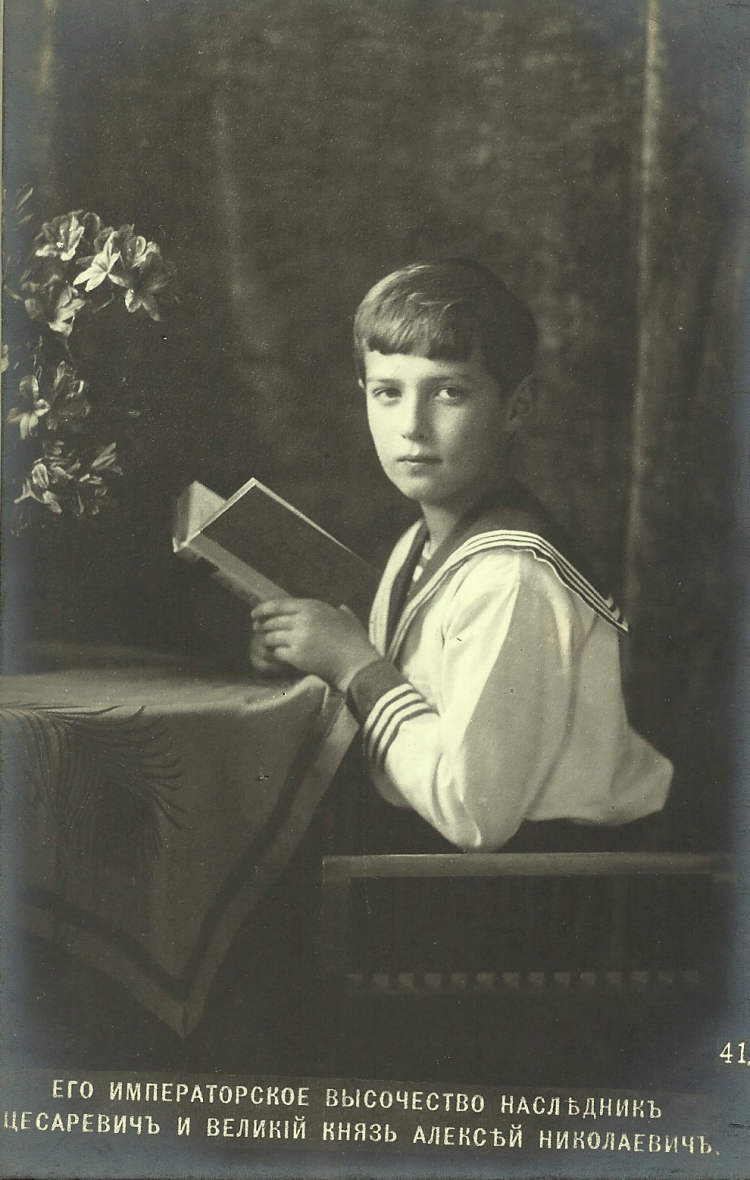
The image above and the two below are, of course, of Alexei Nikolaevich (1904-1918), the ill-fated last Tsarevich of Russia, son of Nicholas II and the Empress Alexandra.


Three of Alexei's paternal first cousins - Princes Feodor (1898-1968), Nikita (1900-1974), and Dmitri Alexandrovich (1901-1980) - three of the six sons of Nicholas II's sister, Grand Duchess Xenia Alexandrovna. They were also related, though less closely, through the three brothers' father, Grand Duke Alexander Mikhailovich; all of the above were descendants of Tsar Nicholas I.


Prince George of Greece (1890-1947) - later George II, King of the Hellenes - was a second cousin, through his father and paternal grandfather, of the four boys pictured above; their shared great-grandfather was King Christian IX of Denmark. He was also less closely related to them through his paternal grandmother, Olga, Queen of the Hellenes, born a grand duchess of Russia, so he was likewise a descendant of Tsar Nicholas I.


Prince Lennart of Sweden (1909-2004), only child of Prince Wilhelm and Grand Duchess Maria Pavlovna of Russia, was a first cousin once removed of Prince George of Greece, through his maternal grandmother, the aforementioned Queen Olga. Also, he was a second cousin to Alexei, Feodor, Nikita, and Dmitri through his maternal grandfather; their shared great-grandfather was Tsar Alexander II.

Prince Lennart with his father, Prince Wilhelm... and a lion cub? Tiger cub?
Prince Lennart with his father's mother, Queen Victoria of Sweden, and her mother, Grand Duchess Luise of Baden.
Interestingly, these postcards were not only printed and sold in the subject's own country; this example is from Germany rather than Sweden.

Princes Gustaf Adolf (1906-1947) and Sigvard (1907-2002) of Sweden, sons of the future King Gustaf VI Adolf, were paternal first cousins of Prince Lennart. Also second cousins to Tsarevich Alexei through their mothers, both of whom were granddaughters of Queen Victoria.


Crown Prince Olav of Norway (1903-1991), son of King Haakon VII, was a maternal second cousin to Gustaf Adolf, Sigvard, and Alexei; his mother, Queen Maud of Norway, was also a granddaughter of Queen Victoria. He was also related to Princes George (second cousin) and Lennart (second cousin once removed) through both of his parents. (Who were, incidentally, first cousins themselves.)


The short-lived Prince John (1905-1919), youngest child of Great Britain's George V and Queen Mary, was a first cousin of Crown Prince Olav. He was a second cousin to Alexei, Gustaf Adolf, and Sigvard, again thanks to their shared great-grandmother Queen Victoria. He was also a second cousin to George of Greece and to the Russian Princes Feodor, Nikita, and Dmitri - and a second cousin, again, to Alexei - due to their shared great-grandfather, King Christian IX of Denmark. Finally, he was a second cousin once removed to Lennart because of their mutual descendance from King Christian.


Princes Georg Donatus (1906-1937) and Ludwig (1908-1968) of Hesse-Darmstadt - Don and Lu* - were second cousins with John, Olav, Gustav Adolf, and Sigvard, again all through their connection to their great-grandmother Queen Victoria. And they were first cousins with Tsarevich Alexei; indeed, this may have been one of the closest of the cousin connections as the Russian Empress and her brother, Grand Duke Ernst-Ludwig of Hesse-Darmstadt, were very close, and their families came to be as well.


***

* Don and Lucy - quite often shortened to Lu - just happen to be the names of my much-loved parents-in-law.