L a - b e a u t é - s a u v e r a - l e - m o n d e ~ D o s t o ï e v s k i

L a - b e a u t é - s a u v e r a - l e - m o n d e  ~  D o s t o ï e v s k i


Monday, June 23, 2014

Cupid Chastised, by Bartolomeo Manfredi, 1613


Bartolomeo Manfredi (25 August 1582 [baptised], Ostiano – 12 December 1622), Italian painter, a leading member of the Caravaggisti of the early 17th century.


Sunday, June 22, 2014

Isaac Levitan


Evening Bells, 1892.

Isaac Ilyich Levitan (30 August 1860, Wirballen – 22 July 1900, Moscow), considered by many the greatest Russian landscape painter.  He was born in a shtetl in Lithuania to a poor but educated family.  When he was ten, his family moved to Moscow where, in 1873, he entered the Moscow School of Painting, Sculpture and Architecture.  His mother died two years later, and his father became very ill, dying soon after.  The family descended into extreme poverty and he was expelled from school for inability to pay but, eventually, Levitan was given a scholarship in recognition of his prodigious artistic abilities.  When he was seventeen, his works were exhibited for the first time.  He received good notices in the press, and in the following years became increasingly successful, prolific and much celebrated.

Moon at Twilight, 1899.
Birch Forest, 1885-1889.

Much of his best known work has been described as being "the landscape of mood", in which nature is somehow spiritualized, and seems to reflect aspects of the human soul, a type of landscape painting that could only be Russian.  His work is a perfect example of a crisp, Impressionist-influenced realism, which still manages to be inherently and profoundly poetic; perhaps it comes as little surprise that Anton Chekhov was his closest friend. 

The Evening After the Rain, 1879.
Vladimirka Road, 1892.
Moonlit Night, Highway, 1897-98.

He had been ill for some time, and in 1897 Levitan was diagnosed with degenerative heart disease, possibly as a result of the lingering effects of the abject poverty of his youth.  He died three years later at the age of thirty-nine.

Autumn.
Water Lilies, 1895.
A Train on its Journey.
The Quiet Abode, 1890.
By the Deep Waters, 1892.


Saturday, June 21, 2014

Princess Thyra of Denmark


Miniature by Johannes Zehngraf (1857-1908).  Circa 1900-10.

Princess Thyra of Denmark (29 September 1853, Copenhagen – 26 February 1933, Gmunden), born Thyra Amelie Caroline Charlotte Anne, the youngest daughter of Christian IX of Denmark and Louise of Hesse-Kassel. Quiet and gentle, she had neither the great beauty of her eldest sister, Alexandra, Princess of Wales, nor the great charm of her other sister, the future Empress Maria Feodorovna of Russia. But her mother still hoped for a marriage nearly as impressive as her first two daughters' had - rather unexpectedly - been.

1864.
1869.
With her sisters, Dagmar (Minnie), then Tsarevna Maria Feodorovna of Russia, and Alexandra, then Princess of Wales.  Circa late 1860s.

But at the age of eighteen Thyra fell in love with a lieutenant in the Cavalry, Vilhelm Frimann Marcher, and became pregnant. Because of Thyra's station, marriage was never considered. Instead, the young girl went with her mother to visit family in Greece, where her brother was king. Her extended stay there was then explained by false reports that she had taken ill. As "official " news gave out that her condition had worsened, her father and younger brother joined her and her mother. At the end of 1871, she gave birth to a daughter. Only a few months later, in January of 1872, the baby's father hung himself. (The circumstances of his suicide are unclear, and it is further unknown whether Thyra ever knew of his death.) Because of the princess' depression, she lingered in Greece until March. And then, on her way home she became actually ill, with typhoid, and didn't reach Denmark until June.  Her little girl was adopted by a Danish couple; it isn't known if Thyra ever had any further contact with the child.

Circa 1870.
Circa 1870.
1870s.  (I haven't been able to identify the artist.)

For the next several years she lived quietly and gave little or no thought to marriage but her mother eventually resumed the search for a suitable husband. In 1878 she married Ernst August, 3rd Duke of Cumberland and Teviotdale, the exiled heir to the Kingdom of Hanover. As the Kingdom of Hanover had been annexed by Prussia in 1866, and since the relations between Denmark and Prussia had long been very tense, the match was controversial. But the couple was happy and had six children. (Ironically, their youngest child, Ernst August, married the only daughter of the Kaiser, bringing about a partial rapprochement between the Hanover family and the Hohenzollerns.)

Circa 1886.
With members of her extended family - Danish, British, Russian - at Bernstorff, 1892.  Thyra is at center, in the light colored suit.
Circa 1900.

Two of their sons died young, and Thyra had frequent bouts of depression - and perhaps more than one breakdown. But the gatherings of her Danish family - always very close - were a frequent and pleasant diversion, and the Duke and Duchess of Cumberland were comfortable in their exile in Austria. Her husband died in 1923, and Thyra lived another ten years, passing away at the age of seventy-nine.

Circa 1913.


Friday, June 20, 2014

Orazio Riminaldi, two paintings


Daedalus and Icarus, circa 1620.
Amor Vincitore, 1624.

Orazio Riminaldi (5 September1593, Pisa - 10 December1630, Pisa), Italian painter of the Baroque period.  In Rome he studied with Orazio Gentileschi, under whose influence he painted in a Caravaggist style, but after his return to Pisa, his style became more muted.  He died of the plague at the age of thirty-seven.


Thursday, June 19, 2014

Portraits of Leopold I and Margarita Teresa in theatrical costume, by Jan Thomas, 1667


Costumed as Acis for the play "La Galatea".

Leopold I (9 June 1640, Vienna – 5 May 1705, Vienna), Holy Roman Emperor, King of Hungary, Croatia, and Bohemia, the second son of Ferdinand III, Holy Roman Emperor.  Originally intended for the church, Leopold became heir apparent in 1654 by the death of his elder brother Ferdinand IV. Elected Holy Roman Emperor in 1658, Leopold would rule as such until his death in 1705.  Leopold's reign is known for the conflicts with the Ottoman Empire in the east, and the rivalry with Louis XIV, a first cousin, in the west.  He was a great patron of music, and was an accomplished composer, himself.  His first marriage, to his niece and cousin Margarita Teresa of Spain, was quite happy and though he, by necessity, married twice more, he was heartbroken at her premature death.

The distinctive Habsburg facial features, the result of rampant inbreeding, are evident in both portraits.

***

Costumed for the play "La Galatea".

Margarita Teresa of Spain (12 July 1651, Madrid – 12 March 1673, Vienna), wife of Leopold I, Holy Roman Empress, Queen consort of Hungary, Croatia, and Bohemia. She was the daughter of King Philip IV of Spain, and the elder sister of Charles II, the last of the Spanish Habsburgs. She is the central figure in the celebrated Las Meninas by Velázquez, and the subject of many of his later paintings.  She married Leopold - her maternal uncle and paternal cousin - at the age of fifteen.  It appears they were very happy together, sharing a number of interests, especially theatre and music.  But after giving birth to four children - only one of whom survived infancy - and weakened by many miscarriages, Margarita Teresa died at the age of twenty-one.


***

Jan Thomas van Ieperen (5 February 1617, Ypres – 6 September 1673, Vienna), Flemish Baroque painter and engraver active in Antwerp and at the Habsburg court in Vienna. Much of his work translates the monumental Baroque style of Peter Paul Rubens into the small format of cabinet painting.  He also made large-scale paintings and mezzotints.


Wednesday, June 18, 2014

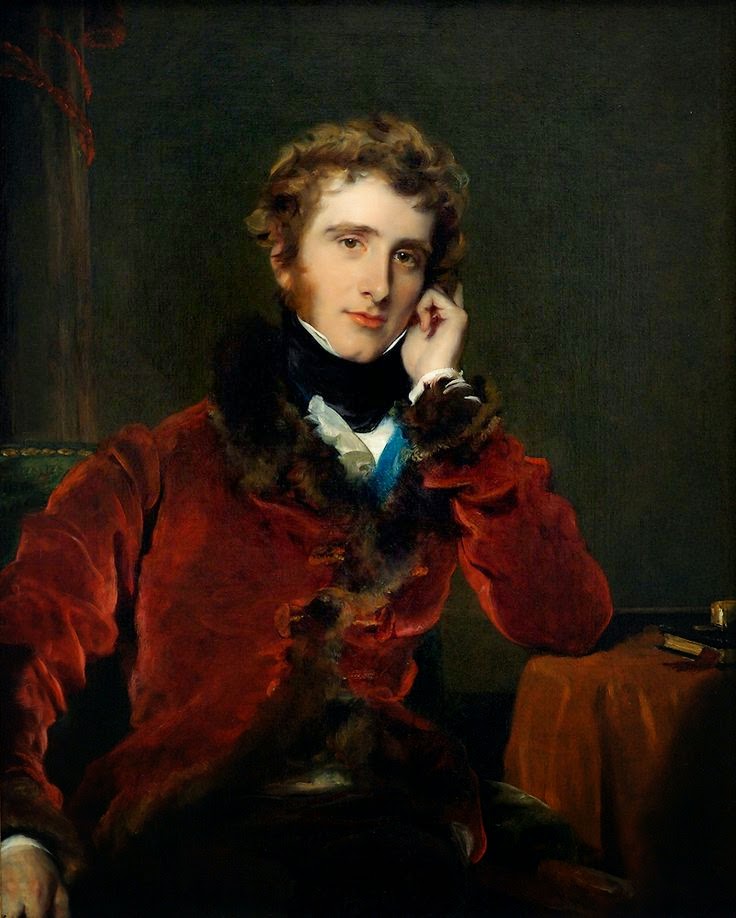
George James Welbore Agar-Ellis, 1st Baron Dover, by Thomas Lawrence, 1823-24


George James Welbore Agar-Ellis, 1st Baron Dover (14 January 1797 – 10 July 1833), only son of the 2nd Viscount Clifden, was a British politician and man of letters.  He served in Parliament between 1818 and 1831, consistently supporting liberal principles.  And he was president of the Royal Society of Literature in 1832, a trustee of the British Museum and of the National Gallery, and a commissioner of public records.  In 1822, he married Lady Georgiana Howard, daughter of the 6th Earl of Carlisle. They had two sons, who became respectively the 3rd Viscount and 5th Viscount Clifden, and two daughters.  Lord Dover predeceased his father, dying at the age of thirty-six.


Tuesday, June 17, 2014

Monday, June 16, 2014

Saint Sébastien, by Alcide-Joseph Lorentz


Saint Sebastian is one of the most frequently depicted religious/mythological subjects in classical painting - really makes you wonder, doesn't it?  In fact, arrow-riddled, alluringly nekkid Sebastians are so common, that they all start to run together after a while.  But I rather like this one.  Not actually terribly attractive, he looks like a real person, someone who might might make the supreme sacrifice for his beliefs.  The detail of his scattered Centurion's armor and clothing is great, and I love the bleak landscape, especially the toxic sky and the sunset/sunrise's creeping acid light.

***

Alcide-Joseph Lorentz (1813-1891?), French painter and lithographer.  He exhibited at the Salon from 1841 to 1850 as a history painter, but is perhaps better remembered as a cartoonist for Parisian periodicals.  (Sadly, I was only able to find this tiny bit of information on the painter.  And only from one source.)


Sunday, June 15, 2014

The 3rd and 4th Earls of Dorset, by William Larkin, 1613


Richard Sackville, 3rd Earl of Dorset (18 March 1589, London – 28 March 1624, London), eldest son of Robert Sackville, 2nd Earl of Dorset. The 3rd Earl is perhaps best remembered as the first husband of Lady Anne Clifford. The marriage was far from successful, not least because of Sackville's repeated infidelities, and his extravagance and indebtedness; he was called "one of the seventeenth century’s most accomplished gamblers and wastrels". None of his three legitimate sons survived their father, and when he died at the age of thirty-six, he was succeeded by his younger brother.


*


Edward Sackville, 4th Earl of Dorset (1591 - 17 July 1652, London), second son of Robert Sackville, 2nd Earl of Dorset. Notorious in his youth for a a duel in which, though gravely wounded himself, he killed Edward Bruce, 2nd Lord Kinloss. Considered one of the handsomest men of his day, he was an energetic and successful politician and courtier. He was directly involved in the early colonization of North America and, later, he supported the Royalist cause during the English Civil War. After the execution of the King in 1649, the Earl is said to have never again left his home, Salisbury Court, where he died at the age sixty-one. His eldest son, Richard, succeeded him as 5th Earl.


 *

William Larkin (early 1580s – April or May1619), English painter active from 1609 until his death in 1619, known for his iconic portraits of members of the court of James I.  His work is characterized by a fairly frontal, lightly modeled presentation of his subject, set against an unnaturally raked background, and opulently adorned in embroidery, lace, and jewelry, all meticulously described.  He was the last in a line of a particular strain of English portrait painting that included the later Holbein the Younger and Nicholas Hilliard; writing in 1960, Sir David Piper said of his work, "Artistically, they are a dead end, but they have a strange and fascinating splendour."


Saturday, June 14, 2014

Queen Victoria Eugenie of Spain, four autochromes by Charles Chusseau-Flaviens , circa 1910


Queen Victoria Eugenie of Spain (24 October 1887, Balmoral Castle – 15 April 1969, Lausanne), born Victoria Eugenie Julia Ena of Battenberg, Queen Consort of Spain as the wife of King Alfonso XIII. Called by her fourth given name, Ena, by her family and by the British public, she was the second child of Prince Henry of Battenburg and Princess Beatrice, the last-born child of Queen Victoria. Princess Beatrice was her mother's constant companion and personal secretary - the Queen had been extremely reluctant that her daughter should even marry - and Ena and her three brothers grew up in her grandmother's household.


In 1905, the nineteen year old king of Spain made an official visit to England. It was known that he was searching for a suitable bride, and even though there were several strikes against the pretty and blond English princess - her father's un-royal birth, her Protestantism, the strain of haemophilia in her family; one of her three brothers was actually afflicted - the young king would not be dissuaded, and they became engaged. After delicate negotiations between Spain and Great Britain, and with her conversion to Roman Catholicism, they were married 31 May, 1906. A glittering royal gathering attended the festivities in Madrid, but the occasion was marred by an assassination attempt made while the procession was returning to the Royal Palace after the ceremony. From a balcony, an anarchist threw a bomb down at the royal carriage; more than thirty people and several horses were killed, and many more spectators were injured. The royal couple were uninjured, but Ena's wedding dress was spattered with blood, an inauspicious beginning to the marriage and to her life in Spain.


Ena and Alfonso had six children. The first, the heir Alfonso, the Prince of Asturias, and the last, Gonzalo, were both afflicted with haemophilia. Although he had been warned of this possibility, Alfonso never came to terms with the situation, and their marriage quickly deteriorated; the king was also lavishly unfaithful, producing several illegitimate offspring. It was small comfort that she was much lauded for her regal beauty and great style; she was called "the best-dressed queen in Europe". And though Ena worked hard to support charitable institutions, education and, particularly, the Spanish Red Cross, she was never popular in her adopted country. In 1931, as Spain descended into civil war, the royal family went into exile, first in France and then Italy. Ena and Alfonso separated and Ena lived in England before settling in Switzerland; she purchased a chateau, the Vieille Fontaine, outside Lausanne.


Alfonso died in Rome in 1941. Ena returned briefly to Spain - still Franco-controlled, but preparing for a re-establishment of the monarchy - in 1968, to stand as godmother at the baptism of her great-grandson, Infante Felipe, who would become the present crown prince of Spain. She died the following year at the age of eighty-one. In 1985, her remains were returned to Spain and were interred in the Royal Vault of the Escorial, next to those of her husband and three of her sons.

***

Charles Chusseau-Flaviens (active 1890s - 1910s), French independent photojournalist.   His distribution of other photographer's work for publication created one of the first photo press agencies, but there appears to be no other available biographical information.