L a - b e a u t é - s a u v e r a - l e - m o n d e ~ D o s t o ï e v s k i

L a - b e a u t é - s a u v e r a - l e - m o n d e  ~  D o s t o ï e v s k i


Monday, May 19, 2014

Three drawings by Moreau le Jeune


Jean-Michel Moreau (26 March 1741, Paris – 30 November 1814, Paris), called Moreau le Jeune, French draughtsman, illustrator and engraver.  At the beginning of his career he produced copy drawings of the old masters or contemporary paintings for use by engravers, or made engravings of the work of more famous contemporary artists.  After 1781, when he was appointed Dessinateur et Graveur du Cabinet du Roi, a position which brought an annual pension and lodgings in the Louvre, he required the services of other engravers to reproduce his own designs.  His career was not impeded by the French Revolution - an event with which he apparently sympathized - and after the Restoration, in the last year of his life, he was once again appointed to royal office.  He is best known for his pen and wash drawings of important events at court and, especially, his charming genre scenes - much reproduced - that record the fashionable dress and elegant interiors of the last years of the Ancien Régime.


Sunday, May 18, 2014

Three photographs of Orest Daszo, by Les Demi-Dieux, circa early 1960s


The man who photographed under the name Les Demi-Dieux (the demi-gods) has long been considered one of the most artistic and certainly the most mysterious of the classic physique photographers.  Only recently identified as Danny Fitzgerald, he lived and worked in Brooklyn - where his images were taken in the early 1960s - and apparently died in 2000, but there is still very little known about his life.


Saturday, May 17, 2014

Queen Juliane Marie of Denmark, by Vigilius Eriksen, 1776


Juliane Marie, Queen of Denmark (4 September 1729, Wolfenbüttel – 10 October 1796, Fredensborg Palace), born Juliana Maria of Brunswick-Wolfenbüttel-Bevern, second consort of king Frederick V of Denmark and Norway, mother of the prince-regent Hereditary Prince Frederick of Denmark and Norway, and herself de facto regent from 1772 to 1784.

In 1752 she married the Danish king, doing so only six months after the death of his first wife, a fact that did not make her popular with the Danes. After the death of her husband in 1766, and now Queen Dowager, she was treated with open hostility by the new king, Christian VII, his wife, and their court. But by 1770, the king had become mentally ill, and his wife and her lover, Johann Friedrich Struensee, had taken control of the government. Juliane Marie became the center of the opposition forces, and in 1772 they seized power; Struensee was executed and the queen exiled.

Juliane Marie's son, Hereditary Prince Frederick, was now made regent but, in reality, his mother was the real power during his regency. Her government was extremely conservative, bolstering the rights and privileges of the nobility, but she was loathed in more liberal circles. She was also given responsibility for the upbringing of the crown prince, later Frederick VI, who resented her influence and control.  In 1784, he was declared of legal age, and at his first council meeting, he dismissed all in the government loyal to Juliane Marie and her son, and himself assumed the regency for his mentally ill father.  There were those - including King Gustav III of Sweden - who urged her to stage a coup, but she declined, and lived the remaining twelve years of her life quietly at court.

***

Vigilius Eriksen (2 September 2, 1722 in Copenhagen – May 25, 1782 in Rungstedgård), Danish artist.  Before his tenure as court painter in Denmark, he had spent fifteen years at the court of Russia, where he worked for both empresses, Elisabeth and, especially, Catherine II.

***

The Queen's likeness is generalized and quite doll-like - she looks nothing like the sharp-minded woman she must have been - but I love this painting's beautifully calculated low vantage point perspective and, especially, the amazingly detailed rendering of fabric and lace; for someone like me, these passages are really awe inspiring.


Like most important royal commissions, there are several copies and variations that are based on the original painting.


Friday, May 16, 2014

Four boys by Philip de László


Raymond P. Johnson-Ferguson, 1923.
Charles Douglas Conyers Lang, 1926.
Philippe de Gramont, 1928.
Nubian serving boy, Aswan, 1929.


Thursday, May 15, 2014

Princess Marie Auguste of Anhalt, by Atelier d'Ora, 1922


Princess Marie Auguste of Anhalt (10 June 1898, Ballenstedt – 22 May 1983, Essen), Princess Joachim of Prussia, later Baroness von Loën, daughter of Eduard, Duke of Anhalt and his wife Princess Louise Charlotte of Saxe-Altenburg.  In 1916 she married Prince Joachim of Prussia, the youngest son of German Emperor William II, and they had one child, Prince Karl Franz.  After the end of World War I and his father's abdication, Prince Joachim struggled to adjust to his altered status, and in 1920 the couple filed for divorce.  In July of that same year, plagued by depression, he committed suicide.  At his death, his brother Eitel Friedrich, took custody of his three-year-old nephew, claiming it as his right, as the legal head of the House of Hohenzollern.  He accused Marie Auguste of being unfit, but the German courts returned Karl Franz to her full custody in 1921.

She remarried in 1926 to Johannes-Michael, Baron von Loën, a childhood friend, but they divorced in 1935.  In her last years, she had financial difficulties, and "adopted" several adults, giving them a claim to her royal style in exchange for money.  The best known of these adoptees, was Hans Robert Lichtenberg, who took the name of Frédéric, Prinz von Anhalt, and later married Zsa Zsa Gabor.


 ***

All the documentation that I've been able to access identifies the sitter in these four photographs as Marie August of Anhalt.  But honestly, as a portrait painter and a very adept "identifier of faces", I see little or no resemblance to earlier, verified photographs of Marie Auguste.  It's possible that with the advent of the streamlined Twenties, she thought a good deal of slimming was in order; the woman in the images above does look like she may have been heavier at one time.  Still, I do hope I haven't muffed it...!

Around the time of her marriage.
With her son, Karl Franz.


Wednesday, May 14, 2014

Three portraits by Carl Christian Vogel von Vogelstein


Christiane Sophia, née Freiberg, the wife of Dresden apothecary Franz Friedrich Wetzel,1839.
Young Lady with Drawing Utensils (Countess Thekla Ludolf, née Weyssenhoff), 1816.
Burchard Ch. Richter, 1812.


Carl Christian Vogel von Vogelstein (26 June 1788, Wildenfels – 4 March 1868, Munich), German painter of portraits, landscapes, and religious subjects.  Stylistically, he endeavored to find a balance between the Classicism and Romanticism which were then the prevailing schools.


Tuesday, May 13, 2014

Robert Taylor, circa 1936


These three photographs were taken near the beginning of Taylor's career, before he started his noble battle to prove he was really an actor - well, a rather limited one, anyway - and not just an alarmingly pretty face.  These portraits still revel in the latter fact.  The photographer of the middle image was Ted Allen.  I know that the other two are by Ted Allen or George Hurrell - one of each or both - but I haven't been able to verify the creator of either image.


Monday, May 12, 2014

Woman at her Writing Desk, by Johann Ender, 1820


Johann Nepomuk Ender (4 November 1793, Vienna – 16 March 1854, Vienna), Austrian painter.  Successful as a portrait painter from an early age, he studied at the Akademie der bildenden Künste Wien, where he won all four of its top prizes.  He later traveled to Greece and Italy, where he produced work on historical and biblical themes.  He was a professor at the Academy from 1829 to 1850.


Sunday, May 11, 2014

Three night scenes by Jacob Philipp Hackert


Fireworks on the Castel Sant'Angelo, 1775.
Eruption of Vesuvius,circa 1774.
Eruption of Vesuvius, 1779.

Jacob Philipp Hackert (15 September 1737, Prenzlau – 28 April 1807, San Pietro di Careggi), Brandenburger landscape painter, long resident in Italy.  A son and nephew of artists, he studied at the Akademie der Künste in Berlin, and traveled to Sweden and Paris, before settling in Italy in 1768.  Based primarily in Rome and Naples, he was very successful, but in 1799, in the fallout from the French Revolution, he lost his royal patronage, and moved to Florence.  He bought an estate nearby, and died eight years later.

Jacob Philipp Hackert, by Anna Dorothea Lisiewska (Therbusch), 1768.


Saturday, May 10, 2014

The Maharaja and Maharani of Indore


Portrait of the Maharaja of Indore in traditional dress, by Bernard Boutet de Monvel, 1934.

Maharajadhiraj Raj Rajeshwar Sawai Shri Yeshwant Rao II Holkar XIV Bahadur (6 September 1908, Indore - 5 December 1961, Bombay), Maharaja of Indore, a member of the Holkar dynasty of the Marathas. Educated at Cheam School and at Christ Church, Oxford, in 1926, at the age of seventeen, he succeeded his father Tukojirao Holkar III, who had abdicated in his favor. At first under a regency, he was invested with his full powers in 1930.

The Maharaja of Indore, by Boutet de Monvel, 1929.
The Maharani of Indore, by Boutet de Monvel, 1929.
The Maharani of Indore in traditional dress, by Boutet de Monvel, 1934.

In 1924 he had married Maharani Shrimant Akhand Soubhagyavati Sanyogita Bai Sahib Holkar (1914 - 13 July 1937, Tarasp, Switzerland).  He and Maharani Sanyogita, who had also been educated in England, had a daughter, Usha, born in Paris in 1933.
 

The royal couple, very young and fabulously wealthy, with quite contemporary tastes, were completely cosmopolitan, making very prolonged sojourns to Europe and America; there were complaints that they spent so little time in their home country.

In Hollywood, on the set of "The Plainsman", with Gary Cooper and Cecil B. DeMille, 1936.
With actress Gail Patrick, 1936.

In 1930 they commissioned a German architect to build a new streamlined Art Moderne palace, Manik Bagh, in Indore.  Every detail of the this remarkable building was designed and created in Europe; the names involved in the project include Ruhlmann, Le Corbusier, Puiforcat, Eileen Gray, Luckhardt, Brancusi, etc.

Boutet de Monvel's portrait of the Maharaja can be seen on the wall.
The "Indore Pears".  Here, set as earrings.  Almost forty-seven carats each,
they were sold to Harry Winston in 1946.  In the portrait of the Maharaja
wearing Indian dress, the two stones are pendant from a diamond necklace
that can be seen under the strands of pearls.  (See below.)  In the Monvel
painting of the Maharani, they have been set into a diamond and emerald
necklace, the work of Mauboussin.
The diamonds as set by Chaumet, 1913.
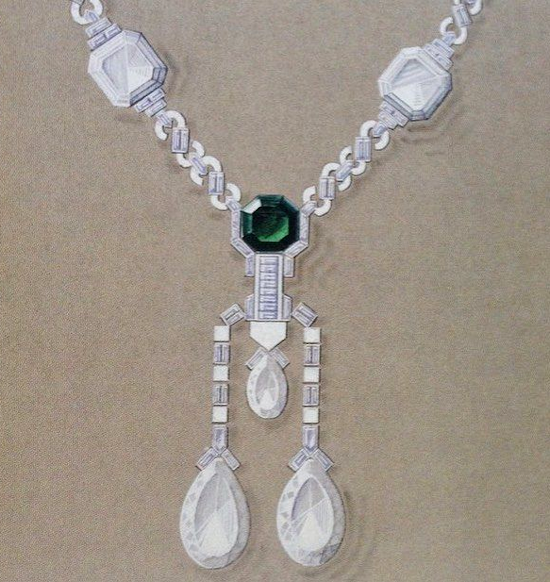
Two designs by Mauboussin for a necklace setting of the "Indore Pears".
The completed necklace, as worn by the Maharani in Boutet de Monvel's portrait, differs from both of these designs.

The Maharaja of Indore came to the studio [in Paris] to be photographed, also in Western clothes - sack suits and formal evening dress. He was young, tall and very elegant. I got a substantial order from this sitting. […] Next year, the Maharaja was in the South of France with his young bride. He had taken an entire floor of a hotel in Cannes for himself and his retinue. I arrived in Cannes before noon, was assigned to my room in the suite […] The Maharanee was an exquisite girl in her teens. She wore French clothes, and a huge emerald ring. The Maharaja had bought it for her that morning while taking a walk. […] The next day I was asked to bring my camera to their suite […] to make a series of photographs that would be a record of their honeymoon. First, I had to play some jazz to which the subjects danced, and then they sat down holding hands. I made a few exposures, after which I suggested that they pose separately for individual portraits. - Man Ray

Thirteen portraits by Man Ray.
The Maharani appears to be wearing the same gown here as in the portrait by Boutet de Monvel.

The Maharani Sanyogita died at the tender age of twenty-two.  (It's been very difficult to gather any information on her life and death. Several years after I first published this post, I read that she was in Switzerland for a "cure" - whether just a rest cure or for something more serious, I don't know - and that she suddenly became ill and was operated on for a ruptured appendix, but died during the operation; I've found nothing else to corroborate any of this.)  She left behind her four year old daughter, and her husband, not even thirty, was devastated.

The Maharaja married twice more, both times to American divorcées.  He had a son with his third wife, whom he had married in 1943, but because of the irregularity of this marriage, his titles eventually passed to his daughter from his first marriage.

Two drawings of the Maharaja by Boutet de Monvel.

After the independence of India, Indore was combined with twenty-four other princely states to form the new state of Madhya Bharat, where the Maharaja served as senior Up-Rajpramukh (second in command to the governor) until 1956, when the Indian states were again reorganized.  He then worked for the United Nations.  He died in a hospital in Bombay (Mumbai) at the age of fifty-three.


***

Bernard Boutet de Monvel (9 August 1881, Paris - 28 October 1949, San Miguel, The Azores), French painter, sculptor, engraver, fashion illustrator, and interior decorator. Successful in his youth, he was awarded the Légion d'Honneur for his valor as a bombardier during World War I. He is best remembered for his cool and glamorous portraits of the 1920s and 30s. He was killed in a plane crash in the Azores, alongside violinist Ginette Neveu and boxer Marcel Cerdan, Edith Piaf's great love.