L a - b e a u t é - s a u v e r a - l e - m o n d e ~ D o s t o ï e v s k i

L a - b e a u t é - s a u v e r a - l e - m o n d e  ~  D o s t o ï e v s k i


Sunday, August 15, 2021

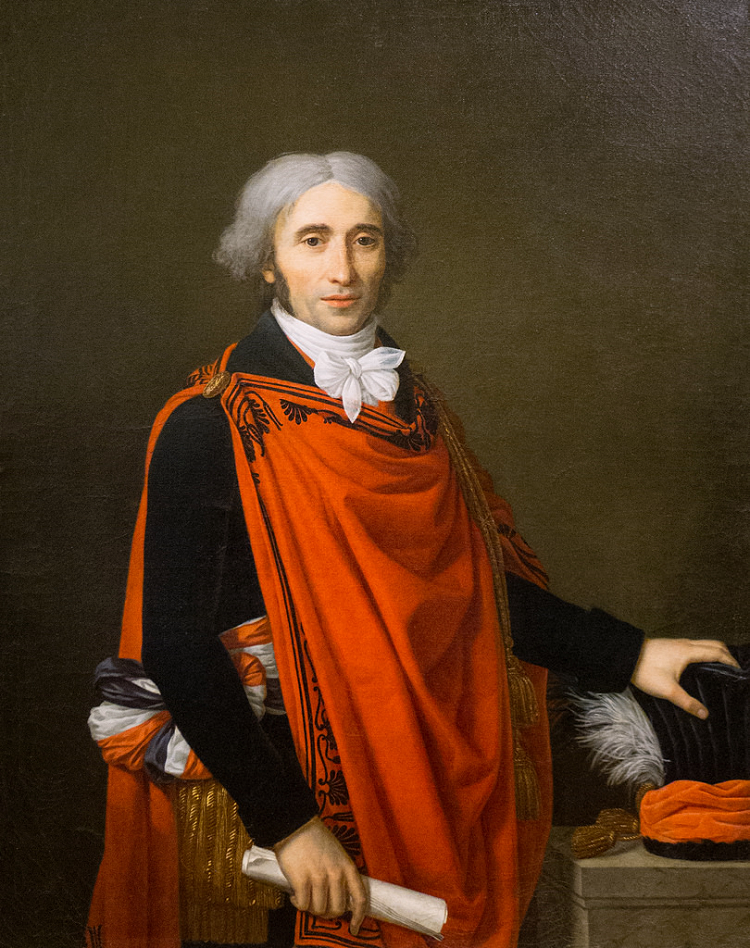
The connoisseur, admiring - Pierre Victor, baron de Besenval de Brünstatt by Henri-Pierre Danloux, 1791


Pierre Victor, baron de Besenval de Brünstatt (14 October 1721, Solothurn, Switzerland - 2 June 1791, Paris), the last commander of the Swiss Guards in France. The son of Jean Victor de Besenval, a colonel of the regiment of Swiss Guards and diplomat in the service of France, the younger Besenval served first as aide-de-camp to the duc de Broglie during the campaign of 1748 in Bohemia, then as aide-de-camp to the duc d'Orleans during the Seven Years' War. He then became commander of the Swiss Guards and a popular courtier at Versailles. A particular favorite of Marie Antoinette and her circle, witty and charming, he was also a passionate collector of art and objects. In the days leading up to the French Revolution, he was given command of the troops which the king had concentrated in Paris. But at the storming of the Bastille, he proved incompetent, fled the capital, was arrested, tried, but miraculously acquitted. He retired to his hôtel in the rue de Grenelle where he sat for this portrait the following year, the same year he died at the age of sixty-nine. 


Today he's remembered primarily as the author of his Mémoires, published in 1805 to 1807 by the vicomte de Ségur. Full of scandalous stories of the court of Louis XVI, both true and false, the authenticity of the memoirs is far from certain. (The vicomte was actually Besenval's son, rather than that of the baron's best friend, Philippe Henri, marquis de Ségur.)


*

Prominent in Danloux's charming portrait of the baron - the connoisseur sitting surrounded by his beautiful things - are three bronze doré mounted Chinese celadon vases, the visible half of the garniture de cheminée in the baron's salon de compagnie. The six vases - three pairs - were sold in 1795, four years after the death of the baron, but were briefly reunited before being auctioned by Christie's London. (The auction actually closed just last week. 8 July 2021, to be precise... which also happened to be my birthday.)


Sunday, August 8, 2021

Gentlemen of the Révolution - portraits by Jean-Louis Laneuville

 
Bertrand Barère de Vieuzac, circa 1793-94.
Joseph Delaunay, 1793.
Pierre-Charles Ruamps de Surgères, 1792.
Jean de Bry, circa 1793.
 Marie-Jean Hérault de Séchelles, before 1794.
 Jean-Baptiste Michaud, 1792.
Portrait of a Revolutionary, circa 1794.
Pierre-François-Joseph Robert, circa 1793-95.
Unknown man, attributed to Laneuville, circa 1790s.
 Jean-Baptiste Desmolin, circa 1799.
Louis Legendre, circa 1795.
Louis-François Bertin, circa 1795-97.
Portrait of a Tennis Player, circa 1792.
 Jules François Paré, 1793.

*

Jean-Louis Titon La Neuville, called Jean-Louis Laneuville (26 December 1756, Paris - 26 March 26 1826, Paris), French painter, art expert and dealer. Born the illegitimate son of Jean-Baptiste Maximilien Pierre Titon - famous as the lawyer for the queen during the trial of the "Affaire du collier" and later a victim of "The Terror" - little is known about his early training. He studied, at least briefly, with his contemporary Jacques-Louis David - his style was sufficiently similar to that of David's, that many of his works have been wrongly attributed to the latter - and he exhibited at the Exposition de la Jeunesse between 1783 and 1789. He started sending pictures to the Salon after it was opened for non-academicians in 1791. During the Revolution he appears to have sought out the patronage of powerful political figures, demonstrated by the fact that eight of the twelve portraits he sent to the Salon of 1793 were politicians, and in 1795 the numbers were four of the six. It isn't clear if he targeted these clients because of his own political enthusiasms or because he saw it as likely market. In 1791 he was elected a judge of the Prix d'Encouragement, and in 1796 signed a petition defending the acquisition of looted artworks. He continued to receive private and official portrait commissions during the reign of Napoléon. He was also active as an expert art appraiser and possibly also as an art dealer since his estate included a large number of Old Masters and contemporary French art. Unlike David who had been exiled as a regicide in 1814, Laneuville exhibited work at the Salon until 1817. 

*

La Citoyenne Tallien à la prison de La Force, tenant ses cheveux qui viennent d'être coupés, 1796.

Laneuville was exclusively active as a portrait painter. And while he nearly all of his portraits are of men, he was able to gain a commission from Thérésa Cabarrús, recently become madame Tallien, a beautiful and rather outrageous figure, prominent in Paris social circles following the end of the Reign of Terror. She had been imprisoned herself in the last days of the Terror as she was the mistress of Jean-Lambert Tallien, a revolutionary politician who had fallen from grace after criticizing the bloody methods of the present regime. In 1795, a year after the end of the Reign of Terror and her release from prison, she asked the artist to make a portrait of her in her cell, the depiction of which is believed to have been based on her own description. She is shown holding a lock of hair in her hand, hair that had been cut off in anticipation of her upcoming execution by the guillotine. The portrait of madame Tallien was exhibited at the Salon of 1796, where it caused a scandal; it was taken down after only a few days. It seems likely that painful memories of the Terror - certainly conjured by that cut lock of hair and all that it specifically symbolized - were still too fresh in the minds of the public. A few days before the exhibition closed, though, after the artist had made some unspecified changes, the portrait of madame Tallien was returned to the walls of the Salon.

Apparently the identity of the person depicted in the wall drawing has never been ascertained.


Friday, August 6, 2021

Flora, a bust of Luise Engel, by Christian Daniel Rauch, circa 1835-39


Edited and adapted from Christie's' lot essay, October 2020:

A GIFT TO THE EMPRESS? 

This composition was originally intended as the study for a head of Danaid commissioned by Emperor Nicholas I of Russia. Rauch took great care in the model’s creation, choosing Luise Engel, a young woman famed for her beauty, for his subject. Dissatisfied, however, with his inability to capture the longing expression necessary for a Danaid, he transformed the study into a Flora, adding the elaborate wreath adorned with a double band of flowers. In 1839, Rauch noted in a letter that he sent a version of the Flora composition as a forerunner to the Danaid to Empress Alexandra Feodorovna, who was so pleased with the piece that she thanked him with a diamond ring decorated with her cipher. Rauch charmingly declared the bust to be a "fallen chip" from his larger Danaid composition for the Emperor, which was finished in the same year to great acclaim. In her
catalogue raisonné on the artist, von Simson discusses three marble busts of Flora, the first one gifted to the Empress, the second, a significantly damaged version, in a private Berlin collection in the late 1990s, and a third recorded in the account book. It is possible that this piece is the latter, however, given the provenance of the present bust, it is more probable that this work is that which was gifted to the Empress in the 1830s. Further strengthening the Imperial Russian provenance, is that this bust formed part of the auctioned collection of the painter Paraskewe von Bereskine. Included in this sale were multiple lots of Russian origin and documented pieces from the Imperial Russian collections, formerly in the Palace of Pavlovsk and the Catherine Palace at Tsarskoe Selo.

Rauch’s sculptures still shape the landscape of many German cities today. He was particularly sought after for his public monuments and he found favor among many royal and aristocratic collectors, including the Prussian ruling family and the royal houses of Bavaria and Hanover. Interest in Rauch and the "Berlin School" as not only limited to the Continent. Rauch was collected by members of the British aristocracy including the sixth Duke of Devonshire and the Duke of Wellington, who visited Rauch’s studio in 1826 and subsequently commissioned several works. He was also featured in London’s Great Exhibition of 1851. While Rauch may have become famous for his public monuments and well-publicized royal commissions, his reputation has been revived by sculptures such as the present bust. It is technically brilliant but, most of all, it’s modern appeal is that it is refreshingly intimate and intensely personal.


Auction estimate: USD 30,000 - USD 50,000
Price realised: USD 200,000

*

Christian Daniel Rauch (2 January 1777, Arolsen – 3 December 1857, Dresden), German sculptor, founder the Berlin school of sculpture, and the foremost German sculptor of the nineteenth century. His father was employed at the court of Prince Frederick II of Hesse, and at the age of thirteen Rauch was apprenticed to the court sculptor of Arolsen, Friedrich Valentin. Five years later he became assistant to Johann Christian Ruhl, the court sculptor of Kassel. At the age of twenty, after the death of his father and older brother, he moved to Berlin where he was appointed groom of the chamber in the king's household. He abandoned sculpture temporarily, but his in spare hours he eventually began working again, coming under the influence of Johann Gottfried Schadow, and in 1802, he exhibited his “Sleeping Endymion.” Queen Louisa of Prussia, recognizing his talent, sent him to study at the Prussian Academy of Art. In 1804, Count Sandrecky gave Rauch the means to complete his education at Rome, where he was befriended by Wilhelm von Humboldt, Antonio Canova, and Bertel Thorvaldsen. He remained in Rome for six years. In 1811, he was commissioned to execute a monument for recently deceased Queen Louisa, a work that brought him great fame; a similar statue of the Queen, even more successful, was placed in the Sanssouci Park at Potsdam. The creation of nearly all public statues soon came to be entrusted to him. In 1830, along with the architect Karl Friedrich Schinkel, he began work on a colossal equestrian monument at Berlin to honor King Frederick II of Prussia. This work was finally inaugurated with great ceremony in May of 1851, and is regarded as the crowning achievement of his work as a portrait and historic sculptor. In 1837 Rauch became an associate member of the Royal Institute of the Netherlands. He died twenty years later at the age of eighty.


Sunday, August 1, 2021

The gentleman Bogart


Taken after his star-making role in "The Petrified Forest" but before actually becoming a star several years later, these photographs capture a refined and gentlemanly Bogart, images that reflect his privileged upbringing, so different from the hard-boiled "Bogie" of movie legend. The setting is said to be one of the villas at the Garden of Allah, the famous West Hollywood hotel complex where Bogart frequently resided, during and between marriages. Circa 1936-37, the portraits are possibly the work of Mickey Marigold, a still photographer for Warner Brothers.