L a - b e a u t é - s a u v e r a - l e - m o n d e ~ D o s t o ï e v s k i

L a - b e a u t é - s a u v e r a - l e - m o n d e  ~  D o s t o ï e v s k i


Showing posts with label Louis Hersent. Show all posts

Friday, September 27, 2024

Quand il n'y a pas assez de souffle.... - two daughters of Louis-Philippe, by Louis Hersent, 1829


Born almost exactly a year apart, after their brother Ferdinand Philippe, the duc d'Orléans, the two sisters were the eldest of their parent's ten children, eight of whom survived to adulthood. The portraits were painted a year before the July Revolution of 1830, the event that raised their father to power, and made their close-knit family France's royal family.

Louise d'Orléans, before her marriage styled mademoiselle de Chartres.

Louise d'Orléans (Louise-Marie Thérèse Charlotte Isabelle; 3 April 1812, Palermo - 11 October 1850, Ostend) was the second child and eldest daughter of Louis-Philippe and Marie-Amélie, from 1830 to 1848 King and Queen of the French. In 1832 she became the first Queen of the Belgians as the second wife of King Leopold I. The marriage was a political arrangement between France and Belgium and Louise was unhappy to leave France and her family. Of a shy nature and a delicate constitution, she had little of a public role as queen. The couple had four children, three surviving to adulthood, but she died of tuberculosis at the age of only thirty-eight.

Marie d'Orleans, before her marriage styled mademoiselle de Valois.

Princess Marie of Orléans (Christine Caroline Adélaïde Françoise Léopoldine; 12 April 1813, Palermo - 6 January 1839, Pisa) was the third child and second eldest daughter of Louis-Philippe and Marie-Amélie. A talented sculptor and artist - she was a student of Ary Scheffer - she had her own studio installed in the Tuileries Palace. She was described as a lively character, interested in both society and politics. In 1837, she married Prince Alexander of Württemberg. A member of the cadet branch of a not very prestigious princely family, her new husband was nevertheless closely related to most of the crowned heads of Europe. They had one child together. But only six months later, after traveling to Italy in hopes that the climate would bolster her rapidly faltering health, she died of tuberculosis; she was only twenty-five.

*

These two paintings reside somewhere in the collection of the vast, uninhabited palace of Caserta, some twenty-two miles north of Naples. Begun in 1752, the complex - the largest palace erected in Europe during the eighteenth century - was constructed for the House of Bourbon-Two Sicilies as their main residence as kings of Naples. At first I wondered what these portraits of two French princesses were doing in an Italian palace, until I remembered that their mother was actually born there; Marie-Amélie was the tenth of eighteen children of Ferdinand I of the Two Sicilies and Maria Carolina of Austria. 

The paintings, as seen in these images, look to be extremely dirty, discolored, and much in need of conservation. Hersent was a good painter, and even veiled with grime as they are, disfigured with neglect, the fresh, tender charm of the young girls - Louise was only seventeen, Marie sixteen - is clearly discernable. And to me, the rather wretched state of the portraits somehow adds another note of poignancy to the stories of the sisters, in some strange way aligning with their early deaths. Their youth was never quite lost, then, but buried. The paintings survive, but exist, entombed, in the airless shadows of that vast palace.


Sunday, March 1, 2020

The second son - portraits of Louis d'Orléans, duc de Nemours


Attributed to Léon Jan van Ysendyck, 1835.
By Michel Martin Drolling. This is usually dated 1835 on the internet, but I think it more likely 1825, when he would have been eleven.
From the Album du Bal costumé donnée par S.A.R. Madame, Duchesse de Berry le 2 mars 1829 aux appartements des Enfants de France aux Tuileries,
colored lithograph after Eugéne Lami, 1829.
Louis-Philippe, duc d'Orléans en uniforme de colonel-général des Hussards, et de ses fils le duc de Chartres et le duc de Nemours, by Louis Hersent, circa 1830.
Le duc de Nemours et le maréchal Gérard dans la tranchée de la citadelle d'Anvers, décembre 1832, by Victor-Amédée Faure, 1837.
The artist, Faure, was the brother of my wife's great-great-great-great-grandfather.
Le roi Louis-Philippe entouré de ses cinq fils sortant par la grille d'honneur du château de Versailles après avoir passé une revue militaire 
dans les cours, 10 juin 1837, by Horace Vernet, 1848. Left to right: François, prince de Joinville; Antoine, duc de Montpensier; Ferdinand-
Philippe, duc d'Orléans; Louis-Philippe; Louis, duc de Nemours; Henri, duc d'Aumale.
By Franz Xaver Winterhalter, 1939.
Miniature by Sir William Ross, 1840. 
Marriage of the duc and duchesse de Nemours in the chapel of the château de Saint-Cloud, 27 April 1840, by Félix-Henri-Emmanuel Philippoteaux, 1847.
The couple surrounded by his parents and family, including Léopold I, King of the Belgians; he was married to Louise d'Orléans, eldest daughter of Louis-Philippe.
By Franz Xaver Winterhalter, 1843.
 In a costume worn to a ball at Buckingham Palace, 6 June 1845, watercolor by Eugéne Lami, 1845.
1870.
Circa 1880s.
Circa 1890s.

*

Louis Charles Philippe Raphaël d'Orléans, duc de Nemours (25 October 1814, Paris – 26 June 1896, Versailles), second son of Louis-Philippe, King of the French, and his wife Marie-Amélie de Bourbon-Siciles. Born at the Palais Royal during the first year of the Bourbon Restoration, at the age of twelve he was nominated colonel of the first regiment of chasseurs. And after his father had assumed the throne, in 1830 - only sixteen - he was made a chevalier of the Ordre du Saint-Esprit and entered the Chambre des Pairs. The following year he was nominated to become the first king of the Belgians, a prize which would go to his brother-in-law Leopold, Duke of Saxe-Coburg and Gotha. He fought in Algeria on three separate occasions - 1836, 1837, 1841 - as a commander during the latter two. He also made official visits to other royal courts - particularly that of Great Britain - during the 1830s and '40s. In 1840, he married Victoire of Saxe-Coburg and Gotha - niece of Léopold, King of the Belgians, first cousin of both Queen Victoria and Prince Albert - at the château de Saint-Cloud. They would have four children. After the revolution of 1848, and his father's abdication, he joined the extended Orléans family in England. His great aim in the first decade of exile - especially after the death of his father in 1850 - was to broker a reconciliation between the two branches of the House of Bourbon, something he saw as necessary if there were to be any hope of restoring a French monarchy. Negotiations continued until 1857, but were ultimately fruitless. In that same year, his wife died after giving birth to their fourth child; her husband never remarried. In 1871, after the fall of the Second Empire, the exile imposed on the french princes was lifted and his rank in the army was restored. After his retirement, he continued to act as president of the Red Cross until 1886, when the government imposed new restrictions on the princes of the blood and he withdrew from Parisian society. He died ten years later at the age of eighty-one, having outlived his wife, a daughter, and almost all of his siblings. He was interred in the necropolis of the Orléans family, the Chapelle royale de Dreux.


Sunday, May 5, 2019

Enfants de France - portraits of French princes (and three princesses)


Sons (and daughters) and grandsons and great-grandsons of kings, sons and great-nephews of emperors, only three eventually ascended the throne of France. One was horrified to find himself there and lost it, one schemed to reclaim it, one lost it again. And only one of those abandoned the throne as a result of the most natural of causes: old age and illness and death.

 The comte de Provence - later Louis XVIII - and his elder brother the duc de Berry - later Louis XVI - by François-Hubert Drouais, 1757.
Louis-Joseph-Xavier de France, duc de Bourgogne, by Jean-Martial Frédou, circa 1760. The eldest grandson of Louis XV and heir apparent.
 The duc de Bourgogne, also by Jean-Martial Frédou, 1761. A much loved child, he died at the age of nine from the effects of a fall two years previously.
Louis-Auguste de France, duc de Berry - later Louis XVI - by Jean-Martial Frédou, 1760.
Louis-Stanislas-Xavier de France, comte de Provence - later Louis XVIII - by Maurice Quentin de La Tour, 1762. 
Charles-Philippe de France, comte d'Artois - later Charles X - with his sister Madame Clothilde, by François-Hubert Drouais, 1763.
The comte d'Artois, by Jean-Martial Frédou, circa 1765-67.
 The comte d'Artois, also by Jean-Martial Frédou, 1773.
 Louis-Antoine, duc d'Angoulême,by Joseph Boze, 1785. After his father Charles X's abdication in 1830 he became Louis XIX -
for about twenty minutes - before he signed his own abdication; many legitimists do not consider either of the acts as valid.
Louis-Charles de France, duc de Normandie - later the titular Louis XVII - by Alexandre Kucharsky, 1792.
Marie-Thérèse-Charlotte of France, Madame Royale - later the duchesse d'Angoulême, later dauphine of France - by Heinrich Friedrich Füger, circa 1795.
Napoléon-François-Charles-Joseph Bonaparte, roi de Rome - later Herzog von Reichstadt - by Pierre-Paul Prud'hon, 1811.
 Henri-Charles-Ferdinand-Marie-Dieudonné, duc de Bordeaux, comte de Chambord - grandson of Charles X and later the legitimist pretender -
and his elder sister Louise-Marie-Thérèse - later Duchess of Parma and Piacenza - by Louis Hersent, 1821.
Napoléon-Eugène-Louis-Jean-Joseph Bonaparte, prince impérial, by Franz Winterhalter, 1864.
The Prince Impérial, by Jules Lefebvre, 1870.


Sunday, October 14, 2018

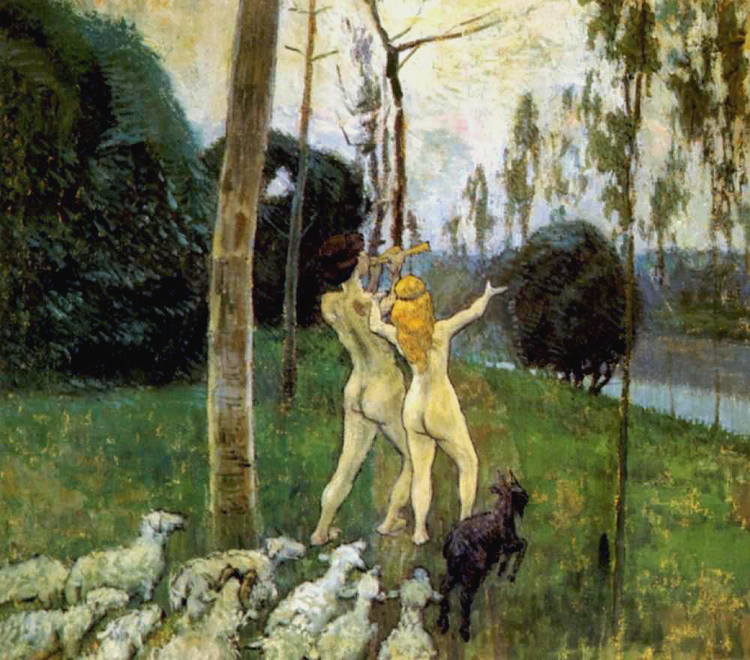
Daphnis et Chloé - just a boy and a girl in the woods


François Gérard, circa 1824.

(Freely edited and adapted from Wikipedia)

Daphnis and Chloe
(Greek: Δάφνις καὶ Χλόη) is the only known work of the 2nd century AD Greek novelist Longus. Nothing is known of the author's life, or even if that was his actual name. If it indeed was, he was possibly a freedman of some Roman family which bore the name as a cognomen. The novel was given a contemporary setting on the isle of Lesbos, when and where scholars assume the author to have lived.

Daphnis et Chloé demandant à un vieux chevrier ce que c'est que l'amour, by Lancelot-Théodore, comte de Turpin de Crissé, 1809.

It's the tale of a boy - Daphnis - and a girl - Chloe - each of whom is left abandoned - as a form of infanticide - out in the country. But a goatherd named Lamon discovers Daphnis, and a shepherd called Dryas finds Chloe. Each decides to raise the child he finds as his own. The two children grow up together, herding the flocks of their foster parents. They fall in love but, being completely naive, do not understand what to do with their feelings. Philetas, a wise old cowherd, explains to them what love is and tells them that the only cure is kissing. They do this.... Eventually, Lycaenion, a woman from the city, educates Daphnis in love-making. He decides not to test his newly acquired skill on Chloe, however, because Lycaenion tells him that Chloe "will scream and cry and lie bleeding heavily [as if murdered]." Throughout the book, Chloe is courted by suitors, two of whom - Dorcon and Lampis - attempt with varying degrees of success to abduct her. She is also carried off by raiders from a nearby city and only saved by the intervention of the god Pan. Meanwhile, Daphnis falls into a pit, gets beaten up, is abducted by pirates, and is very nearly raped. [!] In the end, the two lovers are recognized by their birth parents, get married, and live out the rest of their lives in bucolic contentment.

Konstantin Somov, 1930.
John-Étienne Chaponnière, 1828.
Paris Bordone, circa 1555-60.
Set design for the Diaghilev production of Daphnis et Chloé, by Léon Bakst, 1912.
Jehan-Georges Vibert, 1866.
Nicolas-Andre Monsiau, 1817.
Pedro Weingärtner, 1891.
Joseph-Marius Ramus, 1835.
François Boucher, 1743.
Harold Speed, 1924.
Pieter van der Werff, circa 1700.
Adriaen van der Werff, circa 1694.
Gerald Brockhurst, circa 1914.
Louis Hersent, 1842.
Jean-Baptiste Carpeaux, 1874.
Dominique Papety, circa 1830s-40s.
Idylle, by Camille-Félix Bellanger, 1893 (?).
Pierre Cabanel, circa 1870.
Victor Borisov-Musatov, 1901.
L'Orage, by Pierre-Auguste Cot, 1880.
Jean-Pierre Cortot, 1825.
Printemps, by Jean-Francois Millet 1865.
Maurice Denis, 1918.
Daphnis et Chloé revenant de la montagne, by Charles Gleyre, circa 1850.
The Wooing of Daphne, by Arthur Lemon, 1881.
Idylle, by Jean-Léon Gérôme, 1852.
Paysage avec Daphnis et Chloé, by François-Louis Français, circa 1897.