L a - b e a u t é - s a u v e r a - l e - m o n d e ~ D o s t o ï e v s k i

L a - b e a u t é - s a u v e r a - l e - m o n d e  ~  D o s t o ï e v s k i


Showing posts with label Jean-Baptiste Regnault. Show all posts

Sunday, August 4, 2024

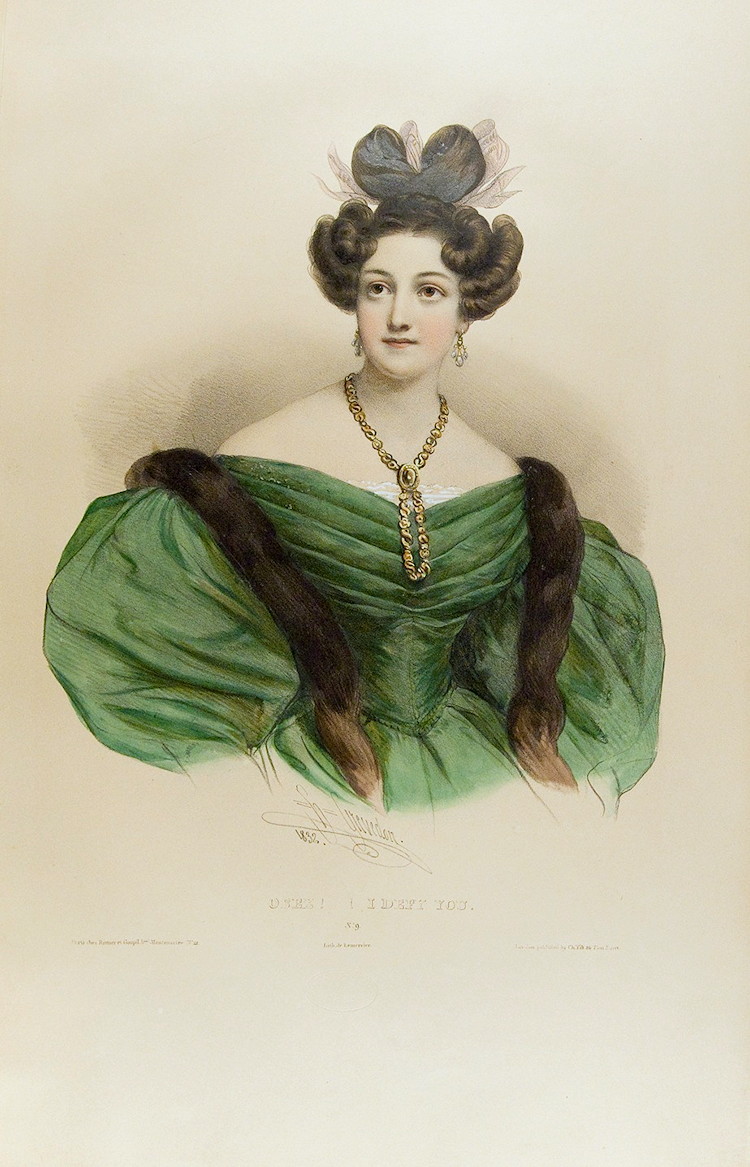
À la mode actuelle - selections from Le Vocabulaire des dames, by Henri Grévedon


Large-scale lithographs of fashionably dressed women - imaginary portraits - were popular in the late 1820s and 1830s, and Henri Grévedon produced about twenty series between 1828 and 1840, each containing between four and twenty-eight prints. Among those were:

Epoques remarquables de la vie de femme, 1830
Le Vocabulaire de dames, 1831-34
Heroïnes des principaux romanciers contemporains, 1833
Le Miroir des dames, ou Nouvel alphabet français, 1834
Recueil de quelques portraits d'actrices des principaux théâtres de Paris, 1831-1834
Les Mois, 1838
Portraits de femmes, selon leur rang social, 1840


His Le Vocabulaire des dames was produced over a period of four years; the title page of the series states, "This collection of portraits will be replenished every month, as soon as new fashion appears." The lithographs were produced in four batches of six prints over the four years and could be purchased individually or as a series. The series was sold commercially, by subscription and through stores, in both Paris and London.


Most likely, Grévedon not only created the drawings, but also lithographed many of the sheets himself, as they display the signature of the master, but bear no indication of another lithographer. 


The series' lithographs were large, measuring roughly 19x12 inches (49x31 cm) making it impossible to insert them into albums of a commonly available size. They were, instead, considered suitable as images to be framed and hung on a wall; industrious print retailers offered gilded and glazed frames to fit.


The special advantage of many of Grévedon's works is that they're hand-painted. As a rule, the coloring was not repeated, which gave each sheet a special individuality. The beautiful hand-coloring also significantly increased the price of the lithographs. The black and white edition of Le Vocabulaire des dames sold for 9 francs per lot, while the hand-colored edition sold for 15 francs per lot.


*

Pierre-Louis ("Henri") Grévedon (17 October 1776, Paris - 1 June 1860, Paris), French painter, illustrator, and lithographer. In 1789, at the age of thirteen, he entered the workshop of Jean-Baptiste Regnault at the École des Beaux-Arts de Paris. He first exhibited at the Paris Salon in 1804; for his debut he was awarded a 1st class medal. He traveled to Russia in 1806, remaining there until 1812, followed by stays in Stockholm and England, before returning to France in 1816. He exhibited from 1824 to 1859 at the Paris Salon, and in January of 1832 was awarded the Légion d'honneur.


Wednesday, November 18, 2015

Randomly V


(It's been two months and five days since I've had time to scrape together a blog post. We're all moved into the new house, but we're far from set up yet; so much more to do. So I thought I'd make it easy on myself and start off with a simple-to-assemble "randomly" post. It's good to be back.)

Margherita Gonzaga, Duchess of Lorraine, by Frans Pourbus the Younger, 1606.
Unknown subject, photographer unknown, ND.
Moonrise, by Stanisław Masłowski, 1884.
Marie-Hélène Arnaud and Joanna McCormick in Lanvin, photograph by Henry Clarke, 1957.
Unknown subject, unknown miniaturist, circa 1770s.
Arturo López-Willshaw, by Alexandre Jacovleff, 1923.
Unknown model,  photograph by Studio Arax, ND.
Mademoiselle Vaughan, by Paul César Helleu, 1905 (?).
Family portrait (On the Balcony), by Fyodor Slavyansky, 1851.
L'Amour et l'Hymen buvant dans la coupe de l'Amitié (Cupid and Hymen Drink from the Cup of Friendship),
by Jean-Baptiste Regnault, 1820.
Madame Spranza, Mathew Brady Studio, New York City, circa 1855-60.
Unknown subject, Josiah Johnson Hawes and Albert Sands Southworth, circa 1850.
Ted Shawn and His Men Dancers, 1934. (Film still?)
Anna Pavlova, circa 1911-12.
Portrait of a Monk of the Benedictine Order Holding a Skull, by Sir Anthony van Dyck, ND.
Portrait d'homme, by Maurice Quentin de La Tour, circa 1760.
New Moon, by Isaac Brodsky, 1912.
"French pet store", photographer unknown, circa 1925.
Antoinette-Pauline de Montet-Duchambge, by Robert Lefèvre, circa 1810.
Jimmy Martin, photograph by Kris Studios, ND.
Cordelia, by Sir Walter Westley Russell, 1930.


Wednesday, June 17, 2015

L'Éducation d'Achille par le centaure Chiron, by Jean-Baptiste Regnault, 1782


 "The Education of Achilles by the Centaur Chiron"

In Greek mythology, Chiron was held to be the premier centaur - something of a prince among centaurs - and notable for his youth-nurturing nature. Like the satyrs, centaurs were notorious for their lascivious ways, inclination to violence when intoxicated, and their generally uncouth behavior. Chiron, by contrast, was intelligent, civilized, and kind. But then he wasn't always thought to be related to the other centaurs; archaic mythology gives that he was sired - no pun intended - OK, yes it is - by the titan Cronus who had taken the form of a horse and impregnated the nymph Philyra. Later tradition ascribes his gentility to Nurture rather than Nature; Apollo and Artemis were his foster parents, and many of their personal attributes - music, archery, hunting, medicine, prophecy - became his as well. He would then pass on these skills to many of Greek mythology's great heroes, Achilles among them.

This painting is no "great work", certainly, but nice enough. And a good example of the late eighteenth century Neoclassical taste for dramatic mythological subjects. Well-drawn figures and drapery; balanced, graceful composition; richly contrasted lighting; warm but subtle coloration. But I have to say I'm distracted by the little tuft low down on Chiron's abdomen. Is that the correct location for that particular "place marker"? Really, it does cause one to ponder the specific anatomy of a centaur, doesn't it...?


***

Jean-Baptiste Regnault (9 October 1754, Paris – 12 November 1829, Paris), French painter. Born in the French capital, his first teacher was the history painter Jean Bardin, who took him to Rome when he was only fourteen. Four years later, having returned to Paris, he joined the studio of Nicolas-Bernard Lépicié. In 1776 he won the Prix de Rome with his "Alexander and Diogenes" and returned to Rome, where he spent the next four years at the Académie de France in the company of Jacques-Louis David and Jean-François-Pierre Peyron. In 1783 he was elected Academician; his diploma picture, the "Education of Achilles by Chiron" - this post's featured painting - is now in the Louvre.  He became very well known as a teacher; several of his students became celebrated artists in their own right, and his influence rivaled that of David. He was married twice, lived to the age of seventy-five, and is buried in Père-Lachaise.