L a - b e a u t é - s a u v e r a - l e - m o n d e ~ D o s t o ï e v s k i

L a - b e a u t é - s a u v e r a - l e - m o n d e  ~  D o s t o ï e v s k i


Showing posts with label Horst P. Horst. Show all posts

Sunday, March 2, 2025

Gertie, tonight - Gertrude Lawrence in Hartnell for Coward by Horst, Vogue, 15 November 1936


*

When the image is enlarged, the rather crude retouching of Miss Lawrence's slightly less than aristocratic nose is quite obvious.
The two relevant pages from Vogue. (In the above, it's clear that, for publication, the nose in question has been re-retouched.)

*

Two images of the We Were Dancing gown "in action." This photograph credited to Vandamm.
Photograph - presumably for Shadow Play - by Sasha (Alexander Stewart).


Sunday, April 14, 2024

But was he... Fred? - photographs by Horst


*

Some of the titles of the photographs in this series refer to the subject as merely a "handsome blond man," while others are specifically titled "portrait of Fred." They are also variously dated, from a firm 1932 to a vague "circa 1940." Why so much confusion when, clearly, all seven were taken during the same session? Even the top auction houses disagree about the titles and date. So, I guess we'll just have to say that they're lovely photographs of a lovely young man, whenever it was that the camera was blessed with his presence, and leave it at that.


Friday, August 26, 2022

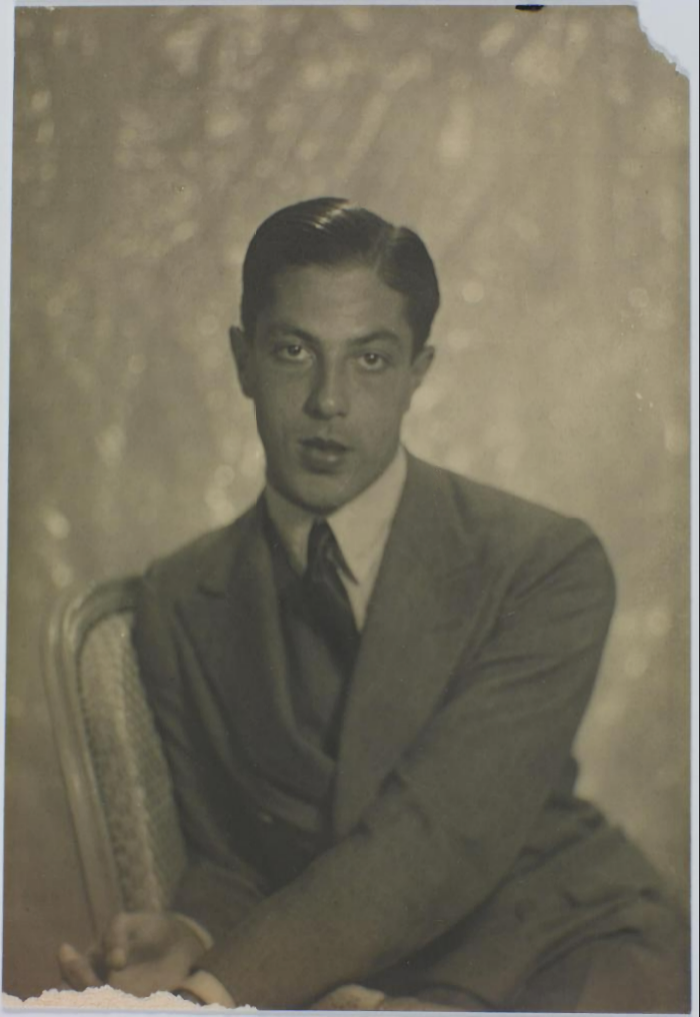
When your one true possession is style - portraits of baron "Niki" de Gunzburg

 
Horst P. Horst, 1937.
Man Ray, circa 1928. (Three images.)
Horst P. Horst, 1934. He is costumed as "Archduke Rudolf" for his famous Bal de Valses.
George Hurrell, circa 1935-36.

Nicolas "Niki" Louis Alexandre, 5th baron de Gunzburg (12 December 1904, Paris - 20 February 1981, New York City), French-born magazine editor and socialite, he served as an editor at several American publications, including Town & Country, Vogue, and Harper's Bazaar, and was named to the International Best Dressed List Hall of Fame in 1971. He was born into a wealthy and influential Russian-Jewish family, whose fortune had been made in banking and oil. The Günzburgs, as they were originally known, were ennobled during the 1870s by the Grand Duke of Hesse and by Rhine; their Hessian title was made hereditary in 1874 by Czar Alexander II of Russia. (When the family began spending more time in France later in the century, the umlaut was dropped and the particle "de" adopted.) Raised primarily in England, where his father worked as a banker and director of the Ritz Hotels Development Corporation, he would spent his later youth in France, where he was accustomed to a lavish lifestyle. One that included constant parties, costume balls, and other entertainments, but little or nothing in the way of useful or gainful employment. It's said that when his father died in 1929, it was discovered that the family fortune had fairly vanished. Three years later he starred in and co-produced Danish film director Carl Dreyer's expressionistic horror film Vampyr, under the pseudonym Julian West. In July of the following year he threw his famous Bal de Valses, which had as its theme the milieu of the Viennese Imperial Court, circa 1860. Attended by le tout-Paris - the likes of Chanel, Carlos de Beistegui, Natalie Paley, Fulco di Verdura, and wall to wall aristocrats - it was a last hurrah. Having booked passage even before the night of the ball, he arrived in the United States shortly after, settling first in Hollywood, where he was one of a growing colony of European émigrés who sought refuge there. But he soon abandoned California for Manhattan; he arrived in New York City on 10 November 1936 and rented an apartment in the Ritz Tower. His certificate of immigration from the French Consulate General in New York listed him as sans profession. But he later worked as an editor at Harper's Bazaar and than as editor in chief of Town & Country. In 1949 he was appointed senior fashion editor of Vogue. He was also a mentor to three fashion designers who would go on to great success: Bill Blass, Oscar de la Renta and, most notably, Calvin Klein. Gay, he never married, but had two long term relationships. The first was with actor/singer Erik Rhodes, best known for his comic roles in two Astaire/Rogers vehicles, The Gay Divorcee and Top Hat. The second was an artist from Texas, Paul Sherman. The two met in the late 1950s and remained together until Gunzburg's death at the age of seventy-six. He was buried in Glenwood Cemetery, near his summer home in Highland Lakes, New Jersey, with a small private service at which Blass, de la Renta, and Klein were among the mourners. The title of baron de Gunzburg became extinct on his death.

A writer at Vogue once described him as:

A slender, attractive man with a really dry wit, a gift for mimicry, and a sharply developed taste for the simple but cultivated amenities of living.

*

Five additional proofs from the Man Ray sitting, circa 1928.


Sunday, July 17, 2022

Randomly XXIV

 
Knabe auf einer bunten Blumenwiese vor sommerlichem Himmel (Boy in a colorful flower meadow in front of a summer sky), Tom Von Dreger, 1919.
Gowns by Lucien Lelong, jewels by Mauboussin, photographed by Horst P. Horst for the 1 April 1935 issue of Vogue.
Evgeny Lushpin, circa 1999.
Madame Lambinet, née Nathalie Sinclair, by Gustave-Clarence-Rodolphe Boulanger, 1887.
Courtesy Stephen Rutledge.
Pansies and Fern-shoots, by John Brett, 1862.
Courtesy Stephen Rutledge.
Painting and Poetry, by Francesco Furini, 1626.
Still from the Swedish film Kamrater i Vapenrocken (roughly, Comrades in Uniform), 1938.
Goodnight, aka The Bedroom, by Dame Laura Knight, 1931.
Ivan Leontyev, by Carl Christian Vogel von Vogelstein, before 1812.
L'Archer, by George Barbier, circa 1920s.
Cupid Preparing his Bow, by Jacob Huysmans (after Van Dyck), second half of the seventeenth Century.
Winged Cupid, by Antonio Canova, circa 1795.
Joséphine Baker, costumed for a performance at the Folies Bergère, 1937.
The Young Girl and the Cabbage, by Firmin Baes, 1903.
A lady seated with her pet spaniel in a park, circle of Jean-Frédéric Schall, circa 1780s.
Courtesy Stephen Rutledge.
French Windows 1916, by Tomas Clayton, 2016.
Gypsy Boy, New York City, by Helen Levitt, 1939.
Negligée worn by Marjorie Merriweather Post , circa 1918-21.
Study of a man, Rafael Pellicer Galeote, circa second quarter of the twentieth century.
Portrait of a nobleman at the age of eighteen, by Frans Pourbus the Younger, 1593.
The Michelin band performs at the inauguration of the Michelin Hour radio show, 17 April 1928.
Cours de danse, by Victor Gabriel Gilbert, 1905.
Ziegfeld Follies dancers, circa 1920s.
Figure study for The Spirit of Vulcan, Genius of the Workers in Iron and Steel, Rotunda, Pennsylvania State Capitol, by Edwin Austin Abbey, circa 1902-08.
"Buss[ing] and hugging."
Cherry Blossoms, by Henri Fantin-Latour, 1872.
Seascape, Storm, by Claude Monet, 1866.
Walter Griffin, by Dennis Miller Bunker, 1881.
Anna Roslund, by Gabriele Münter, 1917.
Judith with the Head of Holofernes, by Massimo Stanzione, circa 1640.
Enfants en patins à roulettes, by Pierre Jahan, 1941.
Catherine Duchemin, flower painter, wife of the sculptor François Girardon, French School, circa 1663-65.
Saint Sebastian Thrown in a Pond, by Bernard Bénézet, 1866.
Julia Margaret Cameron, by George Frederic Watts, circa 1850-52.
Water Lily and Moth, by John La Farge, circa 1878.
Self-Portrait, by Philipp Veit, 1816.
Iokepa, Hawaiian Fisher Boy, by Hubert Vos, 1898.
The Pink Dress (Albertie-Marguerite Carré, later Madame Ferdinand-Henri Himmes), by Berthe Morisot, circa 1870.
Courtesy Stephen Rutledge.
Still life with fruits, flowers, shells, and insects, by Balthasar van der Ast, circa 1620.
Portrait of a Young Man, by Pompeo Batoni, circa 1760–65.
Courtesy Stephen Rutledge.
Natalia Alexandrovna von Buxhoeveden, née Alexeyeva, by Vladimir Borovikovsky, before 1808.
Norman Earthenware, aka A Pot from Rouen, by Pierre Bonnard, circa 1910.
Study of Lilia, by Carolus-Duran, 1887.