L a - b e a u t é - s a u v e r a - l e - m o n d e ~ D o s t o ï e v s k i

L a - b e a u t é - s a u v e r a - l e - m o n d e  ~  D o s t o ï e v s k i


Showing posts with label Vigilius Eriksen. Show all posts

Friday, June 7, 2019

An empress, twice over - Catherine II by Vigilius Eriksen, circa 1762


This has long been one of my favorite portraits and certainly my favorite portrait of the Empress - even though I'd never seen a decent image of it. It always looked quite dirty, with big patches of very yellowed varnish. It was unfortunate - and seemed rather odd - that such an important painting would be languishing in so poor a state. But now that it's been properly cleaned and restored, Eriksen's compositional and painterly skill can finally be fully appreciated.


The artist painted the Empress on several occasions, and this is considered one of the most satisfying portraits of the oft-portrayed subject. (It's also thought to be one of the painter's most successful pieces.) Eriksen used a very successful approach to the composition, allowing him to show Catherine both full-face and in profile. Intentionally or merely fortuitously, in doing so he manages to capture the contrasting aspects of the Empress' complicated character: the profile is severe, commanding, befitting the ruler of a vast empire - an image fit for a coin - while the face turned to the viewer is that of a charming, intelligent, and very cultured woman.

For the record, this is how you paint diamonds.

The Empress was portrayed shortly after she came to the throne in 1762, and is depicted wearing the sash, star and badge of the Order of St. Andrew as well as the Small Imperial Crown. On the cushions in front of the mirror are the remainder of the imperial regalia: the Large Imperial Crown, created by the Swiss jeweler Jérémie Pauzié especially for the coronation, the sceptre and the orb. The earliest mentions of the portrait date from 1762–63. In the 19th century, the painting hung in the Romanov Gallery of the Small Hermitage among other portraits of members of the House of Romanov.

Before restoration - though it might already have had some cleaning.

From the Hermitage website:

The restoration project included the following work: strengthen of the primer and paint layer across the entire surface; removal of superficial soiling; test removals of varnish and overpaintings; thinning and smoothing of the old varnish layer across the entire surface of the painting; removal of old restoration modifications of colour; second restoration of varnish; new coating of varnish; making good losses of paint.


In the middle of restoration, with old restorations and overpaintings removed.
After restoration.


Sunday, May 12, 2019

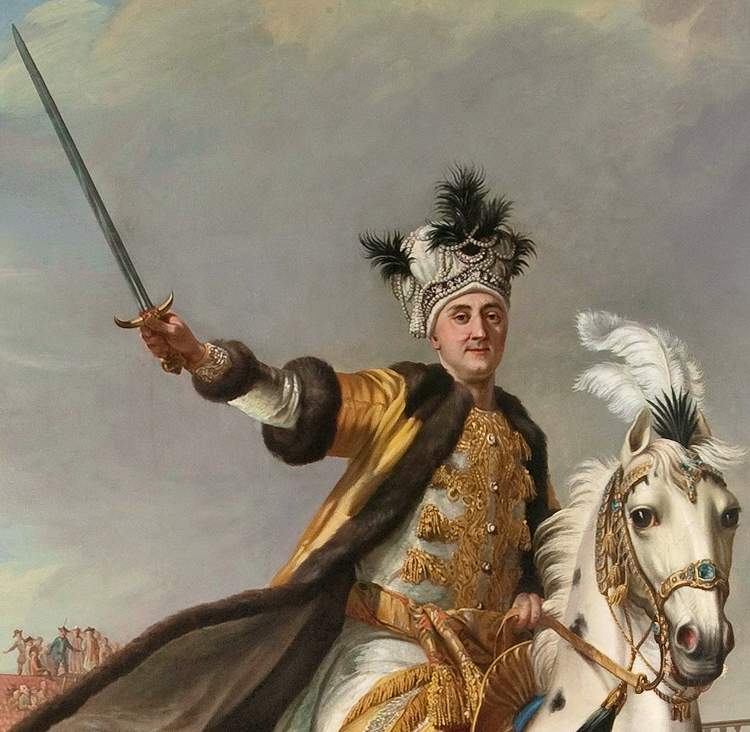
The Orlov brothers - two equestrian portraits by Vigilius Eriksen, circa 1766


Count Grigori Grigorievich Orlov. The two paintings measure more than thirteen by eleven and a half feet.

These portraits by the Danish painter Vigilius Eriksen are of the two most celebrated of the five Orlov brothers. Count Grigori Grigorievich Orlov (1734–1783), pictured above in Roman costume, was a lover of the Empress Catherine the Great and one of her closest advisors; he fathered her illegitimate son, Alexei, born the same year as the coup d'état which deposed Catherine's husband and secured her place as sole ruler of Russia. Virtually her co-ruler for some years, he was supplanted by Grigori Potemkin in 1774.

Count Alexei Grigorievich Orlov.

Count Alexei Grigorievich Orlov (1737–1808), depicted in Turkish dress, was one of Catherine’s most important military and diplomatic leaders. The ablest of the Orlov brothers, he was integral to Catherine's plot to take power in 1762; some sources claim he participated in the resulting death of Peter III, that he conveyed the Emperor to Ropsha Palace and even participated in his murder, though the circumstances of Peter's death are much disputed.


In 1766, Catherine the Great ordered the first Russian "carousel," an exhibition of horseback riding, swordsmanship, and shooting then popular in all the great courts of Europe. While the event was repeated in subsequent years, no later celebration inspired as much artistic and literary creativity as the first; there are references to the event in the works of Casanova, Voltaire, and others, as well as numerous paintings and other works of art. These large equestrian portraits commemorate the prominent participation of the Orlov brothers, still the most influential figures at court. Eriksen was Catherine's court painter in the early years of her reign and is responsible for many of the best known images of the Empress.


*

The portraits hung in the Winter Palace until the death of the Empress in 1796. Paul I began his reign by clearing away any reference to his mother's long succession of lovers, and these paintings were shut up in warehouses for many years. Sent to the Court Stable Chancellery in 1827, during the reign of Nicholas I, they found their way to the Gatchina Palace six years later. During World War II, in advance of the Nazi occupation, there was a mass evacuation of the art treasures resident in the suburban palace-museums outside of St. Petersburg; it is likely these were part of that exodus. After the war, they were returned to the repository of art and furnishings held at the Pavlovsk Palace Museum and, in 1958, handed off to the Hermitage and stored in the Central Warehouse of Museum Holdings.

The two paintings in the early stages of restoration.

These paintings were stored in rolls for decades. This type of storage - where the painting is taken from the frame and then detached from its stretcher - is generally used as only a temporary, emergency measure, and is the result of a number of reasons, among which is the need to transport overly large paintings, or where there is the lack of space or the proper conditions for storing such works of art in any other manner. One way or another, these canvases had been languishing in this state probably since World War II. Previously only known from black and white reproductions - to the public and museum curators alike - they were finally unrolled less than a decade ago and have now been restored.


Saturday, December 12, 2015

Orange, to be fair


Robert Rich, Second Earl of Warwick, by Anthony van Dyck, circa 1632-35.

If I were ever to sit about pondering my favorite colors, orange would never come to mind. And how unfair of me! Because orange is the most remarkable, incredibly important color. Powerful, invigorating. Whether a dazzling highlight - the "perfect spice" - or the main scheme of an image. Orange, I apologize. Orange, I salute you!

The Sisters Schwartz, by Anders Zorn, 1889.
Orpheus, attributed to Paul Duqueyland, circa 1800.
Cornelia Rijdenius, by Johann Heinrich Wilhelm Tischbein, circa 1790-95.
Flower garland with portrait of William III of Orange, aged 10, by Jan Davisz. de Heem, circa 1659-66.
L'éveil du Faune, by Magnus Enckell, 1914.
Les Gentilshommes du Duc d'Orleans dans l’habit de Saint-Cloud, by Henri Félix Emmanuel Philippoteaux,1839. (After Carmontelle, 1770.)
Still-life - tea set, by Jean-Étienne Liotard, circa 1781-83.
Portrait of a lady, by Nicolas de Largillière, circa 1710-20.
Le Printemps, by Jean Dupas, 1926.
Wrapped Oranges, William J. McCloskey, 1889.
Aurelia, by Dante Gabriel Rossetti, 1879.
Mrs. Dora Lamm and Her Two Eldest Sons, by Carl Larsson, 1903.
Frederick, Hereditary Prince of Denmark and Norway, by Vigilius Eriksen, 1777.
The most orange of any painting: Flaming June, by Frederic Lord Leighton, 1895.


Wednesday, October 1, 2014

Catherine II, by Vigilius Eriksen, 1762 - 1764


The Danish painter Eriksen completed several portraits of the young Empress, but this is my favorite.  I love the composition of the painting, the charming conceit of the mirror revealing a second view of the subject.  But mostly, I love the contrast between those two views, the accidental (?) illustration of the two opposing halves of the Empress' character: the refined and cultured European who turns to us, gracefully feminine, and the fierce intelligence, the formidable drive and determination that the reflected profile reveals.


Saturday, May 17, 2014

Queen Juliane Marie of Denmark, by Vigilius Eriksen, 1776


Juliane Marie, Queen of Denmark (4 September 1729, Wolfenbüttel – 10 October 1796, Fredensborg Palace), born Juliana Maria of Brunswick-Wolfenbüttel-Bevern, second consort of king Frederick V of Denmark and Norway, mother of the prince-regent Hereditary Prince Frederick of Denmark and Norway, and herself de facto regent from 1772 to 1784.

In 1752 she married the Danish king, doing so only six months after the death of his first wife, a fact that did not make her popular with the Danes. After the death of her husband in 1766, and now Queen Dowager, she was treated with open hostility by the new king, Christian VII, his wife, and their court. But by 1770, the king had become mentally ill, and his wife and her lover, Johann Friedrich Struensee, had taken control of the government. Juliane Marie became the center of the opposition forces, and in 1772 they seized power; Struensee was executed and the queen exiled.

Juliane Marie's son, Hereditary Prince Frederick, was now made regent but, in reality, his mother was the real power during his regency. Her government was extremely conservative, bolstering the rights and privileges of the nobility, but she was loathed in more liberal circles. She was also given responsibility for the upbringing of the crown prince, later Frederick VI, who resented her influence and control.  In 1784, he was declared of legal age, and at his first council meeting, he dismissed all in the government loyal to Juliane Marie and her son, and himself assumed the regency for his mentally ill father.  There were those - including King Gustav III of Sweden - who urged her to stage a coup, but she declined, and lived the remaining twelve years of her life quietly at court.

***

Vigilius Eriksen (2 September 2, 1722 in Copenhagen – May 25, 1782 in Rungstedgård), Danish artist.  Before his tenure as court painter in Denmark, he had spent fifteen years at the court of Russia, where he worked for both empresses, Elisabeth and, especially, Catherine II.

***

The Queen's likeness is generalized and quite doll-like - she looks nothing like the sharp-minded woman she must have been - but I love this painting's beautifully calculated low vantage point perspective and, especially, the amazingly detailed rendering of fabric and lace; for someone like me, these passages are really awe inspiring.


Like most important royal commissions, there are several copies and variations that are based on the original painting.