|
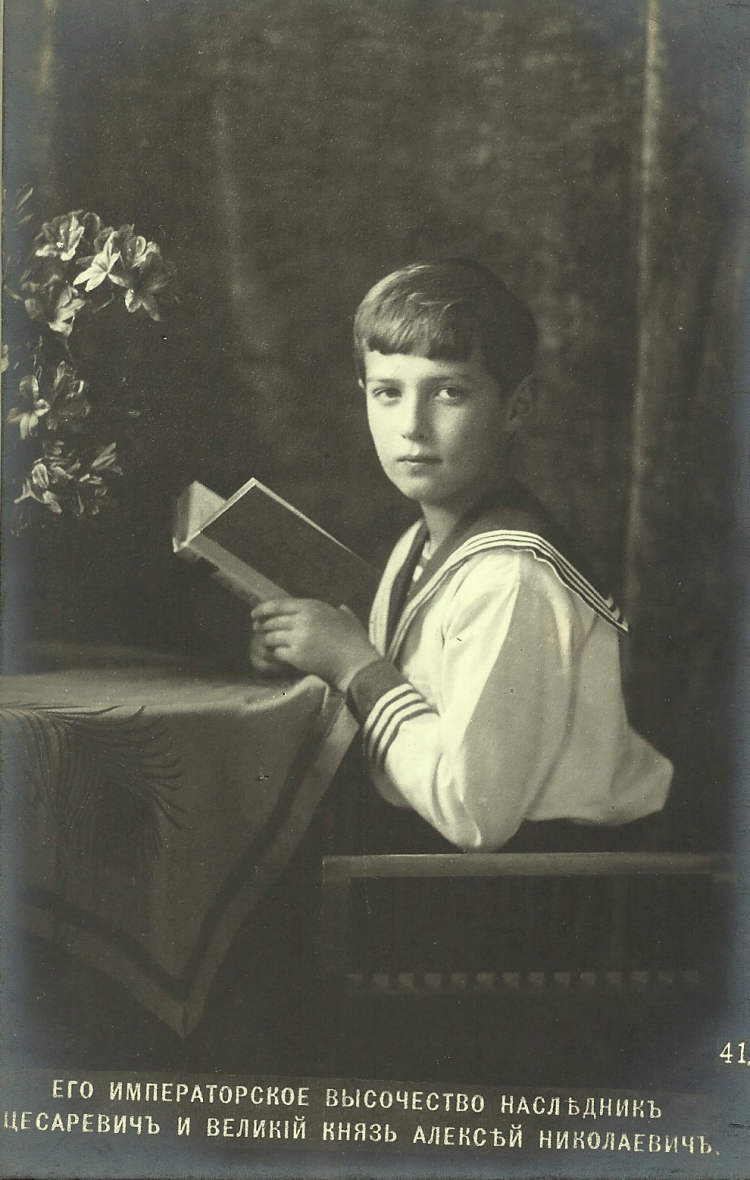
| Those "tagged" are: Rostislav, Vasili, Miss Coster*, Nikita, Dmitri, Alexei (Tsarevich), Doctor Derevenko**, and Alexei's "sailor nanny" Andrei Derevenko***. |
These images are from the annotated photo albums created between 1908 and 1918 by Herbert Galloway Stewart (1866-1960), an English tutor who had been invited by the Grand Duke Alexander Mikhailovich and his wife, the last Tsar's elder sister, the Grand Duchess Xenia Alexandrovna, to teach their sons. Stewart spent a decade in Russia until the cataclysmic events of 1917 and 1918.
 |
| Vasili, Alexei, Dmitri, Nikita, Rostislav. |
Herbert Stewart was born in 1866, the son of a Yorkshire minister and the brother of Major Percy
Marlborough Stewart, the owner of Burnby Hall at Pocklington. A gifted
academic, he became a tutor. At the time it was fashionable for the highest-ranking Russian families
to employ English nannies and tutors; the Tsar himself employed the Yorkshireman Sidney Gibbes. The Grand Duke Alexander Mikhailovich had met Stewart in
Biarritz a number of years earlier and had taken a liking to him. He told him
that when he had sons he would invite Stewart to become their tutor. He entered the employ of the Grand Duke and Grand Duchess in July of 1908.
 |
| Captain Sablin****, the Tsar, Tatiana, Olga, Vasili, Rostislav, Maria, Nikita, Anastasia, Dmitri, Alexei, Miss Coster. |
The Imperial couple had seven children, the first a daughter, Irina, followed by six boys. In 1908 the boys - Andrei, Feodor, Nikita, Dmitri, Rostislav, and Vasili - ranged from eleven years old to one. Living as part of the household in St. Petersburg, and
on the family estate at Ai-Todor in the Crimea, Stewart was in a
unique position; his intimate family portraits record picnics, horseback riding, fishing, swimming, winter sledging, and visits with relatives and
friends. His albums also include informal shots of Tsar Nicholas II and his
children, with whom the family had regular contact.
 |
| The Tsar, Alexei, Tatiana, Nikita. |
The boys appear to have been very fond of Stewart, who seems to have been rather eccentric. Among other things, he's said to have been in the habit of sleeping with the
windows wide open but with an electric blanket, a very new invention. He considered presenting one
of these to the Tsarina, but after his own caught fire, he decided against
it.
 |
| Rostislav, Alexei, Pierre Gilliard*****. |
In the autumn of 1916, Stewart’s photographic record ends, and there is a gap until Thursday, the eighth of March 1917, when he began writing a brief series of diary
entries that provide an eye-witness account of the early days of the
Russian Revolution in St. Petersburg, known as Petrograd at the time. First-hand, he watched the break down of order and the ultimate fall of the
Romanov dynasty which had ruled the country for more than three-hundred years.
 |
| Pierre Gilliard, Alexei, Rostislav, Miss Coster (in the carriage). |
Monday March 12th -
“Much shooting and many disturbances in the
streets. Some regiments joined the revolutionaries. Officers walking
were disarmed. Prison opened. Police stations attacked. Prison close to
the Palace attacked by large crowds – much shooting all round. Palace
guarded till evening when guard removed… Much uncertainty about
everything…"
Thursday March 15th -
“Streets more or
less quiet – constantly patrolled by motors... Soldiers took all guns and
ammunition from the palace including sporting weapons. Not altogether
unlikely that they were simple thieves as they stole boots and other
things as well…”
Sunday March 18th –
“… Many people in
streets and processions headed by red flags going to Duma with various
demands. One asking for division of crown lands. Saw no disturbances.
More istvostchiks
[drivers] and sleighs about today. Prayer in church for
governing powers of Russia. Heard that the Empress Maria had gone to her
son. Our palace is guarded by sailors now, night and day.”
 |
| Standing, left to right, are the two eldest brothers, Feodor and Andrei and, below, Rostislav and Dmitri. |
He recorded in his diary on March 16, 1917, that there was “heavy
depression” at 106, Moika, the family’s palace in Petrograd. The
family left for the Crimea the following month and Stewart left Russia
at the end of the year. He wrote in a letter to one of the boys, Dmitri,
that he hoped there would be no more “unpleasantness” and that the Allies
would “go into Russia, quell the Bolsheviks and help the Russians form a
stable Government”.
 |
| Nikita, Feodor, Dmitri, Andrei. |
The Grand Duchess Xenia, her husband, and their children, all avoided the awful fate that befell her brother and his family; they left Russia on the British battleship HMS Marlborough in April of 1919. They lived the rest of their lives as exiles in England, France, and the United States. Stewart largely lived abroad for the remainder of his life, residing in Navareux in the Basse-Pyrenees. His niece recalled last seeing him on a visit to England in 1957, although by that time he was unwell. He died in 1960, the same year as Grand Duchess Xenia.
*
Just three years ago twenty-two albums of Stewart's photographs were discovered still packed inside a champagne crate from Harrods, languishing in the archives of the Science and Media Museum in Bradford, England. And the collection of Burnby Hall includes a wallet containing Russian rubles, the
diary written during the first days of the Russian
Revolution, and a calling card announcing “Herbert Stewart, English Tutor
to His Imperial Highness, Grand Duke Alexander Mikhailovich”.
 |
| Stewart's diary. |
* Elizabeth Jane Coster (1856-1943), nurse (more like what we'd call a governess) to the children of the grand ducal couple, she remained with the family through the beginning of the Revolution and their subsequent stay in the Crimea, and fled Russia with them aboard the H.M.S. Marlborough in 1919.
** Vladimir Nikolaevich Derevenko (1879–1936), Russian physician and surgeon who served at the court of Nicholas II. From 1912 he was the specialist assigned to attend the hemophiliac tsarevich. During the Revolution, he followed the Imperial family into exile in Tobolsk and then Ekaterinburg. He survived but was later later executed during the Great Purge of 1936.
*** Andrei Eremeyevich Derevenko (no relation to the above; ?-1921), sailor in the Russian Imperial Navy and one of two "sailor nannies" assigned to watch for the welfare of the hemophiliac Tsarevich. He left the service of the family at the beginning of the Revolution; there are conflicting stories as to his motivation for doing so. It is reported that he was later killed while fighting for the White Army during the Russian Civil War.
**** Nikolai Pavlovich Sablin (1880-1937), Russian naval officer, from 1906 serving on the Imperial Yacht Standart, eventually becoming her commander. In 1914, he became the naval aide-de-camp to the Tsar. During the Civil War he fought with the White Russian forces in the south. He left Russia in 1920 and died in Paris.
***** Pierre Gilliard (1879-1962), Swiss-born French tutor to the children of the Tsar, he too followed the family into exile in Tobolsk and Ekaterinburg. He later wrote
Thirteen Years at the Russian Court, one of the best-known first-hand accounts of the Imperial family and the beginning of the Russian Revolution.