L a - b e a u t é - s a u v e r a - l e - m o n d e ~ D o s t o ï e v s k i

L a - b e a u t é - s a u v e r a - l e - m o n d e  ~  D o s t o ï e v s k i


Showing posts with label Napoléon. Show all posts

Sunday, January 11, 2026

Die young, live forever - Marcus Claudius Marcellus as Hermes Logios, circa 20 BC


Marcellus as Hermes Logios - formerly known as Germanicus - is a life-sized marble funerary monument and portrait of Marcus Claudius Marcellus, nephew of the Roman emperor Augustus. Created some three years after the model's death, Marcellus is portrayed as Hermes Logios, the god of eloquence.


The pose of the idealized figure exemplifies what later became known as the Hermes Ludovisi type, and was based on a popular and much copied 5th century BC Greek prototype, with the addition of a portrait head. 

The statue is signed - carved into the figure of a tortoise at the base of the cloak - "Cleomenes (Kleomenes) the Athenian."

The tortoise on the plinth below the drapery alludes to Hermes' invention of the lyre, for which the tortoise shell served as sounding board. Hermes/Marcellus appears to hold a plectrum in his right hand, a plectrum being a small, flat tool used for the plucking or strumming of a stringed instrument.


By 1590 the statue was in the collection of the Villa Montalto-Negroni, Pope Sixtus V's villa on the Esquiline Hill in Rome. It was purchased from the papal collections by Louis XIV in 1664 and placed in the gardens of Versailles; later it was moved to the château itself and installed in the galerie des Glaces. Napoléon had it transferred to the Louvre in 1802, where it remains to this day.


*

Marcus Claudius Marcellus (42–23 BC), the eldest son of Gaius Claudius Marcellus and Octavia the Younger, sister of Augustus. He was educated with his cousin Tiberius and traveled with him to Hispania where they served under Augustus in the Cantabrian Wars. In 25 BC he returned to Rome where he married his cousin Julia, the emperor's daughter. As Augustus' nephew and closest male relative, he would enjoy an accelerated political career. Marcellus and Augustus' general Marcus Vipsanius Agrippa were the two popular choices as heir to the empire. In 23 BC an unidentified illness spread through Rome and both Augustus and Marcellus were infected. Augustus barely survived, but the illness proved fatal to Marcellus; he was only twenty years-old. He would be the first member of the imperial family to have his ashes placed in the Mausoleum of Augustus.


Friday, July 19, 2024

Imperial splendour... in miniature - two portraits by Jean-Baptiste Fortuné de Fournier, after Winterhalter, 1857


The Empress Eugénie and Emperor Napoléon III. Miniatures on ivory: 22 x 15cm / 8.66 x 5.90 inches. The emperor's portrait is signed and dated. The condition of the pair is regrettable, especially as they are remarkably accurate copies of Winterhalter's portraits of the imperial couple. The original paintings, official state portraits of which dozens of copies were made, were believed lost in the burning of the Tuileries Palace in 1871.


*


A view, also by Fortuné de Fournier, showing the actual portrait of the empress in situ in the Tuileries. (while I don't know this for certain, it seems likely that its pendant was hanging opposite, out of view in the watercolor.) On the wall to the right of the empress' portrait are Gérard's portraits of the emperor's parents, Louis Bonaparte and Hortense de Beauharnais, the latter shown with the couple's firstborn son, Napoléon Louis Charles Bonaparte, who died at the age of only four. Through the doorway can be caught a glimpse of the 1812 David portrait of Napoléon I in his study at the Tuileries. A bust of the latter is just visible at left, while one of his nephew can be seen on the console beneath the Winterhalter portrait of his wife.

A beautiful image of the empress, very true to the original portrait, and astonishing in its subtlety, considering that the entire miniature is less than six inches across.

*

Jean-Baptiste Fortuné de Fournier (16 May 1797, Nice - 17 February 1864, Paris), French painter. A watercolorist and miniaturist, he is mainly remembered for his portrayals of the interiors of French imperial residences, particularly Saint-Cloud, Fontainebleau, and the Tuileries. His works are valuable documents for the study of decorative arts under the Second Empire, as they depict the contemporary décor of buildings which, for the most part, have now disappeared.


Sunday, March 20, 2022

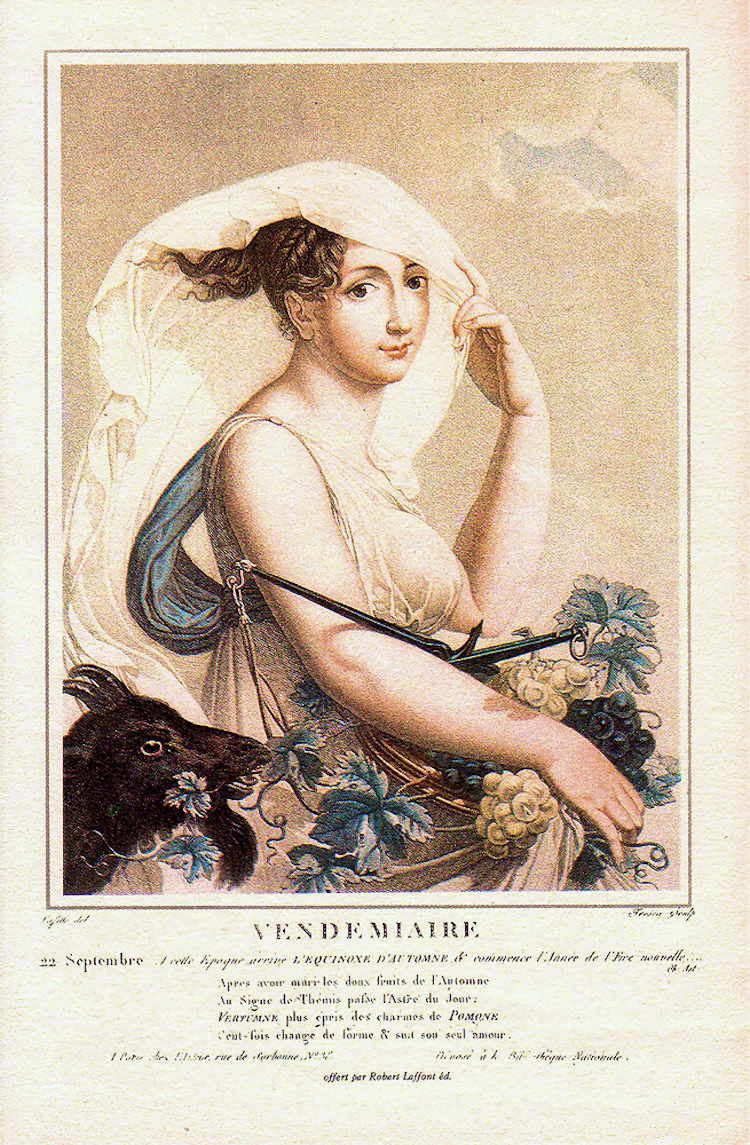
Ladies of the new age - illustrations for the French Republican calendar, 1797-8


Detail of the illustration for the month of Floréal. (Taken from a different printing than the other examples here.)

The calendrier républicain français (French Republican calendar) was created and implemented during the French Revolution to celebrate the founding of the French Republic, and was designed in part to remove all religious and royalist influences from the calendar. It was part of a larger attempt at decimalization in France, with decimalization of the hours of the day, of currency, etc. The new system was used in government records in France and other areas under French rule, including Belgium, Luxembourg, and parts of the Netherlands, Germany, Switzerland, Malta, and Italy.


Each day was now divided into ten hours - each hour into one hundred decimal minutes; thus an hour was one hundred and forty-four conventional minutes - but there were still twelve months, though each was now three weeks long, while each week consisted of ten days. The authorities having decided that the establishment of the French Republic in 1792 marked the beginning of a new era, the introduction of the new calendar on 22 September 1793 also heralded the beginning of Year II.


The republican calendar was used by the French government for about twelve years, from late 1793 until 1 January 1806/Year XIV, when it was finally abolished by Napoléon, already more than a year into his reign as empereur des Français. Decades later it was put into play once more, for eighteen days in May 1871/Year LXXIX, by the Paris Commune.


*

The following images are from an illustrated calendar of 1797-8, engraved by Salvatore Tresca after the originals of Louis Lafitte. 

Autumn:
Vendémiaire (from French vendange, derived from Latin vindemia, "vintage"), starting 22, 23, or 24 September
Brumaire (from French brume, "mist"), starting 22, 23, or 24 October
Frimaire (from French frimas, "frost"), starting 21, 22, or 23 November


Winter:
Nivôse (from Latin nivosus, "snowy"), starting 21, 22, or 23 December
Pluviôse (from French pluvieux, derived from Latin pluvius, "rainy"), starting 20, 21, or 22 January
Ventôse (from French venteux, derived from Latin ventosus, "windy"), starting 19, 20, or 21 February


Spring:
Germinal (from French germination), starting 20 or 21 March
Floréal (from French fleur, derived from Latin flos, "flower"), starting 20 or 21 April
Prairial (from French prairie, "meadow"), starting 20 or 21 May


Summer:
Messidor (from Latin messis, "harvest"), starting 19 or 20 June
Thermidor (from Greek thermon, "summer heat"), starting 19 or 20 July (On many printed calendars of Year II (1793–94), the month of Thermidor was named Fervidor (from Latin fervidus, "burning hot"))
Fructidor (from Latin fructus, "fruit"), starting 18 or 19 August


Sunday, November 22, 2020

From the garden, from the orchard, from the sea - selected work by Antoine Berjon


*

Antoine Berjon (17 May 1754, St. Pierre de Vaise - 24 October 1843, Lyon), French painter and designer, among the most important flower painters of early nineteenth-century France. Born in a commune of Lyon, the son of a butcher, he first studied drawing with the local sculptor Antoine-Michel Perrache. Little is known of his early life,  though it is thought that he may have studied medicine or for a religious vocation. But he is known to have worked as a designer of textiles in Lyon's important silk industry until its collapse with the French Revolution. In 1791, the Paris Salon accepted four of his work; he subsequently visited the capital frequently, and moved there in 1794. He remained in Paris for the next sixteen years, exhibiting at the Salon at least five times. By the time he returned to Lyon he was well known, and was made a professor at the newly established École des Beaux-Arts, which had been founded by Napoléon's decree of 1807 with the goal of reviving Lyon's silk industry. He was dismissed in 1823 after a thirteen years in the position, and was replaced by his gifted pupil Augustin Thierrat. His termination was probably due to his well-known stubbornness and egotism, qualities that most likely put him in conflict with the school's administration. He then set up his own studio in Lyon, giving private instruction, and continued to make art for the remainder of his life. He died in Lyon at the age of eighty-nine.

Terra-cotta bust of Berjon by Clément Jayet, 1788.