L a - b e a u t é - s a u v e r a - l e - m o n d e ~ D o s t o ï e v s k i

L a - b e a u t é - s a u v e r a - l e - m o n d e  ~  D o s t o ï e v s k i


Showing posts with label Johan Zoffany. Show all posts

Sunday, June 14, 2026

The older sister - Archduchess Maria Christina, Duchess of Teschen


Marcello Bacciarelli, 1766.

Maria Christina, Duchess of Teschen (Maria Christina Johanna Josepha Antonia; 13 May 1742, Vienna - 24 June 1798, Vienna), the fifth child and fourth (but second surviving) daughter of Empress Maria Theresa of Austria and Francis I, Holy Roman Emperor. Always called Marie or Mimi at the Viennese court and by her family, she was Maria Theresa's favorite child, and their mother's preference for her caused great resentment among her siblings, bad feelings that only increased with time. Highly intelligent and artistically gifted, she was given an excellent education - a fairly rare attention given to a royal princess at the time - and she was fluent in several languages. 

Johan Zoffany, 1776.

In 1760, at the age of eighteen, she developed an intense romantic attachment to her new sister-in-law, Princess Isabella of Parma. That same year, Prince Albert of Saxony had visited Vienna, becoming close friends with both Maria Christina and Isabella. When the latter died, three years later, she was heartbroken. But she and Albert soon fell in love. His relatively weak royal position made their marriage unlikely, but such was Maria Christina's influence over her mother, that they were allowed to marry in 1766. 

Martin van Meytens (copy?), circa 1765. 

The princess received a rich dowry: the Silesian Duchy of Teschen - in addition to being made Field Marshal and Statthalter of Hungary, Albert would now be titled Duke of Saxe-Teschen - the towns of Mannersdorf, Ungarisch Altenburg, and other properties, and the richly renovated castle in Pressburg, where the couple would live; their household included about one-hundred and twenty people. That she was allowed to make a love match and that the new couple was so lavishly provided for, further alienated her brothers and sisters. The following year she had a daughter who only lived one day, and she contracted puerperal fever and was left unable to have further children; the couple later adopted a nephew in order to have an heir. 

Unknown artist, after Roslin, circa 1778.

They established a luxurious court in Pressburg, hosting many festivities, with frequent visits home to Vienna. And they made themselves popular with the Hungarian nobility and citizens, and devoted themselves to their common interest in art, making Pressburg a cultural center during their time there; it was here that they began their acquisition of drawings and engravings, a passion which eventually led to the formation of the famous Albertina Art Collection. 

Austrian School, circa 1766.

In 1780, it had been decided by Maria Theresa that the couple be appointed joint governors of the Austrian Netherlands, but the Empress died in November, during their preparations of the couple's journey. Her successor, Joseph II, Holy Roman Emperor, had a very poor relationship with his sister, jealous like all their siblings had been of her privileged position and intimate relationship with their mother. He confirmed the appointment but refused his sister the financial resources corresponding to the couple's position. They were also unable to play an independent political role, and were therefore reduced to being little more than a symbolic presence. 

Johann Georg Weikert, 1778.

The Austrian Netherlands, however, was a hotbed of social tensions and the Emperor, who lacked a clear understanding of the situation there, imposed drastic reforms, ignoring any calls for caution from the Duke and Duchess of Teschen. Further radical reforms led to violent riots. The couple tried to resist the Emperor's reckless and inflammatory decrees, but were constantly overruled. Then during the summer of 1789, inspired by the beginning of the French Revolution, outright rebellion arose in the Austrian Netherlands, and in November the couple was forced to flee Brussels. 

Daniel Schmiddely (?), circa 1766.

Two months later the Austrian Netherlands declared itself independent as the United Belgian States, and a month after that, Emperor Joseph II died and was succeeded by his younger brother Leopold II, with whom Maria Christina had a better relationship. In the meantime, continuing political conflict put the new Belgian republic on the edge of civil war. And in December 1790, the Austrians reconquered Brussels without a fight, and six months later the Duke and Duchess of Teschen returned to Brussels, reassuming their roles as joint governors. 

Alexandre Roslin, 1778.

However, in October 1792, the Austrian Netherlands was invaded by Revolutionary France, the French decisively defeating the Austrian troops. As a result, the couple was once again forced to flee. They eventually settled in Vienna, where the Duke lavished much attention on their art collection; they had been able to evacuate the collection from Brussles by sea, though one of the three ships on which the works were transported was destroyed in a storm. 


Maria Christina, who appears to have been struggling with depression at this point, began to suffer from a stomach disease in 1797, and she died the following year at the age of fifty-six. After her death of his wife, the Duke commissioned an impressive white marble cenotaph in the Augustinian Church, the work of the famous neoclassical sculptor Antonio Canova. At his own death in 1822, he was also buried beside her, together with their daughter. 


*

Canova's cenotaph for Maria Christina in the Augustinian Church - part of the Hofburg Palace complex in Vienna - completed in 1805.


Sunday, February 11, 2024

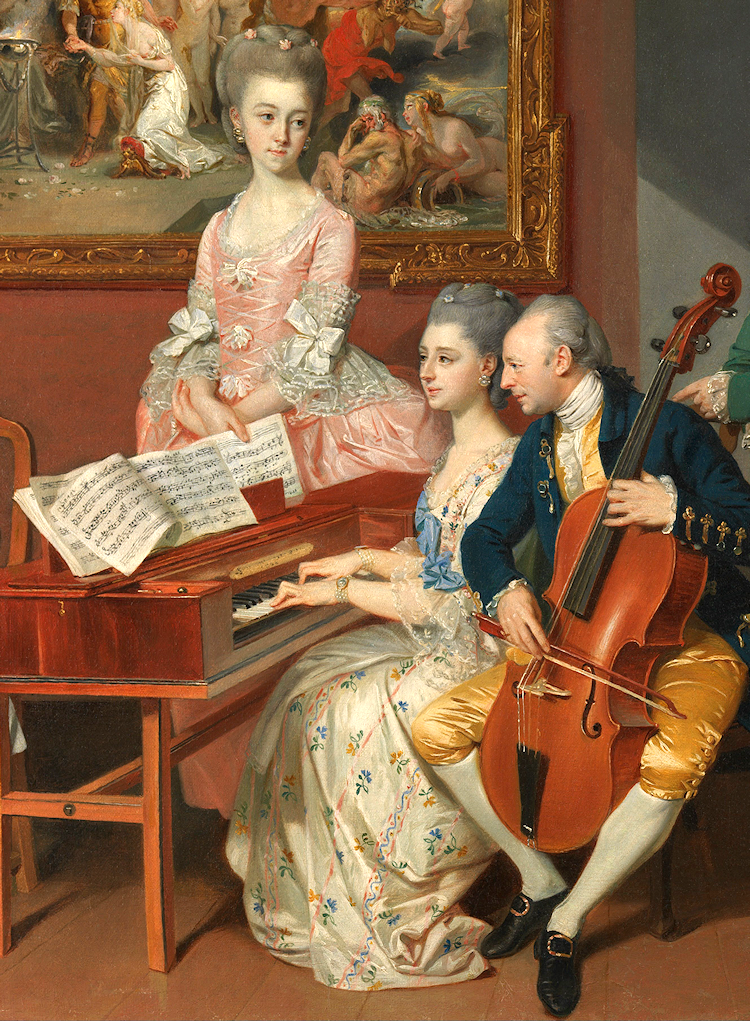
An engagement in Florence - The Gore Family with George, 3rd Earl Cowper, by Johan Zoffany, circa 1775


This "conversation piece" marked the engagement of George Nassau Clavering-Cowper, 3rd Earl Cowper (1738 - 1789) to the Hannah Anne Gore (circa 1758 - 1826), the sixteen-year-old youngest daughter of Charles Gore (1729 -1807); the father of the fiancée commissioned the painting. Hannah Gore - who usually went by her middle name, Anne - and Lord Cowper are portrayed standing. Charles Gore is shown playing the cello, his middle daughter, Emilie, at the keyboard. Mrs. Gore, née Mary Cockerill, is seated at far right with the couple's eldest daughter, Elizabeth.


Lord Cowper was a wealthy art collector, patron, and member of Parliament. When still Viscount Fordwich, he had completed his education by taking the English aristocrat's requisite Grand Tour of the continent. But arriving, finally, in Florence in 1759, he was so taken with the city that he remained; he was also taken by a beautiful Florentine woman, a certain Marchesa Corsi. By the time his passion for the lady eventually faded, he had been thoroughly caught up in the culture and social life of Florence, and repeatedly stayed his departure for home. (He apparently only once returned to England - and briefly - more than thirty years later, just three years before his death.) 


Fifteen years on, in 1774, Charles Gore - described as a "widely travelled, cultured gentleman with artistic tastes" - took his wife and three daughters to Florence, where Hannah met Lord Cowper. The two were married there in June of the following year. In 1780, Cowper bought the Villa Palmieri in Fiesole overlooking Florence. The couple had three sons; the first two would become the 4th and 5th Earl Cowper in succession.

Charles Gore, independently wealthy through his marriage, was an amateur artist; the watercolor of ships is likely a representation of his work.

The fictive mythologically-themed painting in the background has come in for some discussion. Said to represent Hercules - emblematic of virtue - driving Envy or Calumny from a wedding ceremony being held in the Temple of Hymen, some have seen it as sly reference to Lord Cowper's past relationship to the Marchesa Corsi or to the presently necessary curtailment, with his impending marriage, of his liaisons with other Florentine women.


Friday, December 4, 2020

The most beautiful rest - The Tomb of Maria Christina of Austria by Antonio Canova, by Charles Swagers, circa 1820s


This painting by the little-known French artist Charles Swagers depicts the cenotaph that Prince Albert of Saxony, Duke of Teschen commissioned from Antonio Canova as a memorial to his wife, born Archduchess Maria Christina of Austria, who died in 1798. The monument, which stands in the Augustinian Church - part of the Hofburg Palace complex in Vienna - was completed in 1805 and was a strikingly modern interpretation of a figural tomb. The deceased appears only in a portrait medallion, and Christian imagery has been eliminated. It seems the Duke had envisioned a traditional homage to the deceased, but Canova created a new kind of monument, in which the theme of death itself was emphasized: the angel of death, the mourning lion, the cortège of figures - young and old, male and female - entering the doorway of the royal tomb, which has become a portal into the afterlife.


The painting, thought to have been completed in the 1820s but only submitted to the Paris Salon in 1833, differs in one significant way from the actual monument: the inscription on the lintel reads MARIAE CHRISTINAE AVSTRIACAE/ ALBERTI SAXONIAE PRINCIPIS CONIVCI (To Maria Christina of Austria/ Wife of Albert, Prince of Saxony), while in Canova's composition it reads simply VXORI OPTIMAE /ALBERTVS (To the Best Wife/Albert). 

Drawing by Domenico del Frate, engraved by Pietro Bonato, 1805.
Watercolor by an unknown artist, French School, circa first quarter of the nineteenth century.


*

Maria Christina, Duchess of Teschen (Maria Christina Johanna Josepha Antonia; 13 May 1742 - 24 June 1798), the fifth and favorite child of Empress Maria Theresa of Austria. Married in 1766 to Prince Albert of Saxony - a rare love match - the couple received the Duchy of Teschen. Jointly with her husband, she was appointed Governor of the Austrian Netherlands from 1781 to 1789 and from 1791 to 1792. After expulsions from the Netherlands in 1789 and 1792, during unrest spurred on by the revolution in France, she and her husband eventually returned Vienna where, not long after, she would die at the age of fifty-six. Her bereaved husband commissioned an impressive monument to his wife in the Augustinian Church, the work of the famous neoclassical sculptor Antonio Canova. The Duchess is actually buried in the in the Tuscan Vault of the Imperial Crypt in Vienna. When Prince Albert died in 1822 he was buried next to his wife and their daughter, their only child, who had been born fifty-five years before, and only lived for a day.

 Attributed to Martin van Meytens, circa 1765.
By Johan Zoffany, 1776.
By Alexandre Roslin, 1778.


*

Charles Swagers (1792-after 1849), French painter, primarily of historical subjects, active in the early nineteenth century. He studied under his father, Franz Swagers, a landscape and marine painter from Utrecht who had settled in Paris. His mother, Elisa, née Méri, was a miniature painter and the professor of drawing at Écouen. His best known work is the painting of Canova's Tomb of Maria Christina of Austria which he exhibited at the Paris Salon of 1833. In 1840 he was appointed professor of drawing and composition in Dieppe. His sister, Caroline, also a student of their father's, practiced in Paris and frequently exhibited at the Salon. Swagers' son, Édouard, was a painter and lithographer who also practiced in Paris.


Sunday, March 17, 2019

Lofty allegory and base reality - two painted "crowd scenes"


Alegoria às virtudes do Príncipe Regente D. João, by Domingos Antonio Sequeira, circa 1810.

João VI of Portugal (13 May 1767, Lisbon - 10 March 1826, Lisbon), Prince Regent of Portugal (1799–1816) and King of the United Kingdom of Portugal, Brazil, and the Algarves (1816–1826). João was the second son of Queen Maria I and Pedro III of Portugal and became heir to the crown when his elder brother José died in 1788. In 1785 he married Carlota Joaquina, the daughter of the Spanish king Carlos V. After the death of his father in 1786 and the onset of his mother's mental illness, João took the government in his hands in 1792, being officially declared regent in 1799. With the invasion of Portugal by Napoleon Bonaparte's troops in 1807, he embarked with the royal family and his court for Brazil where he chose Rio de Janeiro as the seat of his government. Among his first reforms was the opening of Brazilian ports to international trade, which brought immense changes and prosperity to the colony. And the presence of the court and the refugee Portuguese elite contributed to the development of a luxury trade and much new building.


Dom João soon adjusted to the Brazilian environment and came to be very comfortable in his New World exile. So in 1815, when Bonaparte was defeated in Europe and the royal family were expected to return immediately to Portugal, The Prince Regent preferred to stay in Brazil. The following year, at his mother's death, he became King João VI. The rumblings of Brazilian independence were put down in 1817, and three years later the King was warned of the imminence of revolution in Portugal and the urgent need for his return. But, receiving differing views form his advisers, he delayed his return. Only after much more discussion and a violent attempt at a coup in Rio de Janiero, did the court finally sail for Portugal in the spring of 1821.


Arriving home to a changed political environment, he was forced to swear loyalty to a new constitution. And the following year his elder son, Pedro, who had remained in Brazil, led a revolution to declare that country's independence, and promptly declared himself Emperor of Brazil. During his last few years he endured constant political and family intrigue, most of it instigated by his Spanish-born wife and his younger son, Miguel, both of whom tried to force his abdication along with the restoration of an absolutist regime; the latter was accomplished but not the former. But he died suddenly at the age of fifty-eight, only five years after returning to Portugal. In the 1990s, tests were taken on his exhumed internal organs; analysis of his heart tissue detected enough arsenic to kill two people.


*

Colonel Mordaunt’s Cock Match, by Johan Zoffany, 1785-86.

This crowded painting, teeming with approximately ninety figures, both Indian and European, shows a cock-fight involving birds belonging to Asaf-ud-Daula, the Nawab Wazir (governor) of Awadh and those belonging to Colonel John Mordaunt, an employee of Britain’s East India Company. Asaf, the figure standing at the center, appears to have jumped from his seat to bet with Mordaunt, who gestures to his own bird. In the multitude of figures surrounding them, some can be identified by name. Between the two main protagonists stands Salar Jung, the Nawab’s uncle, calculating the bet on his fingers. Behind Salar Jung, in brightly colored clothes, are Asaf’s chief ministers, Hasan Reza Khan – also the homosexual Asaf’s favourite - and Haidar Ali Khan. Claude Martin, wearing a red uniform and sitting on the white settee on the right, was a French-born defector to the East India Company. He supervised the Nawab’s arsenal and was a friend of the painter. Zoffany himself sits with his arm over a chair in the right background, dressed in white like Mordaunt, pencil in hand. Standing next to him is Ozias Humphry, another artist who had come from Britain in search of new opportunities. At top right in the red coat is Antoine Polier, a Swiss-born engineer at the Nawab’s court. Below him, with a hookah, is John Wombwell, the East India Company’s paymaster at Lucknow. Standing at bottom right holding a white bird is Robert Gregory, the assistant to the Governor-General’s representative; Gregory was reportedly cut out of his father’s will for cock-fighting. (Even then, cock-fighting was widely disapproved of in England.) The pudgy fellow in white, in conversation with Gregory, is Lieutenant Golding of the East India Company’s Corp of Engineers. (Golding was not actually present at the cock-fight but stood in for another similarly chubby European who had been there, but who refused to sit for the picture.)


The painting was commissioned in 1784 by Warren Hastings, First Governor-General of Bengal shortly before his return to England; Hastings is not included in the scene but is recorded as having attended one of Mordaunt’s cock-fights that same year. Asaf’s court at Lucknow was the most extravagant of the native courts and attracted European adventurers with its promise of financial gain and its exotic lifestyle. Asaf’s “natural inclinations and attachments were for low, ill-born and base-minded associates […] He delighted in meaningless amusements and was immensely pleased with anyone who indulged in filthy language; and the more obscene the conversation was in any company; the better he was pleased.” Mordaunt, the illegitimate and nearly illiterate son of the Earl of Peterborough, was a particular favorite, serving as commander of the Nawab’s bodyguard and director of court amusements, including cock-fights.


The painting has drawn much critical debate over the years. At Lucknow, Indians and Europeans appeared to enjoy social equality, with the latter often having Indian wives and children. But the painting may be making a sly criticism of the licentiousness of those surrounding the titular leader of Awadh. The draperies swirling about the Nawab’s groin have been interpreted as indicating that he was sexually aroused, a depiction which would have been intended to mock him. And a vignette at the center of the composition shows a young Muslim boy in pink being publicly groped by a Hindu man, while a nearby spectator is being restraind from expressing his indignation at this. But the Europeans, though depicted in a more “gentlemanly” manner, are nonetheless shown as active participants in this “low” diversion. So, whether the resulting image is a commentary on the libertinism of the Anglo-Indian elite, or merely an attempt to ridicule the Indians and thereby assert European superiority, remains a matter of interpretation.