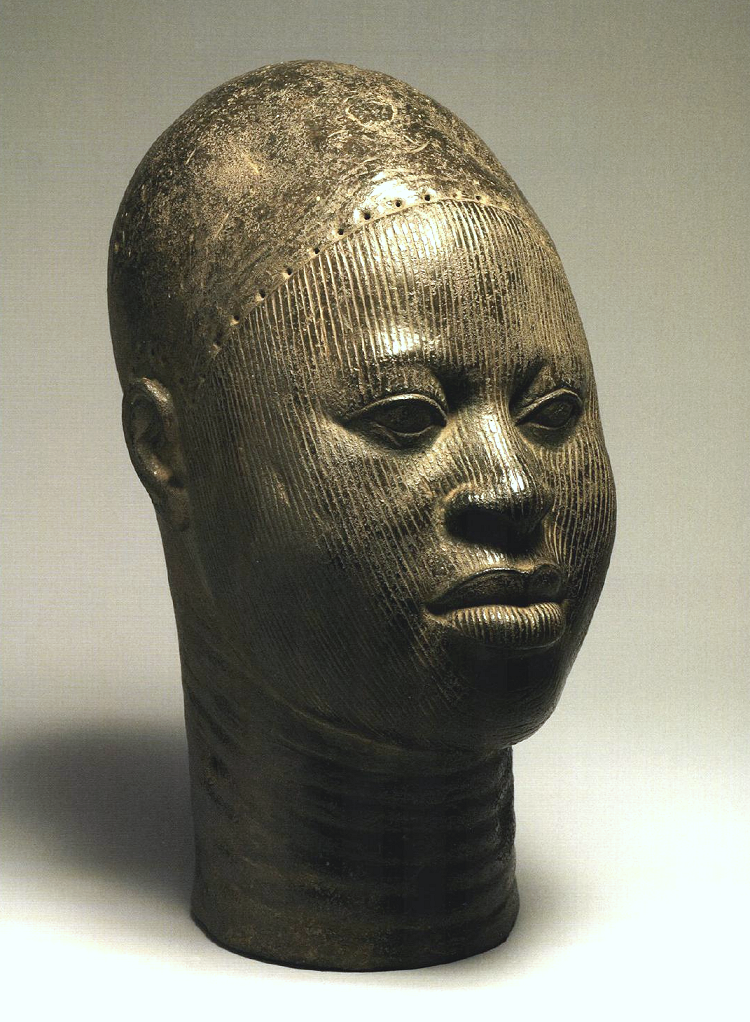
The sculptural heads and the upper half of a brass figure were found by accident at the Wunmonije Compound, Ifẹ̀, during house-building. Most of the objects found in the compound and neighboring areas ended up in the National Museum of Ifẹ̀, but a few pieces were taken out of Nigeria and still remain in the collections of foreign museums. The export of these pieces spurred the colonial authorities - Nigeria was ruled by Great Britain from 1885, officially, until 1960 - to enact legislation that same year, meant to control exportation.


 |
| Four images. |


Attempting to explain the creation of these sculptures, work then thought to be extremely anomalous, Frobenius concocted a theory stating these must have been cast by a colony of ancient Greeks who had established themselves in the area in the thirteenth century BC. The claim - which was widely circulated in the press - he further expanded to hypothesize that this ancient Greek colony could very well be the origin of the legend of the lost civilization of Atlantis.


It's now recognized that these statues represent an indigenous African tradition, one that attained a very high level of realism and refinement, and the Ifẹ̀ sculptures are considered one of the greatest achievements of African culture. The naturalistic features of the Ifẹ̀ heads are unique, though, and the stylistic similarities of these works suggest that they were made by an individual artist or in a single workshop.

 |
| Two images. |