L a - b e a u t é - s a u v e r a - l e - m o n d e ~ D o s t o ï e v s k i

L a - b e a u t é - s a u v e r a - l e - m o n d e  ~  D o s t o ï e v s k i


Showing posts with label Charles X. Show all posts

Friday, March 24, 2023

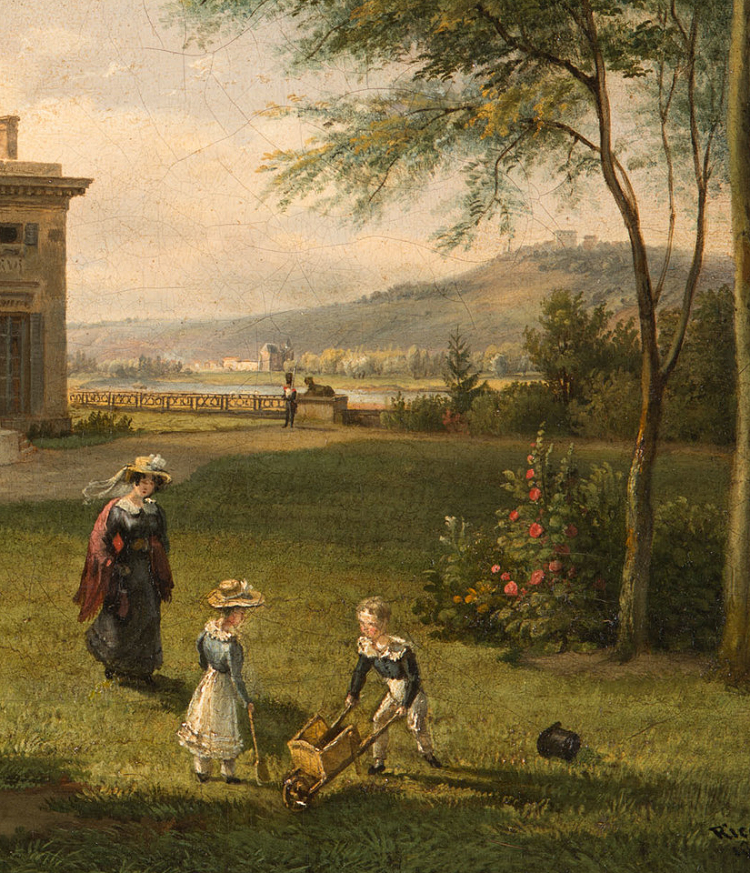
False idyll - the family of the duc de Berry in the parc de Bagatelle by François-Edmé Ricois, 1825


In the leafy, sun-dappled garden of the Château de Bagatelle the figures of Charles Ferdinand and Marie Caroline, duc and duchesses de Berry, are seen to be enjoying a pleasant afternoon chat, while a governess attends to their children, Princess Louise and Henri, duc de Bordeaux. But the charming family group is only a cruel illusion;, the duc de Berry was assassinated seven months before the birth of his son, fully five years before the creation of the painting.


Charles Ferdinand d'Artois, duc de Berry (24 January 1778, Versailles - 14 February 1820, Paris) was the younger son of the comte d'Artois, future Charles X of France. During the French Revolution he left France with his father, served in the émigré army of his cousin, the Prince of Condé, and then with the Russian army. In 1801 he moved to England where he stayed for thirteen years. In 1814 he returned to France, and his uncle Louis XVIII appointed him commander-in-chief of the army at Paris on Napoleon's return from Elba. In 1816 he married Princess Maria Carolina of Bourbon-Sicily with whom he had one surviving child, their daughter Louise, later Duchess of Parma, at the time of his death. Leaving the opera with his wife on 13 February 1820, he was stabbed by a disgruntled Bonapartist and died the next day. Seven months later, the duchess gave birth to a son, Henri, duc de Bordeaux. Later better known by his preferred title, the comte de Chambord, he was considered by French Legitimists to be their king, Henri V. The comte de Chambord married but had no issue, so the senior male Bourbon line became extinct at his death in 1883.


 A lithograph after the painting - which is now in the British royal collection -  was made by Louis Julien Jacottet.

Interesting that, though this is supposed to be a copy of the original, all five of the main figures have been repositioned.

*

François Edmé Ricois (29 August 1795, Courtalain - 21 January 1881, Mareil-Marly), French painter known for his views of castles and landscapes. 1816, he entered the École des Beaux-Arts, where he studied under Jean Victoire Bertin and Anne Louis Girodet. He made his Salon debut in 1819 and continued to exhibit there until just a few months before his death. He was awarded a second class medal at the Salon of 1824, and went on to exhibit widely in France and Switzerland, obtaining medals at Douai, Lille, Toulouse, and Cambrai. His daughter, Marie-Octavie Ricois, was also a painter.


Friday, April 17, 2020

En famille - three family groups


In his apartments at the Tuileries, Louis XVIII receives his nephew the duc d'Angoulême, victorious commander-in-chief of the Pyrenees Army. Standing beside the duc is his wife, "Madame Royale", Marie-Thérèse Charlotte, duchesse d'Angoulême; only surviving child of Louis XVI and Marie Antoinette, she had been married off to her first cousin while in exile in 1799. Behind the king is the comte d'Artois, the future Charles X, who holds in his arms his grandson, Henri-Charles-Ferdinand-Marie-Dieudonné d'Artois, duc de Bordeaux. The child was the only son - born posthumously - of the duc de Berry who had been assassinated in 1820. His widow, Marie-Caroline de Bourbon-Sicile, duchesse de Berry, stands beside her first surviving child, Louise-Marie-Thérèse d'Artois.

Louis XVIII recevant le duc d'Angoulême à son retour de la campagne d'Espagne (Louis XVIII receiving 
the duc d’Angoulême on his return from the campaign of Spain), by Antoine-Jean-Baptiste Thomas, 1823.

*

За чайным столом (At the Tea Table), by Alexei Voloskov, 1851.

This group-portrait-as-conversation-piece was painted at the estate of Grigori Stepanovich Tarnovsky, Kachanivka/Kachanovka, Chernihiv Oblast, the Ukraine. In a room decorated with Gothic style motifs, Voloskov portrayed the owner of the estate seated at the table on the left. Leaning on the back of his chair, stands his brother (?)Vasili Tarnovsky, a prominent public figure on the peasant question, while seated across the table from him is his wife Lyudmila Vladimirovna. The girl in the white dress is Vasili's daughter, Yulia Vasilievna.


*

Retrato da Família do 1.º Visconde de Santarém (Portrait of the Family of the 1st Viscount of Santarém), by Domingos Antonio Sequeira, 1816.

João Diogo de Barros Leitão Carvalhosa, the 1st Viscount of Santarém, is portrayed here with his second wife, their five children, and his younger brother, D. António Roberto, archbishop of Adrianopolis. The portrait hanging over the mantlepiece depicts his first-born son - from his first marriage - with his aunt and uncle, the Viscounts of Vila Nova da Rainha, sister and brother-in-law, respectively, of the Viscount of Santarém. The statuette on the table represents King João VI, who ascended the throne of Portugal in March 1816.


Friday, May 31, 2019

Three brothers, three kings - portraits of Louis XVI, Louis XVIII, and Charles X


Dressed in the robes of the Ordre du Saint-Esprit.

Louis XVI, by Alexander Roslin, 1782.
The comte de Provence, the future Louis XVIII, by Antoine-François Callet, 1788. (The crown and regalia must have been added after he became king.)
The comte d'Artois, the future Charles X, by Antoine-François Callet, 1779.

And in their coronation robes; Louis XVIII chose to forgo a public coronation ceremony.

Louis XVI, by Antoine-François Callet, 1779.
Louis XVIII, by Robert Lefèvre, circa 1822.
Charles X, by François Gérard, 1825.

*

And now for something a bit more realistic: a sketch for a coronation portrait of Louis XVIII by Antoine-François Callet, circa 1814 or later.


Sunday, August 19, 2018

"Blue boy"... no, not that one....


Portrait of Jacques Bizet as a Child, by Jules-Élie Delaunay, 1878.
Louis-Antoine de Bourbon, duc d'Angoulême, by Joseph Boze, 1785.
Portrait of a Boy, by Kuzma Petrov-Vodkin, 1913.
Portrait of a Boy Wearing a Blue Bow Tie, American School, second half of the nineteenth century.
Young Peasant in Blue/Jockey, by Georges Seurat, 1882.
Grand Duke Alexander Pavlovich, later Tsar Alexander I, at the age of fifteen, by Jean-Louis Voille, 1792.
Die Baba (The Baby), by Marlene Dumas, 1985.
Boy in a Turban holding a Nosegay, by Michiel Sweerts, circa 1661.
The Boy in Blue, by Isaac Grünewald, 1919.
Portrait of a Young Boy Dressed in a Brown Coat with a Blue Waistcoat, by Nathaniel Hone, third quarter of the eighteenth century.
Portrait of an Indian boy, by Rudolf Swoboda, last quarter of the nineteenth century.
Almost........!    The Blue Page, by Thomas Gainsborough, circa 1770-72.
Boy in a Blue Shirt, by Joan Eardley, circa 1950s.
Cortlandt Field Bishop, by William-Adolphe Bouguereau, 1873.
Boy in the Blue Jacket, by Amedeo Modigliani, 1918.
Boy in a Striped Sweater, by Amedeo Modigliani, 1918.
Jacques de Chapeaurouge, by Jean-Étienne Liotard, 1744 (? More likely circa 1746-49).
The Irish Boy in Blue Denim (Anthony Lavelle), by Robert Henri, 1927.
Charles-Philippe de France, comte d'Artois, later Charles X, by Jean-Martial Frédou, 1773. (Father of the duc d'Angoulême, above.)
Blue Boy with the Banana, by Diego Rivera, 1931.
Boy in Sailor Suit (John Goldsmith), Boris Grigoriev, circa 1923-24.
Pojke med Apelsin (Boy with Orange), by Axel Jungstedt, 1882.