|
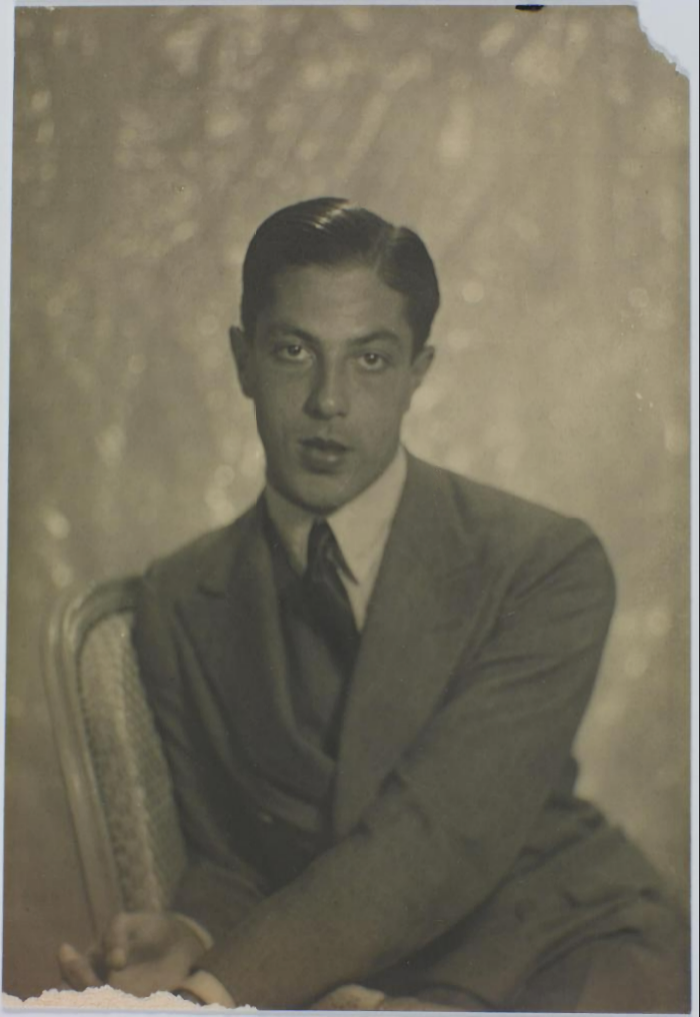
| John Alfred Piver, circa 1935. Inscribed to Serge Lifar with a quotation from Eugene Onegin in Russian, "And happiness was so possible / so close." |
 |
| Cecil Beaton, 1935. |
 |
| Horst P. Horst. |
 |
| George Hoyningen-Heune, 1933. |
 |
| Jean Cocteau. |
 |
| Studio Dorvyne, 1934. |
Princess Natalia Pavlovna Paley (5 December 1905, Boulogne-Billancourt – 27 December 1981, New York City), Russian aristocrat, a non-dynastic member of the Romanov family as the morganatic daughter of Grand Duke Paul Alexandrovich - therefore a first cousin of Nicholas II - she would later, in France and the United States, become known as a fashion model, socialite and, briefly, a film actress.
Her father, youngest brother of Alexander III, had two children from his first marriage to Princess Alexandra of Greece, Grand Duchess Maria Pavlovna and Grand Duke Dmitri Pavlovich; Dmitri's young mother, only twenty-one, had died six days after giving birth to him. The Grand Duke Paul was devastated at his loss, giving the guardianship of his infant children over to his brother Sergei and Sergei's wife. But some years later he began a liaison with Olga von Pistohlkors, the wife of an army officer and mother of three children. The affair led to a son - Vladimir - being born and, with the ensuing scandal, the couple went abroad. Finally, in 1902, Olga's divorce was granted and they married. But because he had married morganatically and without the Tsar's permission, the Grand Duke was banished from Russia, dismissed from his military commissions, all his properties in Russia seized, and the guardianship of his children made permanent.
 |
| Horst P. Horst, 1934. |
 |
| George Platt Lynes. |
 |
| John Alfred Piver, circa 1935. (?) |
 |
| Dorothy Wilding, 1934. |
 |
| Man Ray, 1934. (Two images.) |


They settled in Paris. Their second child, Irina, was born the following year and two years later the youngest, Natalia. They lived very happily there, collecting art and old porcelain, entertaining lavishly. But in 1912 the Grand Duke's privileges were restored, and in 1914 the family returned to Russia permanently. Only months later war started, followed by the Revolution. Unwisely, the Grand Duke and his family decided to remain in their mansion in Tsarskoe Selo and were soon put under house arrest. By the following summer the Grand Duke was imprisoned, his wife working frantically to get him released. Arrangement were made for their two young daughters to be smuggled into Finland; they made their arduous and dangerous escape in December of 1918. The Grand Duke, along with three of his cousins, was murdered at the Fortress of St. Peter and St. Paul only weeks later. Though his parents didn't know it at the time, their son Vladimir, a talented poet, had also been murdered with other members of the Romanov family, fully six months before.


 |
| In the film "Sylvia Scarlett", 1935 |
 |
| Publicity for "Sylvia Scarlett", 1935. (Two images.) |
After her husband's death, Princess Paley - a title granted during the war - joined her daughters in Finland. They eventually settled in Paris under increasingly straightened circumstances. They were part of the community of aristocratic Russian émigrés, so conspicuous in Paris during the Twenties and Thirties. In 1923 Irina married Prince Feodor Alexandrovich, son of the Grand Duchess Xenia. And at a charity bazaar, Natalia met the couturier Lucien Lelong, who offered her a job in the perfume department of his fashion house; she soon moved on to being a model for the establishment. Lelong was married - though he would marry three times, it appears he was homosexual - but he divorced his first wife, and the two were married in 1927, Natalia - or Nathalie as she was called - still only twenty-one.
 |
| Horst P. Horst. (Two images.) |
 |
| Cecil Beaton. (Two images.) |


It is said that the union was a mariage blanc (unconsummated) in what would have been a pattern for her as far as romantic relations were concerned. At any rate, it seems to have been mostly a marriage of convenience. He offered her wealth and security, while her beauty and aristocratic background were a great asset to his business. She became a sought-after model; beautiful young aristocratic Russian émigrées were all the rage as fashion models at the time. She was featured in all the magazines, especially Vogue, almost always dressed by the house of Lelong. And she was a favorite of the finest photographers of her time: Edward Steichen, George Hoyningen-Huene, Horst, André Durst, Cecil Beaton. She had great personal taste and style and established herself with the Parisian élite, becoming a well-known and popular socialite. Feeling little connection with her husband, she began a series of lengthy and passionate - but almost certainly platonic - affairs, first with the dancer Serge Lifar, then with Jean Cocteau. (Cocteau supposedly wanted to marry her and father her child; she wisely declined.) Throughout her life, Nathalie was almost always attracted to, had relationships with men - like Lelong, Lifar, and Cocteau - who were homosexual.
 |
| Painting by Cecil Beaton, 1940. |
 |
| Painting by Oliver Messel, circa 1935. |
 |
| Drawing by Pavel Tchelitchew. |
In 1933 she began to pursue a film career. She went on to make only six films, the best known being George Cukor's "Sylvia Scarlett" in 1935. (Starring Katherine Hepburn - who would become a lifelong friend - and Cary Grant, the film - with Hepburn in "drag" for most of it - was a notorious bomb.) She mostly remained in the United States after this, setting permanently in New York City. She divorced Lelong in 1937 and, four months later, married John "Jack" Wilson, a theater producer and director, previously the lover of Noël Coward. It was another marriage of convenience. Her beauty, pedigree, and social skills were assets to his business as a Broadway producer. And Wilson was rich, intelligent, amusing, and his homosexuality suited her distaste for physical love. They entertained and traveled extensively. For many years, Nathalie worked in public relations for the fashion house Mainbocher. During this time, she also had a lengthy romantic relationship with writer Erich Maria Remarque, who fictionalized her as "Natascha" in his posthumous novel,
Shadows in Paradise.
 |
| Dorothy Wilding, 1934. |
 |
| Wearing a costume entitled Rêve de l'arc en ciel for a preview of the Beaux Arts Diamond Ball, a charity event held in January of 1940. |
 |
| Edward Steichen, 1935. |
 |
| André Durst, 1936. |
 |
| Sasha Stone, 1929. |
 |
| Edwatd Steichen, 1934. (Two images.) |
 |
| Studio Dorvyne, 1934. |
 |
| Dorothy Wilding, 1934. |
In the 1950s, Wilson's career declined. He had always been a heavy drinker and now descended into mental illness. His wife remained at his side as he was eventually confined to a wheelchair, often violent and in a state of increasing dementia, until his death in 1961, at the age of sixty-two. After the death of her husband, she withdrew from society and in the last two decades of her life, lived as a recluse, surrounded by pets in her Manhattan apartment. She developed diabetes and progressively lost her vision, her blindness isolating her further. The day after Christmas in 1981, she had a fall in her bathroom, breaking her hip. She was operated on that night, but died the following dawn. She was seventy-six.
 |
| Cecil Beaton, circa 1935. (Two images.) |
 |
| Horst P. Horst, 1940. |
 |
| Don Honeyman, 1947 The dress is by Mainbocher. |
(It has been oddly difficult to gather attributions and dates for these photographs, so I've only provided photographers' names and dates where I'm certain of them. With one exception, all of the images are from the 1930s and 1940s, mostly from the mid-1930s. And up until 1937, almost all of her clothes were from the house of her then husband Lucien Lelong.)
*
La princesse sur la plage - in happier times, circa 1931, with her friend and paramour the dancer Serge Lifar, alumnus of Diaghilev and director of the Paris Opéra Ballet.