L a - b e a u t é - s a u v e r a - l e - m o n d e ~ D o s t o ï e v s k i

L a - b e a u t é - s a u v e r a - l e - m o n d e  ~  D o s t o ï e v s k i


Friday, October 19, 2012

Hands and paper

 *

Books.  And magazines, pamphlets, catalogues.  Newspapers.
And letters.  Typed letters.  Hand-written letters.  Telegrams.
Printed greeting cards in the mail.  Postcards sent.  Stacks of photographs, shuffled through.

All these have become thin images on a screen.  Chemical and phantom.
A finger's tap may call them forth.  But our touch can never meet, never know that other existence, a reality of shape and texture and ink.
Our words, our thoughts and memories are only in our eyes and minds, now.  When they used to be in our hands, as well.


*

Thursday, October 11, 2012

Of bullfighting, sex, and the human animal

A friend of mine posted a photograph on Facebook yesterday of a bullfighter being horrifically gored.  He captioned it simply, "Sometimes when you stab an animal that animal will stab you back", as a statement against the institution of bullfighting.  While I understood his point, I can't imagine that he has many FB friends who are also tauromachophiles, and who might thus be converted by the sight of this incredibly gruesome image.  Many, if not most, will feel that what happened to Juan José Padilla last year was only just, considering his chosen profession, but I'm unable to view the incident in quite such a simple, straightforward manner.

For the record, I'm no fan of bullfighting.  And though I generally regret the passing of traditions that contain any element of beauty or glamour, I think that bullfighting should and must pass away.  The animal rights aspect - and for the horses used in the corrida de toros, as much as for the bulls - is clear; the whole business is indefensible.  And yet I think we - especially we Americans, so decisive and short-sighted and unsubtle in all things - don't look with any depth as to why this tradition still exists.  And why it arouses such a deep veneration and passion in those we can't otherwise argue are simply savage or uncultured.  What do they see and experience that we don't?

Though it is usually referred to as a sport or bloodsport, I'd have to agree with the alternative argument that it is an art form.  (A perverse one, yes.)  And much more than that, a ritual.  A very codified ritual of violence.  Blood ritual is not something very comprehensible or attractive to the majority of modern society, and certainly anathema to the ever-lurking Puritan ethos of Americans.  But bullfighting goes back to prehistory.  Prehistory.  And I believe there is something elemental in this bloody pageant that, from the comfort of our modern existence, we now find incomprehensible and rightly horrific.  But has the instinct that would call us to witness this sort of prehistoric theatre been bred out of the majority of us?  Are we safe enough in our soft world that our genetic material can let go all that?  Or is it yet a part of our makeup?  Will it always be?  (The constant insane violence around the planet would seem to answer yes to that query.)  As we get farther and farther away from the original workings of nature, as a technological construct is more and more our living reality, what is our connection with our historical and biological needs and instincts?  Can we maintain a balance that is healthy for us, in the physical and emotional forms we inhabit?

Which brings me to sex.

***

I'm loathe to even bring up this topic, since people will make all sorts of assumptions about my own sex life and my relation to "the act".  And I'll feel compelled to make all sorts of suspicious defense for the quality and variety of said sex life.  I'll need to try and convince all and sundry that I have a very healthy regard for the delightful activity, and that I'm surprisingly hangup free, and -- well, you see where we get to with this.  But, as with most things, I can't help but pipe up when I have something to say.  And I can't help but observe that our modern society is in a complete frenzy about sex.  Still. 

We had the sixties, didn't we?  And then the Seventies.  We've even had Madonna.  (Still do, apparently.)  You'd think we'd be a little fatigued by the constant, adolescent chatter about sex.  Like it was something new.  Maybe - but only maybe - we do it better now, otherwise it's the same old terrific thing.  The difference being that, for several decades now, we've had a seemingly ever escalating obsession with it.  Or at least our obsession with talking about it, portraying it, seems to keep escalating.  It is ever present in the media, in advertising, in popular music.  And especially in film, graphic or even actual.  Its pointed inclusion seems to be a current prerequisite of most entertainment, "high" or "low"; it's often its raison d'être.

And there is a definite pressure in the arts to make work that is sexualized and graphic.  I know or am acquainted with a lot of writers, my wife among them.  A lot of them write a lot about sex.  To be clear, I have no problem with that; writing about sex is just as valid as writing about anything else.  (Much of it deals with abuse, which I put in a different category altogether, and don't take issue with here.)  But I think that within the literary community and in publishing, there's a sense that if there isn't a fair amount of sex in your work - good, bad, or ugly - and if you aren't being quite graphic, that you're backing off of something important and "deeply human", and that therefore your work is probably shallow and maybe even cowardly.  (And not terribly marketable.) 

I enjoy my share of "graphic".  Yes, I do.  But that doesn't keep me from thinking that things are quite a bit out of balance in this regard.  What is it that keeps us so continually fixated on sexuality, ours and that of others, fictive or real?  Not all of us are still working out the effects of our sexually repressive childhoods, are we?  We don't all need to reclaim our sexuality and maximize, fortify our performance and/or pleasure, do we?  Our sexual selves really don't need this much expression, do they?  Or is it...?

***

I believe that the further we get from any sort of a natural existence, the more we find ourselves connected to and are often troubled by our more "animal" instincts.  Our moral conscience has advanced to a point of civilization where most would find bullfighting - blood ritual - abhorrent, but what is retained within us, unalterable?  To varying degrees we are all conscious or unconscious of our biological underpinnings and heritage.  But finding ourselves submerged in the disorienting technological soup of modern life, it becomes increasingly difficult to function with any sort of human/animal certitude; our lives are machine-made, but where does the animal still lurk?

Which brings us back to sex.  The farther we remove ourselves from nature, and the more dislocation we sense in our not-yet-adapted bodies, the more fiercely we crave a connection with the animal we find in our genetic selves, the connection that we experience through sex.  Our lives are so altered by the unnatural, our instincts so denied, that we flee to the safety of our sexual lives.  Because sex is one of the very last places left to us that allows for an unaltered, untempered connection with our purely animal selves.  I believe the unbalanced nature of our lives has led us to an unbalanced obsession with sex and sexual expression; we hunger for some vestigial connection with the elemental within us.  The animal instinct has become a refuge.

Thursday, October 4, 2012

Winston Wächter booth at Art Platform - Los Angeles

Here are a few pictures from last weekend's big art fair in LA.  I was very pleased that WW took three of my paintings with them, and gave my work some "southern exposure".  They hung La Légèreté délicieuse de la grandeur and Un regard oblique, and had L'Équilibre "in the closet".  Golly, it's been simply years since "the closet" was in play...!

Thank you Stacey, Megan, and everyone at Winston Wächter for all your support of my work.


Wednesday, October 3, 2012

Rex - briefly

By way of my friend Stephen Rutledge's excellent and informative blog, I'm informed that yesterday was the birthday of film reviewer Rex Reed; he's seventy-four.

When I was growing up, I saw him on television talk shows all the time.  Daytime and nightime.  Long before I understood what "homosexual" was, what "queer" was, I knew that he was that.  I guess it's just one of those things one recognizes.  The languor, the bitchiness.  And right or wrong, I'm sure his example was very instructive to a generation of gay men coming up; is this what I am?  Is this how I am to behave?  Is this how I am to gain acceptance?

And his public "personality" seemed to be the point of his frequent appearances on mainstream media.  His film reviews were hardly reliable.  Or even the point.  He seemed too much interested in score-settling and scathing bon mots - or just making stuff up - to really be taken seriously as a film critic.  He never seemed all that comfortable in front of the camera, and was fairly humorless.  It was his ever-caustic drawling that put him "on the couch"; he could always be counted on to say something mean-spirited and outrageous.

And then he was quite photogenic.  A great swathe of dark hair, long lashes, sparkling eyes.  And it was that sort of soft, feminized, loose-mouthed, Southern sort of male beauty.  Pretty but lacking structure; Elvis-ian.  The sort of beauty that, at first glance, I might find attractive but, almost immediately, the slackness becomes rather repellent.  Though Reed may be entirely different in his personal life, at this distance, the lack of heart, the pointed unkindness Reed demonstrated time after time on the television of my childhood, was ultimately just us unattractive as his pretty face.


Friday, September 28, 2012

Belle Grove - une maison perdue


I've never been able to love the South.  If for no other reason than that I grew up in the sixties, and I clearly remember scenes of the Civil Rights Movement on television.  Children turned away from segregated schools, police turning fire-hoses on peaceful protesters, the hateful faces of Southern whites.  I was very young, and when my parents explained it to me, told me about the history of slavery and the change that African Americans were trying to effect in the South, I knew that the vicious resistance of Southern whites was wrong.  I knew it was wrong.  And, perhaps childishly, I've never been able to forgive the South, never been able to hear a soft Southern accent without a cringe.

Of course I understand that racial hatred in America has never been merely confined to the South.  Our whole history has been steeped in racial hatred, in the submission and degradation of non-whites.  But the smug Southern, bible-thumping, self-righteous racial prejudice I saw on the television, at such a young age, bred a mirror prejudice in me.  Even though I can readily rationalize otherwise, even though I know it's wrong, even though I know my own prejudice has stayed put while the country has moved on, I'm not sure I'll ever entirely rid myself of the feeling that the South is a bad place.

Parallel to this, even as a lover of beauty and of excess, as a lover of buildings, still some part of me has always shunned a closer understanding and appreciation of the great architecture of the South.  Specifically plantation architecture.  It isn't something I've given much conscious thought to but, certainly, it must stem from my horror at the idea that all that richesse was only made possible because of slave labor.  The idea that such beauty was created under that system, at that particular cost, makes me want to turn away from it.  (But then how many of our great buildings were realized under those conditions, the White House most prominently.)

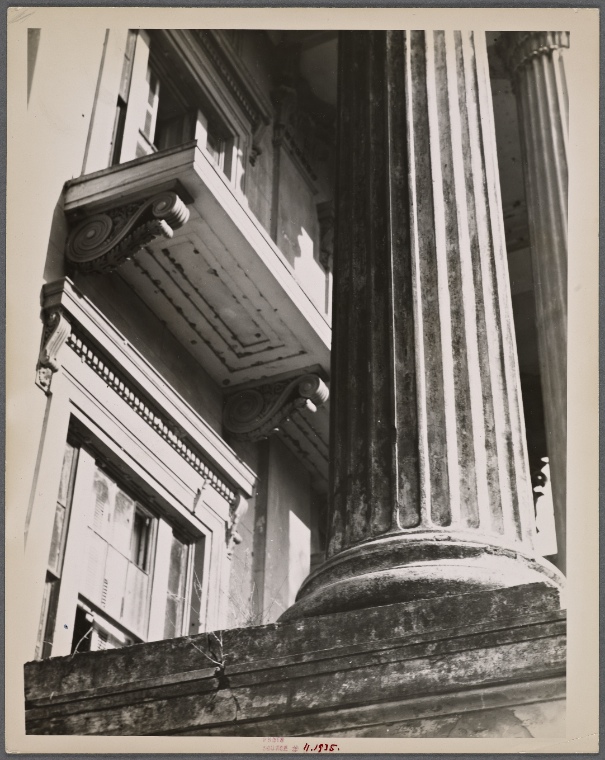
And yet... and yet....  Years ago, I came across a book called "Ghosts Along the Mississippi", by Clarence John Laughlin.  Originally published in 1948, it was filled with images of lost or soon to be lost buildings of the Old South.  (Some, happily, were later saved.)  The title was apt, of course, as the photographs captured all the ghostly decomposition of those once brilliant structures.  You could almost feel their shame at their present state - stripped, crumbling - collapsing with history and memory, as they closed in on themselves.  But there was one, more than any of the others, that caught my imagination.  One whose beautiful proportions and fine detail made its decay, its apparent loss, all the more distressing to me.  I've never forgotten that beautiful house.  Belle Grove. 

***

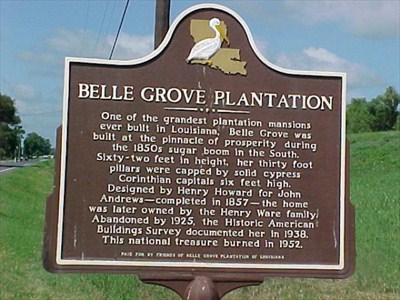
The mansion at Belle Grove Plantation was one of the greatest, largest and most beautiful residences ever built in the South.  Adapted from Wikipedia:


Belle Grove, also known as Belle Grove Plantation, was a plantation and elaborate Greek Revival and Italianate-style plantation mansion near White Castle in Iberville Parish, Louisiana. Completed in 1857, it was one of the largest mansions ever built in the South, surpassing even that of the neighboring Nottoway Plantation. The masonry structure stood 62 feet high and measured 122 feet wide by 119 feet deep, with seventy-five rooms spread over four floors.

Belle Grove was owned by John Andrews, a wealthy sugar planter.  Andrews owned over 7,000 acres spread over several plantations. By the 1850s, his more than 150 slaves were producing over half a million pounds of sugar each year. Andrews built the mansion from 1852 to 1857 at a cost of $80,000, not including the free (slave) labor or the plentiful cypress lumber and hand-made bricks produced on the plantation. The house was designed by New Orleans architect Henry Howard. 

Following the American Civil War and ensuing collapse of the plantation economy, Andrews sold the home and plantation in 1867 to James Ware, for the meager sum of $50,000. The Ware family continued to live and farm the plantation until the early 1920s. After several bad crop years, they were forced to sell the home. From 1925 onwards the house sat vacant.

The post-War era at Belle Grove saw the finely crafted home rot away in Louisiana's harsh environment. Neglect allowed a leaky roof to expand and destroy one wing of the mansion. Several owners purchased the home, each with aspirations of restoration, but none had the means necessary in the lean years of the Great Depression and World War II to stop the onslaught of rapid decay. On March 17, 1952, a mysterious fire during the night destroyed what remained of the house.


Many, if not most, of these photographs are the work of Walker Evans, taken in 1935.


 ***

Viewing these images gives me the most conflicted feelings; pondering this house, I recognize compartments of emotion and thought that can never open into each other, can never resolve.  So much of me feels wretched that such a beautiful thing is lost to the world.  I feel so strongly - always - that beauty should be preserved, honored.  The craftsmanship that was employed here was exemplary and irreplaceable.  And then what of the enslaved people who helped to build this magnificent house, who worked there; this was their house, too.  Their lives and work were in the wood and stone and brick of this house.  But part of me, pained by the thought of the incredible evil of the system that made possible its birth, feels that in some way it "deserved" to die.  Very possibly its dissolution and passing was just.  I don't know....


Friday, August 24, 2012

Great. Weight.

I've been hiking a lot lately, up in Forest Park, as I usually do when the weather is congenial.  Recently, the bottom of my left foot has been a bit sensitive, uncomfortable standing without a shoe on or without some other padding.  So I've been online, self-diagnosing.  Of course I have.  I've decided that it's probably a mild case of metatarsalgia or good old plantar fasciitis.  (I think I've dealt with the latter before - but the other foot? - which gradually went away.)

Explaining plantar fasciitis, that cheeky Wikipedia was coldly insensitive enough to say, "among non-athletic populations, it is associated with a high body mass index."  "High body mass"?  I do believe that that's just another way of saying that I'm too heavy for my own feet.  Which I believe is another way of telling me that I'm just too fat.  Thank you so much, Wikipedia, for informing me that I'm collapsing under my own weight.

[hysterical sobbing]

Saturday, July 21, 2012

Sleep wear trends for the post-op pooch

Two Mondays ago - the day after my birthday - our dear little dog, Nicholas, started feeling very ill.  We had a few really scary days, going back and forth to the hospital, before they finally figured out that he'd ingested part of a doggy toy.  That Wednesday he had surgery.  We had more vet and hospital visits in the days after that, mostly because we wanted to be very sure that everything was going the way it should be and that he was as comfortable as we could make him.  He's doing fine now and almost finished up with his convalescence.  He's been a total trouper through the whole thing; G and I were completely wrecked!

(G tells a more detailed version of the story on her blog.) 

One of the most challenging aspects in the week and a half or so since his surgery has been sleep time.  We arranged our schedules so that, during the day, one or both of us was here to watch him, because the biggest concern was that he'd try and fuss with his incision.  But at night we needed to put him in what they call an e-collar, so that he'd be protected from himself while we slept.  At first he was quite obviously very uncomfortable and none of us slept much at all.  It's progressively gotten easier.  Everyone's seen the sad little dogs and cats burdened with what looks like a inverted lampshade on their heads.  Nicholas' versions were slightly different, and he has kindly agreed* to model them for you.

Model number one:  Thick transparent plastic.  Black Velcro closure.  Matching piping at base.

Pluses:  See-thru and Astro-chic.

Minuses:  Stiff and too small; it was right up against his chin and he couldn't move his head at all.  Also gave him a bruise on his neck.

Verdict:  Thank you.  We've got enough problems right now.  We'll keep looking.


Model number two:  Stiff but quite pliable blue synthetic fabric.  White edging and drawstring.

Pluses:  Softer and more size-adjustable.  Adaptable - can be worn facing out for sleeping, or folded back for day wear.  (see below)

Minuses:  It's a collar.  For a dog.  And Nicholas doesn't find that color blue at all congenial.

Verdict:  It's still a big, floppy, annoying thing.  Thank you, but we'll keep looking.

[Folded back when worn during the day.]


Model number three:  Green cotton onesie, size: 3 months. Embroidery of an effeminate monkey on the side.

Pluses:  Our vet told us that Nicholas might be more comfortable sleeping in a onesie for the last few days of his convalescence.  It fits perfectly and is a nice chartreuse color.  The monkey embellishment is a nice - if rather ironic - reference to the cause of all his problems.  The manufacturer placed three snaps at the butt-end; if one only connects the two outer snaps, there is ample space left to accommodate a dog's tail.  It's cuuute!

Minuses:  He wiggled out of it the first night. 

Verdict:  He goes back to model number two for the duration.


*  No dogs - meaning Nicholas - were harmed in the production of this photo shoot.  Mr. O'Dittle is displaying that rather pathetic aspect merely to give the public some idea of his recent suffering.  In reality - finally, happily - he's feelin' fine!

Friday, June 29, 2012

Out of nowhere

[I don't know where this post comes from.  I don't know what got my thinking moved in this direction, but.... ]

I hate guns.  I hate everything about them.  I know we can't conceive of a world without guns, I know our laws guarantee a "right" to them.  I understand that people can get some sort of feeling of empowerment from shooting guns, can enjoy a thrilling transmission of power.  But even when they're used responsibly, when they're directed at nothing more sentient than a firing range target, I still hate them.

To me they're one of the most blatant symbols of our remove from the natural world.  That our machine-making minds have found a way to maim and kill - without effort - without contact.

If all I have to fight you with is a knife or a sword or my hands, if I have to look you in the eye and wonder the outcome, aren't I going to be a lot more cautious and rational when considering battle?  Just like a smart dog or lion or crow is going to make a judgement about whether a fight is worth it or not.  But if I have a gun - or a mortar or a big bomb - and you don't, I know I'll win.  Easy.  That core of a concept, our internalization of it, I think has had a sickening, dislocating effect on us as humans.

Violence is natural.  No matter how much we try to avoid it - usually a very healthy impulse - it's inherent in life and death.  In small and large ways.  But for violence to be understood, to be healthily processed by our puny human brains, I believe it has to present itself on a human scale.  The velocity of violence has to present in human time.

***

When I was living in San Francisco in the eighties, one of the many less-than-glamorous jobs I scrounged around to get was cleaning house for some people who had a t-shirt business in Mill Valley, across the bridge in Marin County.  The owner of the business always seemed more than a little paranoid.  Really kind of spooky.  He slept with a gun under his pillow.  And he was usually good about putting it away before I got dropped off - I was always alone in the house - but one or two times I had to pick up the gun and put it on the bedside table so that I could make the bed.  The only time I've held a gun.

It was so much heavier than I would have expected.  Heavy steel, machine cold.  Heavy.  Sickening, unnatural.  I found it very disturbing to even touch it.  It wasn't so much a fear I felt.  It just felt like an evil thing.  There are other weapons that can have another purpose, another life beyond violent intent.  A dagger or a sword can be beautifully decorated and ornamental.  It can be worn or hung on the wall and admired for its craftsmanship.  But I found no beauty in this heavy metal object.  And it was made for no other purpose.  For the few seconds it was in my hand, all I could feel from it, hear from it:  This is meant to kill with.  This is meant to kill with.

Monday, June 18, 2012

Decidedly not the same thing....

Preparing to paint - research, designing, Photoshopping, gridding, drawing - is not painting.  Buying art supplies and attending art openings is not painting.   Blogging and feathering my website is not painting.  Since finishing my current show at Winston Wächter and tossing off the small nude that's in the group show at Froelick, I haven't actually painted anything.

There isn't anything to paint.  I'm in the planning stages of several paintings - the beginnings of a whole show, really - but that doesn't give me any of the kind of satisfaction I get from being in the process of actually "building" a painting.  Putting stroke upon stroke of paint upon the panel.  Finishing each little section, moving forward in pictorial space.  Until some paint goes down onto the panel's surface, it's an idea, but it isn't a painting.  And I have nothing I can put paint on.

I used to whine constantly that it was sooo hard for me to just settle down and sit down to paint.  I was too nervous and scattered and dreaded the necessary intense deployment of concentration.  I could squander hour after hour, though, fussing with all the other parts of the art business that aren't actually painting.  And now?  Everything is reversed.  And even though I'm very frustrated over the dearth of paintable surfaces here in the studio right now, I'm very grateful for that reversal.

Friday, June 15, 2012

Two PTSDs walk into a bar....

So what happens when my lurking PTSD comes smack up against that of another struggling friend?  No joking matter, that.  It's unexpectedly wrenching.  In the midst of all the wonderful things that have been happening for me lately, I've had drama on the sidelines.  And I've directed much more attention and worry toward it that I probably should have.  I've added in my own little internal drama.

A very dear friend of mine is having a very difficult time right now, dealing with this insidious illness.  This isn't anything new, but part of its manifestation this time has been to turn on me, the angry rhetoric escalating, and then the grand gesture of officially and harshly discarding me as a friend.  We've never been anything but the most loving friends, always very supportive of each other, personally and in all our artistic endeavors.  So I was completely unprepared for this development, this turn.

Even more so, I've been startled by my own response to it.  I've been extremely anxious all week.  The queasy stomach, the feeling that "something bad" is going to happen.  (I have to admit, the timing hasn't helped; June 9th and 12th are the anniversaries of my dad's death and a car accident that G and I were in, the same year, three days apart.)  I know one of the commonest symptoms of PTSD is just that kind of anxiety.  A gnawing panic and a compulsion to try and tightly control all the aspects of your life.  Also anger, usually misplaced or misdirected.  I can tell myself over and over that my friend's rejection has absolutely nothing to do with me or anything I've done, that it's only the illness.  But it still hurts.  And the hurt makes me mad, because it's hard for me to just accept the hurt.  And the mad doesn't conjure anything productive.  Because you can't just slap the crazy out of someone.  (Though I can totally visualize that working - smack! and they come around - like they always do in the movies.  And, of course, that's crazy.)

I can pretty much see from the other side of it, understand a lot of the cock-eyed reasoning that's in play in my friend's mind, and have at least a small degree of perspective on the situation.  But the unexpected rejection still really gets to me.  An unearned rejection.  And one I can't fight, one I can't work my way back from with reasoning and support.  This seems to be a very tender spot in my emotional make-up; I guess it hasn't been entirely clear to me until now.  Maybe in the "big picture" of my life that's why this has happened, why this kind of situation is playing out again.  Because, happening this time, it brings up all the times in the past when I couldn't protect myself from the rejection, from being traumatized by the shock of it.  I suppose it happens to everyone.  I'm sure everyone has found themselves in that position, helpless.  I don't know, but maybe it's a bit more difficult for me to shake off than it is for most, considering my own struggles with PTSD.  But after I've taken care of myself, worked the methods that help with my own over-reactions, when I can start to turn the corner from the upset and get back some light and perspective... it still hurts.  And it doesn't hurt any less when I know it's not my fault, and that it really isn't the other person's fault.  It just hurts, and I guess I'll have to find a way to let that be.