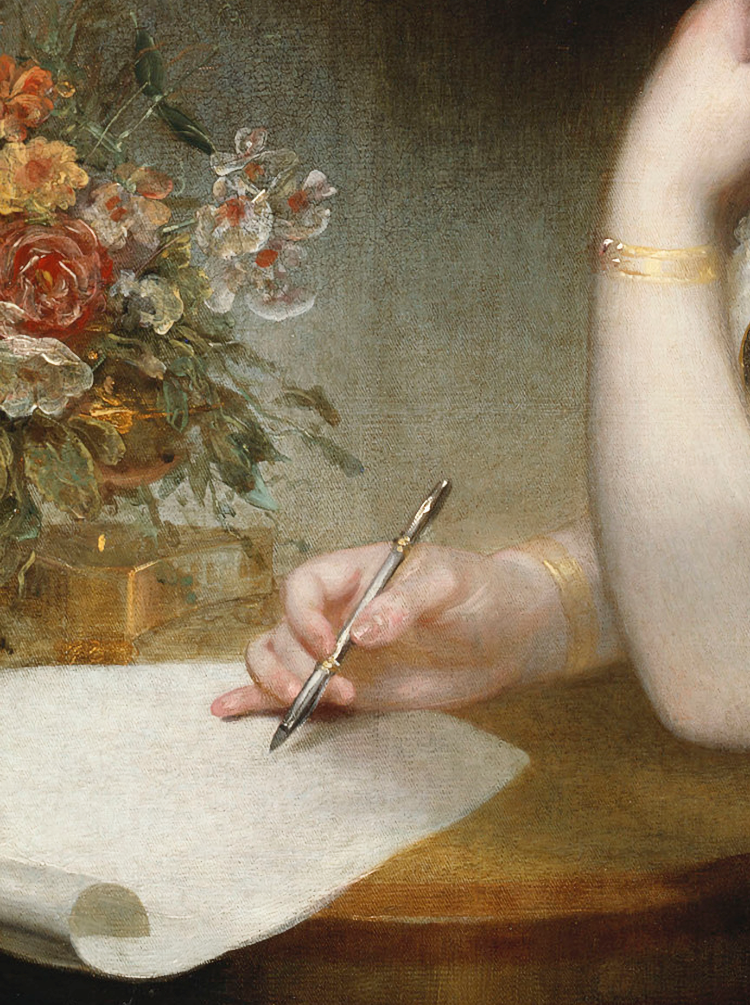
All six portraits are intimate studies of the princesses - Charlotte, the Princess Royal; Augusta; Elizabeth; Mary; Sophia; and Amelia - who are portrayed as accomplished young ladies, affectionate sisters to their devoted brother, George IV. The Princess Royal was the only married sister at this date. As Duchess of Württemberg she wears the red ribbon of the Royal Order of the Golden Eagle of Württemberg, the only one of this set of portraits to bear such a badge of rank. Five of the six paintings are recorded at Carlton House, hanging as overdoors in the South Anteroom; for some reason the painting of the Princess Royal was recorded as being in the Carlton House picture store. All six paintings required restoration by Beechey in 1829.
 |
| Charlotte, Princess Royal, Duchess of Württemberg, (1766-1828). |
The eldest daughter and fourth child of George III of the United Kingdom and his wife, Charlotte of Mecklenburg-Strelitz, in 1797, at the rather late age of thirty, the Princess Royal married, as his second wife, Frederick, Hereditary Prince of Württemberg, the eldest son and heir apparent of Frederick II Eugene, Duke of Württemberg. Her husband was, successively, reigning Duke, reigning Elector and, finally, King of Württemberg. The marriage produced one child: a stillborn daughter born the year after they wed. In 1800, French troops occupied Württemberg, and for the next several years her husband was forced to negotiate with Napoléon, first siding with him, then against him. Frederick died in 1816, and his widow continued to live at the Ludwigsburg Palace, near Stuttgart, as dowager queen of Württemberg. In 1827, she made her first visit to England since her marriage, thirty years before. She died a year later.
 |
| Princess Augusta, (1768-1840). |
Painfully shy as a child, when she reached marriageable age, there was some consideration that Augusta might make a bride for a foreign prince; both the Crown Prince of Denmark - later King Frederick VI - and Prince Frederick Adolf of Sweden would seek her hand. But her parents seemed increasingly unwilling to let go of their daughters, and she never married. At least there is no record of a marriage; apparently she had a decades-long relationship with a gentleman of the court, Sir Brent Spencer, later the king's equerry. In 1812, she asked her brother, then Prince Regent, if the couple might marry. A few years later she was referred to as being "privately married," and Spencer was said to be holding a locket with Augusta's picture when he died in 1828.
 |
| Princess Elizabeth, (1770-1840). |
Known for her optimistic attitude, her sense of humor, and her artistic abilities, Elizabeth was also stifled by her parents' reluctance to letting their daughters marry. And like others of her sisters, she is rumored to have had relationships with men at court. She was said to to have had a child with the son of one of her father's pages. And it appears she had a romantic relationship with diplomat Alleyne Fitzherbert, 1st Baron St. Helens; among other evidence, they exchanged miniatures of each other. In 1818, at a month shy of forty-eight, and against all her mother's resistance, she married Prince Frederick of Hesse-Homburg. It started as more of a marriage of convenience - the bride could escape the constrictive environment of her home, while the groom gained many advantages by becoming allied with the British royal family - but it seems the couple lived together very happily until the prince's death ten years later.
 |
| Princess Mary, (1776-1857). |
Mary was considered the prettiest daughter of George III. Around 1796 Mary fell in love with the Dutch Prince Frederick, the son of William V, Prince of Orange. But the princess' father stipulated that her elder sisters should marry first, and in 1799 Prince Frederik died of an infection while serving in the army; Mary was allowed to go into official mourning. Seventeen years later, in 1816, she married her first cousin, Prince William Frederick, Duke of Gloucester and Edinburgh, the son of George III's brother. Her husband appears to have been in love, while Mary's motive was mostly her desire to leave her mother's restrictive household. Both bride and groom were forty, and there were no children born to the couple. When Mary died in 1857 at the age of eighty-one, she was the last-surviving and longest-lived child of King George III and Queen Charlotte.
 |
| Princess Sophia, (1777-1848). |
Like all her sisters but the eldest, Sophia languished in their mother's tightly controlled household. Like all of the royal couple's daughters, she was well educated. And like others of her sisters, she was rumored to have had relationships with courtiers, the only men they came in contact with. She is thought to have entered into such a relationship with her father's chief equerry, Major-General Thomas Garth, a man thirty-three years her senior; she is said to have had his child in 1800. But there were also various allegations of incest - possibly rape - with her brother, Ernest Augustus, Duke of Cumberland. Historians disagree on the validity of either rumored relationship, the possible parentage of the child, and if there was actually ever a child at all. She never married.
 |
| Princess Amelia, (1783-1810). |
Over-protected and isolated like her sisters, Amelia was also often in poor health; at the age of fifteen, she began suffering the early symptoms of tuberculosis. Three years later, the eighteen-year-old princess was sent for a seaside cure at Weymouth, hoping to improve her health. Among those staying with her was an equerry twenty-one years her senior, the Hon. Charles FitzRoy. Amelia fell in love with FitzRoy, desiring to marry him. The king, frequently incapacitated by mental illness, had this information kept from him. Though she never gave up hope of marrying FitzRoy, the princess knew she could not legally do so due to the provisions of the Royal Marriages Act. She would later tell her brother Frederick that she considered herself to be married, anyway, taking as her initials A. F. R. (Amelia FitzRoy). Her health declined further and she died nine years later; other than a mourning ring containing a lock of her hair which she had had made for her father, her will dictated all her possessions be given to Charles FitzRoy.
*
Beechey had been employed to teach drawing to the elder unmarried princesses, Augusta and Elizabeth; reference to that activity are included in their portraits here. But also to be seen in this group, Mary is shown with a sketch of the bust of a putto - seen behind - while Amelia is portrayed with what appear to be two folders of drawings. So was Beechey perhaps angling to acquire two more Royal pupils...?
In 1800, William Beechey submitted an account to George IV for the six portraits at the price of forty guineas each.




,%20Bartholom%C3%A4us%20Bruyn%20(I),%201538%20-%201539.png)


,%20PORTRAIT%20OF%20A%20LADY%20WITH%20SHACKLE%20OR%20CHAIN%20AT%20HER%20ARM.png)


%20Duchess%20Peony%202007.png)