L a - b e a u t é - s a u v e r a - l e - m o n d e ~ D o s t o ï e v s k i

L a - b e a u t é - s a u v e r a - l e - m o n d e  ~  D o s t o ï e v s k i


Friday, August 16, 2024

Finding legitimacy - Ulrik Christian Gyldenløve, by Abraham Wuchters, 1645


Ulrik Christian Gyldenløve (7 April 1630 - 11 December 1658), the illegitimate child of Christian IV of Denmark and his chambermaid and mistress Vibeke Kruse. Though his illegitimacy precluded any royal status, the surname Gyldenløve - ”Golden Lion" - acknowledged his parentage. (Christian IV had at least five illegitimate children who bore that surname, a name which was also carried by several illegitimate children of previous and future Danish kings.) 

The pendent miniature almost certainly portrays his father, Christian IV.

He was recognized and financially supported by his father during his childhood. And when he was not quite fifteen, his father gave him the Skinnerup gård estate; unimpressed with the manor house, the son had it rebuilt and renamed as Ulriksholm. The king also made him a count, while he chose a military career and was eventually made rigsgeneral (General of the Realm) and commander-in-chief of the Danish army during the Dano-Swedish War of 1657-58. 


He rode at the head of the Danish student army against the Swedish troops during the Siege of Copenhagen in 1658. When the Swedes stormed Kallebodstrand in Copenhagen, where Gyldenløve had his headquarters, he was was killed by several enemy gunshots during the struggle between the Danish-Dutch defenders and the Swedish-German attackers. He was twenty-eight.


He was buried at the Vor Frue Kirke in Copenhagen. As he was unmarried and childless, his estate reverted to the crown. The Gyldenløvesgade streets in Copenhagen and Odense are named after him. And he was long remembered by both the Danish nobility and the peasantry as one of Denmark's foremost military commanders.

A real "scene stealer" - and so beautifully lit - is Gyldenløve's little dog.

*

Abraham Wuchters (1608, Antwerp, Belgium - 23 May 1682, Sorø, Denmark), Brabant-born Dutch-Danish painter and engraver. Together with Karel van Mander III, he represents the main influence from the Dutch Golden Age on Danish Baroque art. Born in Antwerp, he spent most of his career in Denmark where he and van Mander became the preferred painters of the Danish King, nobility, and bourgeoisie. In 1671 Christian V appointed him official Painter to the Danish Court and in 1673 he was also made official Engraver to the Danish Court. As royal painter he also executed decorative works in the royal residences, such as in Rosenborg Castle.


Sunday, August 11, 2024

To wear a straw hat - four photographs of José “Pete” Martinez by George Platt Lynes, 25 May 1937


*

From his time with the PaJaMa artist collective, most likely taken on Fire Island, New York, circa 1937-39. (Five images.)

José Antonio Martinez-Berlanga (he sometimes used the stage name Pete Stefan; 13 March 1913, Mexico - 24 June 1997, Pasadena), dancer, teacher, and artist's muse. He was born in Mexico, but his family moved to Houston, Texas while he was still quite young, and he became involved in dance early on; his mother had been a folklórico dancer back in Mexico. After graduating high school, he moved to New York to study at the School of American Ballet and, upon graduation, he was invited to join the company. 


In 1936, at the age of twenty-three, he met and began a relationship with philanthropist, arts patron, and ballet impresario Lincoln Kirstein. Only two years previously, Kirstein, along with George Balanchine and Edward Warburg had founded the school and dance company. And the year the couple met, Martinez joined Kirstein's second company, the touring Ballet Caravan. The two lived together for several years, and Martinez associated with the loose group of friends that was centered on the artist collective and personal ménage that called itself "PaJaMa" - after the initials of artists Paul Cadmus, Jared French, and French's wife Margaret - where he was a frequent subject of photographs and a model for Cadmus. (George Platt Lynes was another participant in the group.) 


His relationship with Kirstein continued until the latter married Cadmus' sister, Fidelma, in 1941; she moved into the apartment the two men shared, and Martinez continued to live with them for the first year of their marriage. After being denied enlistment at the beginning of WWII, he began work at a Jewish refugee hostel in Haverford, Pennsylvania. Writer Christopher Isherwood was already working there - the two had met previously, in 1939 - and they developed a close, occasionally intimate, friendship. Finally allowed to join the military in 1943, he was in Northern France at the end of the war. 


Returning to New York, he resumed his career with Ballet Society, Balanchine and Kirstein's latest incarnation of their ballet company. (It finally became the New York City Ballet in 1948, the name it retains to this day.) But a lingering knee injury put an end to his performing career in 1947. He eventually decided to become a teacher and opened his own dance studio in Norfolk, Virginia. He later founded other dance studios in Ohio and then California, where he worked until retiring in the mid-1960’s. He died at the age of eighty-four, a year and a half after Kirstein.


*

Portrait of Martinez by Paul Cadmus, 1937.


Friday, August 9, 2024

Awakening to the news - Queen Victoria being told she is now queen, Kensington Palace, Tuesday, 20 June 1837

 
Queen Victoria Receiving the News of her Accession, by Henry Tanworth Wells, 1887. In the Royal Collection.

Upon the death of her uncle, King William IV, Princess Alexandrina Victoria of Kent, aged eighteen years and three weeks, ascended the throne of the United Kingdom as Queen Victoria. This is an extract from her diary on that momentous day :

I was awoke at 6 o'clock by Mamma, who told me that the Archbishop of Canterbury and Lord Conyngham were here, and wished to see me. I got out of bed and went into my sitting-room (only in my dressing-gown), and alone, and saw them. Lord Conyngham (the Lord Chamberlain) then acquainted me that my poor Uncle, the King, was no more, and had expired at 12 minutes past 2 this morning, and consequently that I am Queen. Lord Conyngham knelt down and kissed my hand, at the same time delivering to me the official announcement of the poor King's demise. The Archbishop then told me that the Queen was desirous that he should come and tell me the details of the last moments of my poor, good Uncle; he said that he had directed his mind to religion, and had died in a perfectly happy, quiet state of mind, and was quite prepared for his death. He added that the King's sufferings at the last were not very great but that there was a good deal of uneasiness. Lord Conyngham, whom I charged to express my feelings of condolence and sorrow to the poor Queen, returned directly to Windsor. I then went to my room and dressed.

Since it has pleased Providence to place me in this station, I shall do my utmost to fulfil my duty towards my country; I am very young and perhaps in many, though not in all things, inexperienced, but I am sure, that very few have more real good will and more real desire to do what is fit and right than I have ...


*

Victoria Regina, by Henry Tanworth Wells, 1880. A second - earlier - version by the same artist. Given to the Tate by the artist's daughter on his death in 1903.
Your Majesty, color photogravure after Mary Louisa Gow, published by The Graphic, 1895.
Illustration published in The Graphic, 1 June 1897, during Queen Victoria's Diamond Jubilee.
Queen Victoria Awakened to Hear the News of her Accession, published in the Illustrated London News, 14 May 1911.
A color version of the same.


Sunday, August 4, 2024

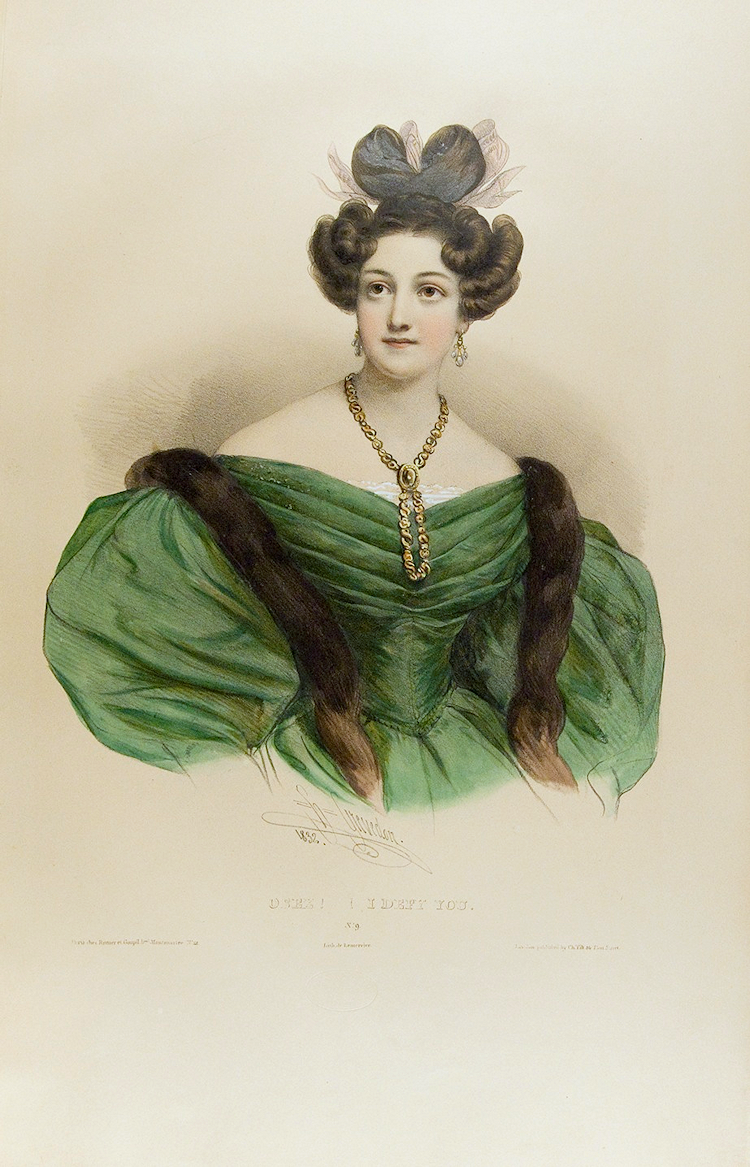
À la mode actuelle - selections from Le Vocabulaire des dames, by Henri Grévedon


Large-scale lithographs of fashionably dressed women - imaginary portraits - were popular in the late 1820s and 1830s, and Henri Grévedon produced about twenty series between 1828 and 1840, each containing between four and twenty-eight prints. Among those were:

Epoques remarquables de la vie de femme, 1830
Le Vocabulaire de dames, 1831-34
Heroïnes des principaux romanciers contemporains, 1833
Le Miroir des dames, ou Nouvel alphabet français, 1834
Recueil de quelques portraits d'actrices des principaux théâtres de Paris, 1831-1834
Les Mois, 1838
Portraits de femmes, selon leur rang social, 1840


His Le Vocabulaire des dames was produced over a period of four years; the title page of the series states, "This collection of portraits will be replenished every month, as soon as new fashion appears." The lithographs were produced in four batches of six prints over the four years and could be purchased individually or as a series. The series was sold commercially, by subscription and through stores, in both Paris and London.


Most likely, Grévedon not only created the drawings, but also lithographed many of the sheets himself, as they display the signature of the master, but bear no indication of another lithographer. 


The series' lithographs were large, measuring roughly 19x12 inches (49x31 cm) making it impossible to insert them into albums of a commonly available size. They were, instead, considered suitable as images to be framed and hung on a wall; industrious print retailers offered gilded and glazed frames to fit.


The special advantage of many of Grévedon's works is that they're hand-painted. As a rule, the coloring was not repeated, which gave each sheet a special individuality. The beautiful hand-coloring also significantly increased the price of the lithographs. The black and white edition of Le Vocabulaire des dames sold for 9 francs per lot, while the hand-colored edition sold for 15 francs per lot.


*

Pierre-Louis ("Henri") Grévedon (17 October 1776, Paris - 1 June 1860, Paris), French painter, illustrator, and lithographer. In 1789, at the age of thirteen, he entered the workshop of Jean-Baptiste Regnault at the École des Beaux-Arts de Paris. He first exhibited at the Paris Salon in 1804; for his debut he was awarded a 1st class medal. He traveled to Russia in 1806, remaining there until 1812, followed by stays in Stockholm and England, before returning to France in 1816. He exhibited from 1824 to 1859 at the Paris Salon, and in January of 1832 was awarded the Légion d'honneur.


Friday, August 2, 2024

Boxed - Still-lifes by contemporary artist Michael Halak

 
Terra Sancta (Pomegranates), 2022. (As far as I can tell, all of these paintings are oil on wood.)
Terra Sancta (Figs), 2022.
Terra Sancta (Grapes), 2022.
Grain, 2022.
Made in China (Gabriel the Archangel), 2021.
Made in China (The Holy Grail), 2021.
 Made in China (St. George and the Dragon), 2021.
Product of Holy Land (Cactus Pear), 2022.
Product of Holy Land (Dates), 2022.
Product of Holy Land (Figs), 2022.

*

Michael Halak was born in 1975 in Kfar Fassuta, a Christian Arab village in the Upper Galilee, Palestine, to a Melkite Catholic family. He received his bachelor's degree in Fine Arts from Haifa University in 2002 and, three years later, he was awarded a residence scholarship to attend the Florence Academy of Art in Italy. He then graduated with a master’s degree in Fine Arts with honors from Haifa University in 2009. He has exhibited extensively internationally across the Middle East, Europe, and the United States.

Thyme, 2020.