L a - b e a u t é - s a u v e r a - l e - m o n d e ~ D o s t o ï e v s k i

L a - b e a u t é - s a u v e r a - l e - m o n d e  ~  D o s t o ï e v s k i


Friday, November 6, 2020

The Ares Borghese


*

The Ares Borghese is a Roman marble statue of the Imperial era (1st or 2nd century AD). The figure has been identified as Ares by the helmet and by the inclusion of an ankle ring,  given to Ares by his lover Aphrodite. There has long been conjecture that the work may have derived from a Greek model, but the cult and representations of Ares are very rare in the ancient Greek world, especially in sculpture. So it is more likely to be a wholly Roman creation, reflecting the taste in Rome at the time for reliefs and statues of the Greek Classical (5th–4th centuries BCE) and Archaic (6th century BCE) periods.

It was originally part of the Borghese collection - from which it obviously derives its name - but was purchased by Napoléon in 1807, and now resides in the Louvre. The figure is nearly seven feet tall. It has endured a fair amount of damage and repair over the centuries; the top of the helmet is lost and the arms are reconstructions. This figure "type" was widely copied and adapted, with examples appearing throughout the empire. Apparently, it was frequently paired with statues of the Venus de Milo "type", the couple then symbolizing the union between war and peace; the sculptures were sometimes given the features of the reigning emperor and his empress. 


An imagined reconstitution in plaster of a Venus/Mars (Ares) group incorporating the Ares Borghese and the Venus de
Milo, the work of French philosopher, polymath, and Curator of Classical Antiquities at the Louvre, Félix Ravaisson.


Sunday, November 1, 2020

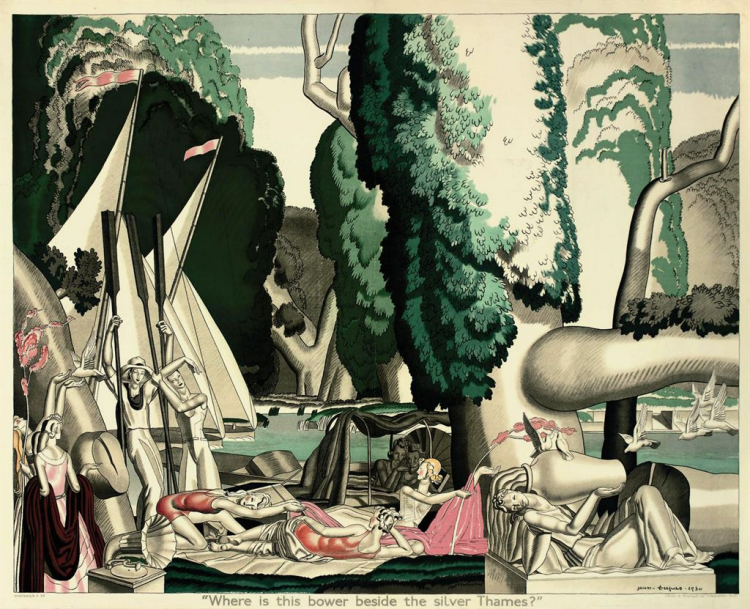
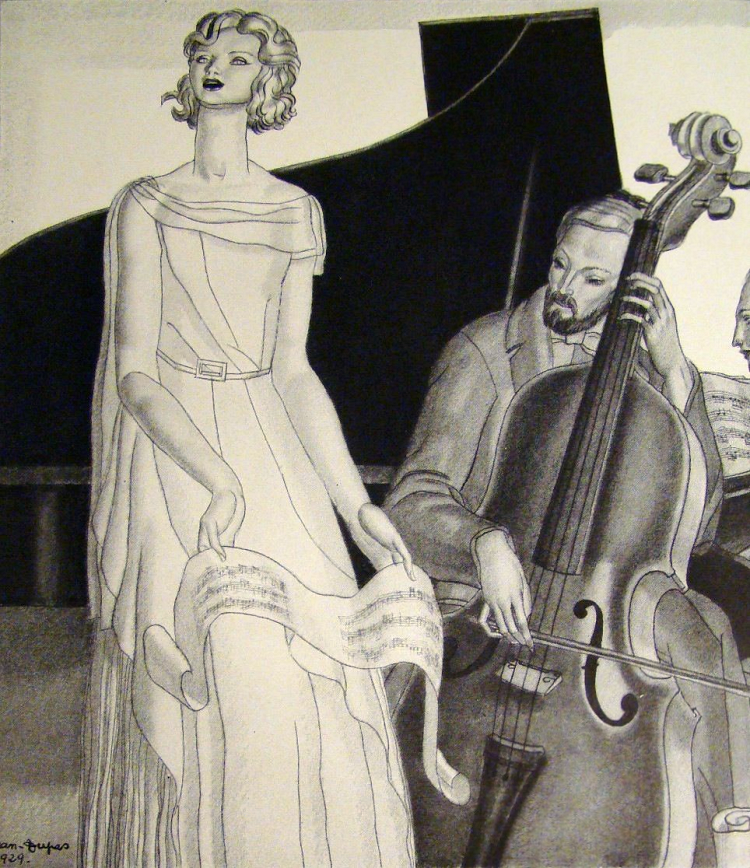
Beauty in a different mold - selected work by Jean Dupas


Les Perruches, circa 1924-25, probably his best known painting.
A study or vignette taken from the composition of Les Perruches.
A study for the above work.
Le Printemps, 1926.
A study for the above work.
Portrait of a young boy.
La Femme à L'Ara, 1921.
Another study or vignette taken from the composition of Les Perruches.
Portrait of a woman, study for "Sylvie."

*

Jean Théodore Dupas (21 February 1882, Bordeaux - 8 September 1964, Paris), French painter, graphic designer, poster artist, fashion illustrator, and decorator whose work is seen by many as the embodiment of French Art Deco painting and graphic design. The son of a merchant marine captain, he began his adult life as a merchant seaman, himself. But he later enrolled in art school, first in Bordeaux and then in Paris, and in 1910 he won the prestigious Prix de Rome for painting and went to study at the French Academy in Rome. From there he sent several paintings to be exhibited at the Salon in Paris, but his studies were interrupted by the war. He first came to public prominence during of the famous Exposition internationale des arts décoratifs et industriels modernes, the world's fair held in Paris in 1925, where his paintings were featured, notably in one of the French pavilions, the Hôtel d'un Collectionneur, a collaboration of furniture designer Jacques-Émile Ruhlmann and other leading designers and craftsmen of the day. (The style moderne that the French government was celebrating with the exposition later became known as "Art Deco", taken from the fair's name.) From the late Twenties and continuing into the Thirties his work was seen everywhere and he was awarded many prestigious commissions. His most important were those completed for the ocean liners the SS Île de France, whose maiden voyage was made in 1927, and the legendary SS Normandie, which entered service in 1935; among other things, he designed the more than four hundred square meters of painted and frosted glass that decorated the grand salon of the Normandie, one entire corner of which is preserved at the Metropolitan Museum of Art. In 1940 he was named curator of the Musée Marmottan in Paris, and the following year was admitted to the Académie des Beaux-Arts and was appointed a professor of painting at the Ecole des Beaux-Arts. He ended his career as the director of the Musée Marmottan before his death at the age of eighty-two.