L a - b e a u t é - s a u v e r a - l e - m o n d e ~ D o s t o ï e v s k i

L a - b e a u t é - s a u v e r a - l e - m o n d e  ~  D o s t o ï e v s k i


Sunday, August 20, 2017

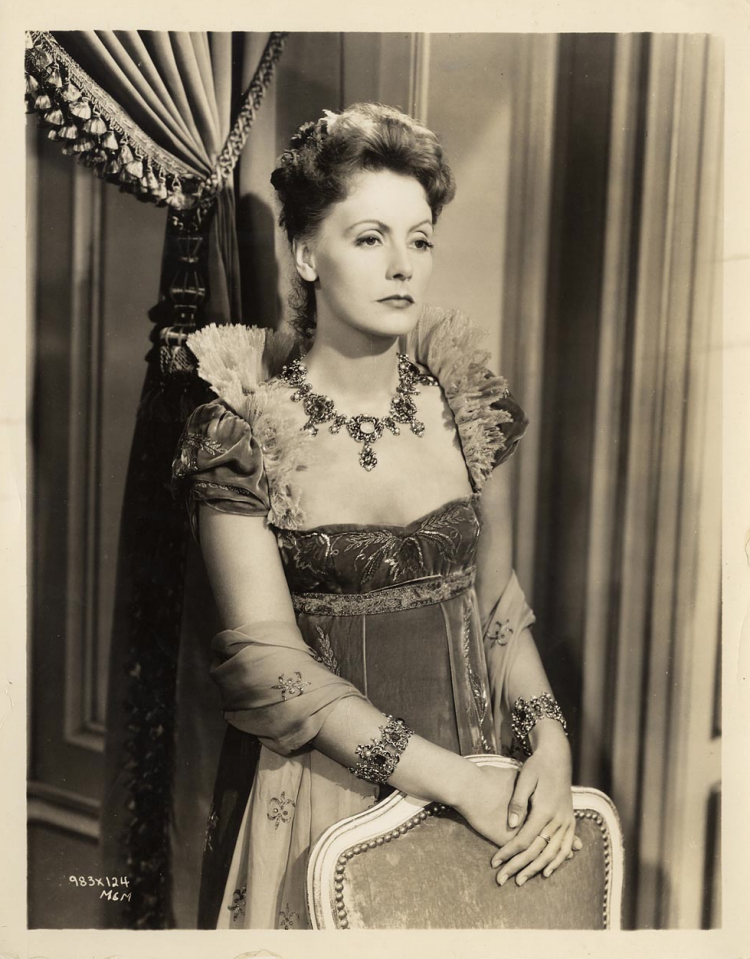
For the love of Poland - portraits of Garbo for Conquest/Marie Walewska, by Clarence Sinclair Bull, 1937


The only film separating Garbo's greatest successes - Camille and Ninotchka - and only two films before the end of her career - after the latter and the last, the disastrous Two-Faced Woman - Conquest, aka Marie Walewska, is one of her least remembered films. Co-starring Charles Boyer as Napoléon - he was nominated for an Academy Award for his performance - it tells the story of a Polish countess coerced into an affair with the French Emperor - both were married to older partners - in the belief that it would save her country from the latest "scourge of Europe". But then they fall in love. Her husband annuls their marriage, Napoléon divorces Joséphine but, for dynastic expediency, he marries Marie-Louise of Austria instead of his beautiful mistress. In spite of his newlywed status, he is quite happy to continue the affair with Countess Walewska, but the lady finds the situation untenable and leaves him, not revealing that she is now carrying his child. (The basic historical facts are not too far off, though the child was born during their affair, so the Emperor certainly was aware of his son. And the Countess didn't divorce her husband until after the end of her affair with Napoléon; the boy had been claimed as the aged Count's own progeny - which, unsurprisingly, fooled no one. Oh, and Napoléon ended the affair, not Countess Walewska.) The film, very expensive to make, was a dud at the box office and lost over a million dollars. Though she was still one of MGM's most prestigious properties, domestic receipts for Garbo's films had long been on the decline. So it was not too much of a surprise that the studio now engineered her "transformation" - triumphant if unsustainable - as the incandescent Ninotchka: "Garbo Laughs!"


***

Examples of the promotional material created for the film.

Fun to find this; I lived in Lompoc, briefly, as a child. Third and fourth grade. At a date considerably later than the debut of this film, thank you!


Friday, August 18, 2017

La Alameda de México, by José María Velasco, 1866


The artistic depiction of the most attractive public thoroughfares in Mexico City reached its height in the nineteenth century and combined panoramic views of specific sites with costumbrista portrayals of citizens relaxing. The growth of the "urban landscape" genre was not only encouraged by the teachers of landscape painting at the Escuela Nacional de Bellas Artes, but also welcomed by the commercial art sector, which was eagerly producing albums of lithographic reproductions. The paseos most favored by the city's inhabitants were the Bucareli Street, the Canal de Santa Anita (or Canal de La Viga), the Las Cadenas promenade adjacent to the city's main square and, oldest of all, the Alameda. In this painting, Velasco depicts the Alameda park which then stood on the edge of the city. In the background, the prospect opens out into fields and rolling hills, and a view of Chapultepec Castle. (An artistic slight of hand as, in reality, the convent of San Diego and other building stood in the way of that view.) Surrounding the shaded fountain and lining the earthen horse path are a loosely arranged group of figures: indigenous, mestizo, and of European descent, rich and poor. And at the center of the composition - in full sun, dressed in white, ribbons fluttering in the breeze - are the Empress Carlota and a lady-in-waiting. The Empress, who had sponsored the remodeling of the park, is escorted by a gentleman and a group of elegant chinaco horsemen. This is a poignant and highly romanticized vision of Mexico under the brief reign of the tragic Emperor Maximilian.


Though I've seen this painting also referred to as Paseo a Caballo de Carlota en la Alameda, though Chapultepec Castle looms in the background, I'm not entirely convinced that the featured horsewoman here is indeed the Empress. The official title makes no mention of her. This was painted in 1866; in August of that year, Carlota sailed back to Europe to fight for her husband's throne. (There was, of course, the famous break in her mental health soon after, and she never returned to her adopted country.) But it appears this painting was first exhibited in 1869, two years after the fall of the Empire. So if it was the Empress that the artist portrayed, by that remove it would have been a connection no one would have been too happy to publicize. So are we to believe that the "starring role" in this beautiful tableau is the soon-to-be-"mad" Carlota, or is it just another pretty lady on a horse?

A view of Chapultepec Castle - at this date, still on the outskirts of the city - and the residence of the Imperial couple, 1864-67.

***

José María Tranquilino Francisco de Jesús Velasco Gómez Obregón, generally known as José María Velasco, (6 July 1840, Temascalcingo – 26 August 1912, Mexico City), nineteenth-century Mexican artist and polymath, most famous for making Mexican geography a symbol of national identity through his paintings. He was both one of the most popular artists of the time and internationally renowned. He received many distinctions such as the gold medal of the Mexican National Expositions of Bellas Artes in 1874 and 1876; the gold medal of the Philadelphia International Exposition in 1876, on the centenary of U.S. independence; and the medal of the Paris Universal Exposition in 1889. His painting El valle de México is considered Velasco's masterpiece, of which he created seven different renditions. Of all the nineteenth-century painters, Velasco was the "first to be elevated in the post-Revolutionary period as an exemplar of nationalism.

Velasco was interested in science, and, as a student at the Academia de San Carlos studied zoology and botany at the nearby medical school; he also studied mathematics, geology, and surveying before becoming a student of painting. In 1879, he described a new species of Ambystoma - a type of salamander - found in the Santa Isabel lake, north of Mexico City, and published his observations in the Mexican scientific journal La Naturaleza. He named the new species Siredon Tigrina; it was later renamed Ambystoma velasci in his honor.


Sunday, August 13, 2017

Overblown and unpleasant kings - Wilhelm II and Carol II, portraits by de László


Emperor Wilhelm II, 1909-11.
Though recently repaired, the portrait still shows the marks of  five slashes apparently inflicted by Russian soldiers at the end of World War II.

The first grandchild of Queen Victoria and Prince Albert, "Willy" suffered a birth injury that permanently damaged his left arm; many believe his disability, and others' reaction to it, severely affected his psychology. He was further warped by his early indoctrination into the all-pervasive Prussian military milieu, and manipulated by politicians who were opposed to the liberal ideas of his father, and who encouraged his increasingly arrogant and pompous behavior. He was eventually alienated from his parents, directing his anger and spite at his mother, especially. As an adult, he was decidedly a poseur, rarely appearing out of military uniform, and presenting himself in portraits as the personification of the most bombastic and bellicose form of kingship. Callous and vindictive, petty and dictatorial, fairly humorless, meddling. Oh, and World War I.

The painting before restoration. The central arch of the colonnade of the Communs, Neues Palais, Potsdam, can be seen in the background.
A finished sketch for the full-length portrait, 1909.
Two sketches for the portrait, circa 1908-11. Here, in the background, the Communs is shown from the same angle as in the photograph below.
In the studio: the artist, the horse, one of the artist's sons, and the unfinished painting, 1911.
At this stage, the building in the background still looks to be a view of a wing of the Communs rather than the colonnade.
Sketch of the borzoi included in the painting, though reversed. In the smaller sketch to the right of the dog, here, one can make out the
Emperor and the horse in the same configuration as in the final painting, but the dog - as here - is in a reversed position. Circa 1908-10.
Reference photograph with sketch of  the horse's head and the dog in its originally planned position. As in the finished painting,
the Communs of the Neues Palais can be seen in the background, though viewed from a different perspective.
Reference photograph. The Emperor is posed on the terrace of the Neues Palais, Potsdam.
1908.
1908.

***

King Carol II of Romania, 1936.

A great-grandchild of Queen Victoria and Prince Albert, Carol grew up under the control of his great-uncle King Carol I, who spoiled the child and, at the same time, instilled a "profound love of German militarism". He also largely excluded the boy's parents from any role in his upbringing; Carol would eventually become alienated from his parents, especially his mother the vivacious, flamboyant Queen Marie. Lazy and apathetic, from his teenage years he became known for his romantic misadventures. At the age of twenty-four, second in line to the throne, he abandoned his army post in order to marry a commoner. The marriage was annulled seven months later, though the couple continued to live together; they even had a child the following year. Only a year later, he made a properly dynastic marriage to Princess Helen of Greece. (A second cousin and also a great-grandchild of Queen Victoria and Prince Albert.) Their only son was born soon after, but the marriage quickly soured, due to Carol's playboy lifestyle, his drinking and womanizing. Then he took up with the infamous Elena Lupescu, who would be his mistress (and finally wife) for the rest of his life, and Helen was finally compelled to divorce him in 1928. Before that, in 1925, because of his relationship with Lupescu, Carol had renounced his right to the throne in favor of his son and had gone to live in Paris with his mistress. Two years later, Carol's father died and his five year old son was proclaimed king. But only three years, later Carol returned to Romania in a coup d'état and took the throne from the boy. Inflicting many petty cruelties on his former wife and alienating his son, indulging in a sybaritic lifestyle, Carol managed to weather the vagaries of Romania politics and the encroachment of Hitler for ten years; it helped that he had a complete lack of scruples. But he was deposed in 1940, and Michael once again became king. Carol and Luspescu went into exile, first in Mexico, then settling permanently in Portugal.

Sketch for the official portrait.
The artist and model.
1936.


Friday, August 11, 2017

The Rose Pavilion "Ozerki" at Peterhof - three watercolors by Luigi Premazzi, 1850


The Rose or "Ozerki" (lakes) Pavilion in the Lugovoi (meadow) Park at Peterhof was designed by Andrei Ivanovich Stakenschneider and constructed in 1845-1848, specifically for the Empress Alexandra Feodorovna, one of several lakeside follies at Peterhof that the architect created for the pleasure of Tsar Nicholas I and his family. While several of the other pavilions destroyed by the Germans during World War II have been restored/reconstructed, this one has not.


***

Most if not all of these photographs are dated circa 1890-1910.
A hand colored photograph.

***

The ruins of the pavilion today.