L a - b e a u t é - s a u v e r a - l e - m o n d e ~ D o s t o ï e v s k i

L a - b e a u t é - s a u v e r a - l e - m o n d e  ~  D o s t o ï e v s k i


Friday, May 12, 2017

Fortuny. Delphos. Peplos.


Geraldine Chaplin in her mother's Delphos, 1979.

There are few garments more iconic, more treasured than Fortuny's "Delphos" and its variant "Peplos"; certainly no garment more collected and still worn. First appearing about 1907, they continued to be made until around 1950. Always more "wearable art" than fashion, since their "rediscovery" in the Seventies, they've become among the most desirable vintage garments, are avidly collected, and have garnered record prices at auction.

Natacha Rambova (Mrs. Rudolph Valentino), photograph by James Abbe, circa 1924.
Clarisse Coudert, wife of Condé Nast, circa 1919.
Nazimova, photographed by Wynn Richards for American Vogue, 1923.

Mariano Fortuny y Madrazo (11 May 1871, Granada – 3 May 1949, Venice), Spanish fashion and textile designer, artist, theatrical and lighting designer, born into a family of celebrated Spanish artists. Fascinated by textiles from childhood, by the first decade of the twentieth century, he was living with his paramour and muse, Henriette - they eventually married in 1918 - in a thirteenth-century Venetian palazzo, producing garments that Marcel Proust declared "faithfully antique but markedly original".

Lillian Gish, circa 1920s.
Same as above.
Actress and singer Régine Flory, Paris, 1910.
Same as above.
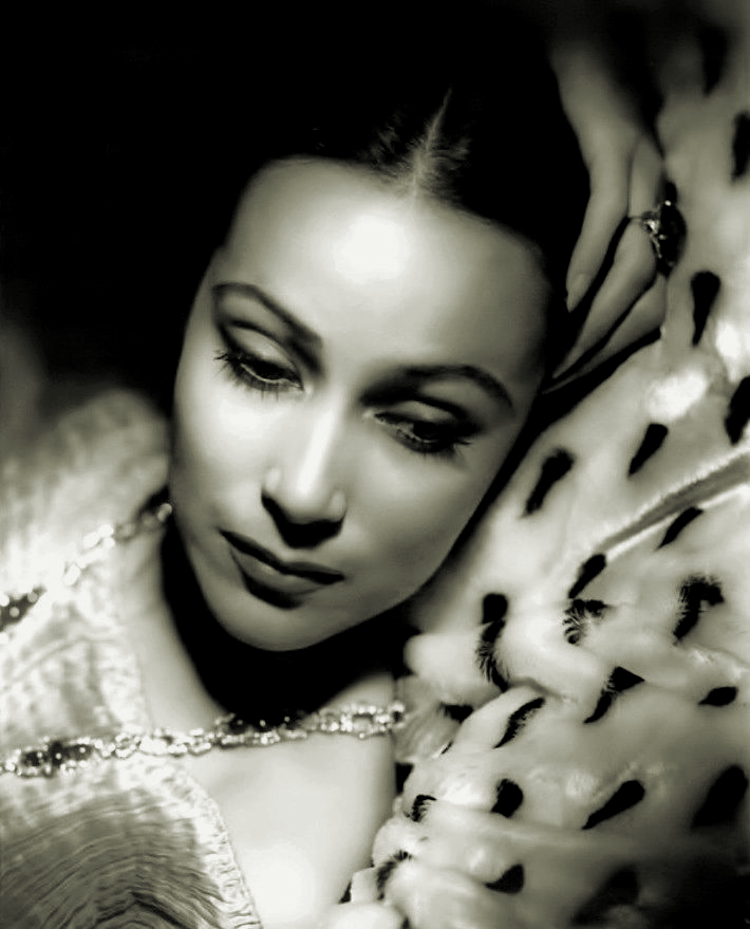
Dolores del Rio, photograph by George Hurrell, circa 1938-40.
Same as above.

He remains best known for his finely pleated Delphos dress and the similar, less common Peplos. The exact method of pleating was a closely guarded secret involving heat, pressure, and ceramic rods, and has never been successfully replicated. On both types of dresses, Murano glass beads are strung on a silk cord attached at the edge of each side seam. The beads serve a functional purpose as well as being decorative, as they weigh down the lightweight silk of the garment, subtly enhancing and flattering the human shape beneath.

Model, circa 1920.
Same as above.
Elsie McNeill Lee, Countess Gozzi, circa 1940.
Same as above. Countess Gozzi, a wealthy American businesswoman, took over the Fortuny Company at Fortuny's death in 1949.

The Delphos was a deliberate reference to the chiton of ancient Greece; designed to be worn with little in the way of undergarments, it was originally intended as a tea gown or as similarly informal clothing to be worn in the privacy of the home, but would eventually be seen more as evening wear. The gowns were often made with slight variations in length and shape. Some have sleeves, others have none. They were usually accessorized with block-printed ribbons and sashes, and were worn with all manner of silk and velvet scarves and cloaks, garments which utilized the rich and varied textiles Fortuny was also rightly famous for; an important inventor as well as designer, he also manufactured the pigments and dyes he used for his fabrics.

Peggy Guggenheim, Venice, 1975.
Charlotte, Lady Bonham Carter (in a Delphos she bought in Venice in 1922), photograph by David Montgomery, circa 1970s-80s.


The method of storage for Fortuny's pleated dresses was almost as revolutionary as the garment itself; twisted and coiled and popped into what resembled a small hatbox. At any rate, it was a method that worked remarkably well to preserve the artist's beautiful creations - and continues to do so.

Mrs. William Wetmore, photograph by Lusha Nelson. Originally published in Vogue, 15 December 1935.
Mrs. Selma Schubart (the sister of the photographer), photographed by Alfred Stieglitz, 1907.
Mai-Mai Sze, photograph by George Platt Lynes, 1934.


Sunday, May 7, 2017

And then he was gone - paintings by Josip Račić


Self-portrait, 1907.

Račić is considered one of the most important and most enigmatic figures in the history of Croatian modern art. From humble beginnings he had, before the age of twenty, appeared in Munich - one of the most lively and creative art centers in Europe at the time - and with three colleagues soon formed what came to be called Die Kroatische Schule (The Croatian School; in Croatian art history they are known as the Munich Circle or the Munich Four.) Within four short years he produced a remarkably mature body of work, almost all of which was created while he was still a student. Three months after turning twenty-three he was dead.

The Girl with a Hat, 1907.
Female Portrait, 1906.
A Man in a Red Vest, 1907.
Lady in White, 1908.
The Girl in Front of the Mirror, 1908.
Self-portrait, 1908.
Lady in Black, 1907.
Portrait of an Old Man, 1907.
Portrait of Artist’s Sister, 1907.
Head of an Old Woman, 1906.
Mother and a Child, 1908.
Portrait of an Old Friend, 1907.
Portrait of a Girl.
Self-portrait, 1906.

***

Josip Račić (22 March 1885, Zagreb – 19 June 1908, Paris), Croatian painter. He had drawing instruction in elementary school, and at the age of fifteen he began studying lithography as a trade. In 1904 he went to Munich to study at the school of Anton Ažbe who encouraged the nineteen-year-old to go on working and studying. The next year he found employment as a lithographic draughtsman in Berlin, but later that same year returned to Munich and entered the Academy of Fine Arts, where he studied for three years. In 1908 he moved to Paris where, that Spring, he died of gunshot wounds in a hotel room. The reason for his suicide remains a mystery.

1908.


Friday, May 5, 2017

I'll take what's behind the curtain - satin drapery and satin ladies by Frédéric Soulacroix and Vittorio Reggianini


Soulacroix.

I can't make any argument for the worth of these paintings. They're sugary and empty-headed and vulgar. It's also a little shocking how both artists duplicated their own work and the work of the other artist with only the slightest of variations. They both painted very effeminate, historicist genre scenes, the sort that were very popular at the end of the nineteenth century. And the pieces I'm focusing on here - examples of a sort of sub-genre with both artists - are variations on an image of a doll-like young lady dressed in satin and toying with, or making an appearance through, full-length satin drapes. A single figure, or a trio, with sometimes an attendant dog, all reflected in highly polished floors. While, as I said, quite vulgar, the thing that nonetheless captures my eye and elicits my grudging admiration is how expertly - especially with the work of Soulacroix - all that damn satin is rendered. The fabric has very specific visual properties which can be quite tricky to capture. And so, with whatever reservations I might have about these two fellow's taste or "artistic integrity", I have to give them their due.

Soulacroix.

These paintings all have quite predictable titles - An Elegant Entrance, A Peek Behind the Curtain, An Illicit Letter, Eavesdropping, Elegant Lady in Pink, etc. - and all were painted at the end of the nineteenth, beginning of the twentieth centuries.

Reggianini.
Reggianini.
Soulacroix.
Reggianini.
Soulacroix.
Reggianini.
Reggianini.
Reggianini.
Reggianini.
Soulacroix.
Reggianini.
Soulacroix.
Reggianini.
Sketch by Soulacroix.


***

Frédéric Soulacroix (1 October 1858, Rome - 3 September 1933, Casena), French-Italian painter. The son of the French painter and sculptor Charles Soulacroix, at the age of fifteen he entered the Accademia di Belle Arti of Florence, three years later being admitted to the Scuola di Pittura. It was in the historical costume genre - images depicting fashionable figures, from the seventeenth century through to the Empire - that he would become successful. He married in 1890; he and his wife had four sons and a daughter. Highly successful and widely collected, he mixed with high society in Florence and Rome, was commissioned to paint Queen Margherita of Italy, and his daughter married a nephew of Pope Pius VII.

Vittorio Reggianini (1858, Modena - 1938, Florence), Italian painter. He studied at the Accademia Belle Arti Modena, and later became a professor there. Like many of his contemporaries, Reggianini eventually migrated south, to Florence, which was then well-known as a center of historical genre painting.

Reggianini.