L a - b e a u t é - s a u v e r a - l e - m o n d e ~ D o s t o ï e v s k i

L a - b e a u t é - s a u v e r a - l e - m o n d e  ~  D o s t o ï e v s k i


Sunday, December 11, 2016

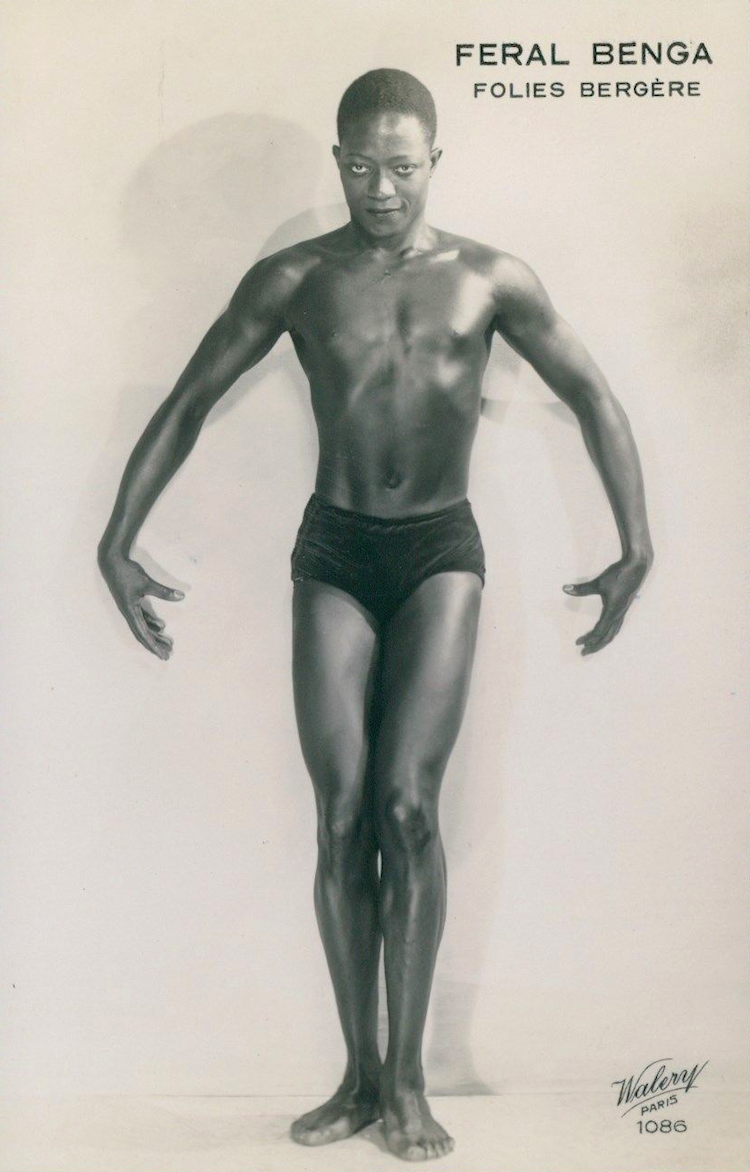
L'Ange noir aux Folies Bergère - dancer Féral Benga


These first images are all by Waléry, Paris, circa 1930.

Féral (François) Benga (1906, Dakar - 4 June, 1957, Paris), Senegalese dancer and model. He was the illegitimate grandson of one of the richest landowners in Dakar, his father had been educated by Catholic missionaries in France, and his uncle was a successful lawyer in Paris. He emigrated to Paris in the early Twenties, adopting the stage name of Féral (wild beast); he was promptly disinherited by his father for "living disgracefully and embracing whiteness". In 1925 he auditioned for and was given a contract by the Folies Bergère and, by the next year, he was one of the group of semi-nude young men playing the drums while Joséphine Baker danced in her infamous banana skirt; the revue was La Folie Du Jour, and Baker and Benga were both only twenty years old. The latter soon became well known as a dancer, himself, an exotic and erotic male counterpart to Baker. It appears that he, like Baker, well understood the commodification of black culture and the black body and his marketability as an object of desire, in his case, particularly in artistic and homosexual circles. He performed successfully in revue after revue, well into the Thirties. While his career didn't have the length and breadth of Baker's, his image survives in the work of photographers Carl Van Vechten and George Platt Lynes, the painter Pavel Tchelitchew, the well known African-American sculptor, Richmond Barthé, and others. He also appeared in a handful of films, most famously as the ange noir in Cocteau's great, surrealist Le Sang d'un Poète of 1930. He accompanied the English anthropologist and author Geoffrey Gorer on a tour of Africa in 1935; the two may have been lovers. (Most of the the artists he collaborated with were gay or bisexual, and his own love life was fairly active.) Up until World War II, it seems he enjoyed a rather lavish and showy lifestyle: a large apartment near the Champs-Élysées, a custom-made Delahaye convertible, a small army of poodles. Not much is known of his life during the war, and what there is is contradictory. At the Olympia Theatre in 1943 he performed in the ballet "Tam Tam", part of which he choreographed. But it's also said that he suffered greatly - physically and emotionally - during the Occupation and had to go into hiding. Having had his own small cabaret before the war, from 1946 he worked at then owned and operated La Rose Rouge, a popular and fashionable cabaret-restaurant on the Left Bank. But eventually, changing times and his lack of business acumen meant that, after ten years, he was forced to close in 1956. At this point, only a year before his death, his family in Senegal decided to welcome him back into the family circle. There, he submitted to familial pressure and - quite unexpectedly - married a cousin, and is even said to have fathered a son. Still, he soon returned to Paris where he died of a pulmonary embolism at the age of only fifty-one.

In costume for his Danse du Sabre.
Costumed for the Folies Bergère "Un coup de Folie", 1930.
Four photographs by George Platt Lynes, circa 1934.
Ten photographs by Carl Van Vechten, 1937.

***

Advertisement for the Folies Bergère "Un coup de Folie", 1930.
Impersonating Joséphine Baker in Tout Pour Joséphine (?), by Studio V. Henry, 1926.
Unknown dance, by Studio V. Henry, circa 1926.
Backstage at the Folies. A scene and an image that would be unimaginable - for so many reasons - in the United States at that time.
As the ange noir in Cocteau's Le Sang d'un Poète, 1930. (Here, his makeup is being touched up.)
Deposition (Féral Benga), by Pavel Tchelitchew, 1938.
Ink wash sketch, by Pavel Tchelitchew, 1938.
"Féral Benga, Senegalese Dancer", by Richmond Barthé , 1935.
At La Rose Rouge, circa 1950.
Signed and dated 1936.
Unknown photographer, ND.


Friday, December 9, 2016

The simplest claret-colored velvet - Edith Kingdon Gould in a Worth gown, portrait by Théobald Chartran, 1898


Edith Mary Kingdon Gould (24 August 1864, New York – 13 November 1921, New Jersey), American actress and socialite. Born to Canadian parents, she was educated in England, and worked as a stage actress until her marriage to George Jay Gould I, extremely wealthy financier and son of Jay Gould, in 1886. Both bride and groom were only twenty-two, and the groom's family were quite understandably unhappy with his choice; at the time, actresses were considered only slightly better than prostitutes. But the new Mrs. Gould, by her vivacity and good humor, eventually won them over. Even more impressively, she went on to be accepted by New York's extremely snobbish "Society". The couple would have seven children. (In the last years of their marriage, Gould also had a mistress with whom he had three more children; he married his mistress six months after Edith's death.) She died at the age of fifty-seven while playing golf with her husband on the golf course of their home in Lakewood Township, New Jersey. From the New York Times: "Edith Kingdon Gould, wife of George Jay Gould, fell dead today while playing golf with her husband on the private golf course at their estate, Georgian Court, in the outskirts of Lakewood. Heart disease was the cause of death." From the Atlanta Constitution: "Mrs. George Jay Gould, the beautiful Edith Kingdon, noted actress of the eighties, collapsed at the ninth tee of the private golf course on the Gould estate, Georgian court, Sunday afternoon while playing a game with her husband, and died in his arms as he was carrying her to the mansion ...."

The original Worth gown.

***

Mrs. Gould was better know for a slightly more elaborate style of dress. Three images from 1903.
Her jewels were lavish, and lavishly talked about.
Two images from 1908.

***

Théobald Chartran (20 July 1849, Besançon – 16 July 1907, Neuilly-sur-Seine), French painter and sometime magazine caricaturist. A student of Cabanel, he began his Salon career in 1872. Five years later he won the Prix de Rome and a third class medal at the Salon, a second class medal at the Salon of 1881 and a gold medal at the Exposition Universelle of 1889. He was also made a chevalier of the Legion of Honor. His clientele reached well beyond France. Beginning in 1881, he exhibited at the Royal Academy and at the Grafton Gallery in London, and he traveled to the United States to complete commissions. Popular during his lifetime but now considered not of the first rank, he is probably best remembered for his 1902 portrait of First Lady Edith Carow Roosevelt, which is still in the White House collection. He may be even better remembered for his portrait of her husband, begun the same year. The President so hated the finished work - his family apparently called it the "Mewing Cat" because of the President's decidedly timid aspect - that he eventually had it destroyed and hired John Singer Sargent to paint a replacement.


Sunday, December 4, 2016

Three early paintings by Friedrich Ahlers-Hestermann


Jünglinge im Gartenpavillon (young men in a garden pavilion), 1904.
Self-portrait, circa 1904.
Self-portrait, 1904.

***

Friedrich Ahlers-Hestermann (17 July 1883, Hamburg - 11 December 1973, Berlin), German painter and art writer. From a merchant family, he studied with the landscape painter Arthur Siebelist from 1899 to 1903; Siebelist surrounded himself with a devoted circle of students, some of would become well-known, including Franz Nölken, Fritz Friedrichs, Walter Alfred Rosam, and Walter Voltmer. Together with Nölken and Rosam, Ahlers-Hestermann went to study and live in Paris in 1907; he remained until 1914. While there, he met his future wife, studied at Matisse's painting school, and was greatly influenced by the work of Cézanne. He also traveled to Italy, England, and Russia during this time. He returned to Hamburg at the outbreak of war and, two years later, married Russian painter Alexandra Povorina. At the end of hostilities, he was teaching at a private art school, and the following year he co-founded the Hamburg Secession. From 1928 he taught at the Art Academy in Cologne, but was dismissed by the Nazis in 1933 due to his previous political activities. He and his wife and daughter moved to Berlin in 1939; in the protective anonymity of the German capital they survived the war. From the end of the war until the year of his death, he was director of the Landeskunstschule (Art School) in Hamburg. And from 1956 to that same year, he was director of the Fine Art Department at the Art Academy in Berlin.

Meine Schüler und ich (my students and I), by Arthur Siebelist, 1902. At far right, Ahlers-Hestermann. Nölken at center with a pink hatband.


Friday, December 2, 2016

The loving, tragic Marie - Catherine Deneuve in "Mayerling", 1968


With Omar Sharif.

Released in 1968, Mayerling was already the twenty-five year old Deneuve's twenty-fourth film. The plot was based on a true incident: the double suicide in 1889 of the married Crown Prince of Austria-Hungary and his young mistress; Mayerling is the name of the hunting lodge where the tragedy occurred. Deneuve plays the unworldly, romantic Baroness Marie Vetsera, and her costar is Omar Sharif as the extremely troubled Archduke Rudolf. A still-dazzlingly beautiful Ava Gardner plays his every bit as troubled mother, the still-dazzlingly beautiful Empress Elisabeth, while James Mason impersonates the rigid and clueless Emperor Franz Joseph. Written and directed by Terence Young, lavishly produced, it's rather slow and a bit squishy; it's no great work of cinema, though I was quite taken with the film when I first encountered it, as a teenager. And, if I remember correctly, they don't completely bungle the history. From me, that's quite a bit more of a compliment than it might appear to be.

Ava Gardner as the Empress Elisabeth, and James Mason as the Emperor Franz Joseph.
The final scene is actually quite moving....

***


***